
Loading...
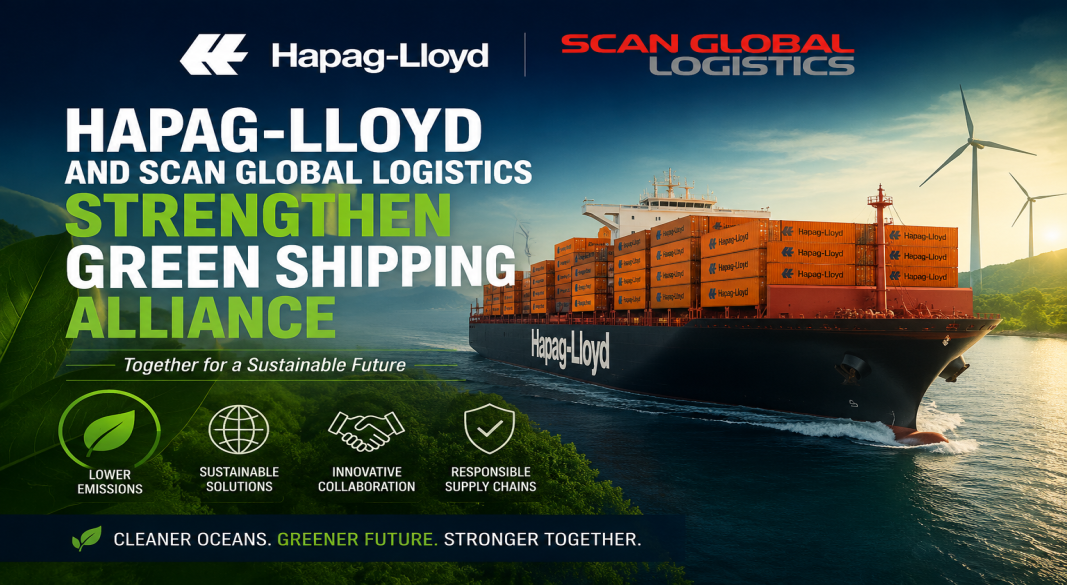
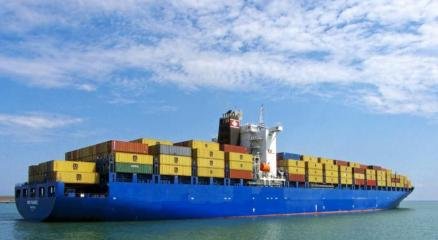
Hapag-Lloyd and Scan Global Logistics are deepening their partnership to further cut emissions in ocean freight. They are expanding their collaboration by using Hapag-Lloyd’s Ship Green solution and integrating it into SGL's existing lineup of emission-reducing options. This will help SGL’s customers take immediate, measurable steps to clean up their global supply chains.
“Together with Scan Global Logistics, we are moving forward with practical solutions to cut emissions in ocean freight,” said Danny Smolders, Managing Director Global Sales at Hapag-Lloyd. “Ship Green lets customers act today and make meaningful progress towards their sustainability goals.”
“Our customers want real emission cuts, not promises for 2030 or 2050. They need solutions available now. By teaming up with Hapag-Lloyd and investing in biofuel, we can lower emissions from ocean freight right away, without changing how our customers work. That’s what makes this partnership valuable,” stated Martin Andersen, Global Head of Sustainability & ESG at Scan Global Logistics.
Through this collaboration, the two companies now enable a total reduction of over 8,500 tonnes of CO₂e emissions (Well-to-Wake) on global shipments. The solution uses second-generation biofuels made from waste and leftover materials, providing a practical and scalable way to lower emissions without altering existing logistics operations.
As the shipping industry continues to develop low-carbon fuels and infrastructure, easy-to-implement solutions are essential. In this partnership, customers can lower emissions in their supply chains through a Book-and-Claim approach based on the Mass Balance principle. This involves blending the usual fuel with biofuel. The physical book-and-claim method allows customers to claim verified emission reductions regardless of the actual shipment. This helps companies manage their Scope 3 emissions across global supply chains transparently and flexibly.
“Ocean biofuel is a strong solution for customers because it cuts emissions affordably, without changing anything in the supply chain,” explains Martin Andersen, Global Head of Sustainability & ESG at Scan Global Logistics.
Both companies are dedicated to ambitious climate goals and to speeding up the decarbonization of global supply chains. Scan Global Logistics aims to reduce its emissions by half by 2030 and reach net-zero emissions by 2050. Meanwhile, Hapag-Lloyd targets net-zero fleet operations by 2045. By collaborating, Scan Global Logistics and Hapag-Lloyd are helping drive the shift towards more sustainable and transparent global supply chains.
For more such news and updates, visit CARGOCONNECT.
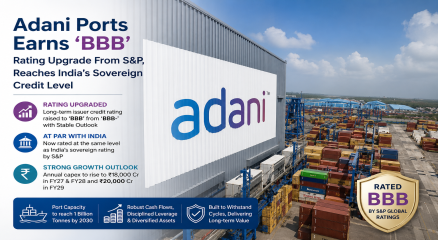
Adani Ports and Special Economic Zone Ltd. (APSEZ) has secured a significant credit rating upgrade from S&P Global Ratings, with its long-term issuer credit rating and senior unsecured notes being revised upward from 'BBB-' to 'BBB'. The agency has maintained a Stable Outlook, highlighting the company's strong financial profile, healthy cash generation, and disciplined approach towards funding its long-term expansion plans. With this revision, APSEZ's credit rating now stands at the same level as India's sovereign rating assigned by S&P, marking a notable milestone for the country's largest private port operator. According to S&P, the upgrade reflects confidence in the company's ability to undertake substantial capital investments without putting excessive pressure on its balance sheet. The agency believes APSEZ's resilient cash flows, prudent leverage management, and diversified infrastructure portfolio provide a solid foundation to support its aggressive growth roadmap over the coming years. As part of its expansion strategy, Adani Ports plans to increase its annual capital expenditure to nearly Rs 18,000 crore during FY2027 and FY2028, followed by around Rs 20,000 crore in FY2029. This represents a significant rise from its historical annual spending of roughly Rs 13,000 crore. The investments will primarily support capacity enhancement and strategic infrastructure development across its logistics and port network. The company is targeting an increase in its domestic port handling capacity from the current 653 million tonnes to one billion tonnes by 2030, reinforcing its long-term ambition of expanding India's maritime and logistics infrastructure. Commenting on the achievement, Ashwani Gupta, Whole-time Director and CEO of APSEZ, described the upgrade as a landmark moment for the company. He said receiving a credit rating equivalent to India's sovereign rating reflects the strength of APSEZ's business model, resilient cash flows, world-class infrastructure assets, and consistent financial discipline. Gupta further noted that the upgrade comes at a crucial stage, as the company is executing one of the most ambitious expansion programmes in the global ports and logistics industry. He added that the recognition also validates APSEZ's disciplined capital allocation strategy and long-term financial management. S&P also pointed to the company's tightening leverage policy and growing portfolio of diversified assets as important factors behind the upgrade. The agency believes these strengths will continue supporting robust earnings and operational stability even as APSEZ accelerates investments across its business. The company stated that the latest rating action recognises its ability to consistently generate strong operating cash flows despite fluctuations in global trade conditions and competitive pressures within the transportation and logistics sector. Its resilient business model, the company said, has enabled it to navigate multiple economic cycles while maintaining financial strength. Earlier this year, APSEZ had also received international recognition from the Japanese Credit Rating Agency (JCR), which assigned the company an 'A-/Stable' rating. The assessment was considered noteworthy as it placed the company above the sovereign threshold—an achievement rarely awarded to an Indian corporate by an international rating agency.
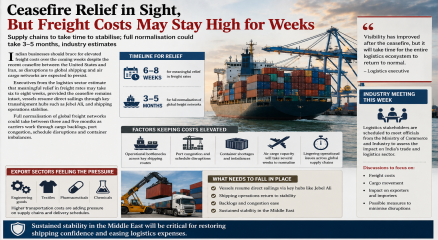
Indian businesses should brace for elevated freight costs over the coming weeks despite the recent ceasefire between the United States and Iran, as disruptions to global shipping and air cargo networks are expected to persist. Industry stakeholders say supply chains will require time to recover even after the reopening of the Strait of Hormuz. Executives from the logistics sector estimate that meaningful relief in freight rates may take six to eight weeks, provided the ceasefire remains intact, vessels resume direct sailings through key transshipment hubs such as Jebel Ali, and shipping operations stabilise. Full normalisation of global freight networks could take between three and five months as carriers work through cargo backlogs, port congestion, schedule disruptions and container imbalances. Industry representatives are scheduled to meet officials from the Ministry of Commerce and Industry this week to assess the impact of the recent geopolitical tensions on India's trade and logistics sector. The discussions are expected to focus on freight costs, cargo movement and possible measures to minimise disruptions for exporters and importers. Although the ceasefire has improved visibility for shippers and logistics providers, companies say pricing pressures remain due to lingering operational bottlenecks across international shipping routes. Air cargo services are also expected to take several weeks to return to normal capacity as airlines gradually restore schedules affected by the regional conflict. Export-oriented sectors, including engineering goods, textiles, pharmaceuticals and chemicals, continue to monitor freight developments closely, with higher transportation costs adding pressure to supply chains and delivery schedules. Industry executives noted that sustained stability in the Middle East will be critical for restoring shipping confidence and easing logistics expenses over the coming months. Follow CARGOCONNECT for more such updates.
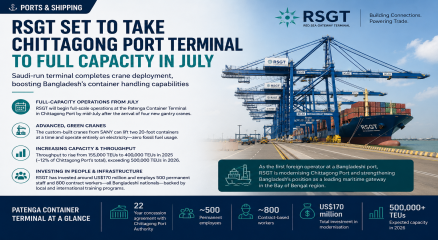
Saudi Arabia's Red Sea Gateway Terminal (RSGT) is preparing to bring its operations at Bangladesh's Patenga Container Terminal to full capacity next month, marking a major milestone in its ongoing investment in the country's maritime infrastructure. The development follows the arrival of four ship-to-shore gantry cranes, completing the terminal's planned equipment deployment and paving the way for a substantial increase in cargo-handling capability. Located within Chittagong Port, Bangladesh's busiest maritime gateway, the facility plays a critical role in supporting the nation's import and export trade. RSGT has managed the Patenga Container Terminal since June 2024 under a 22-year concession agreement with the Chittagong Port Authority. Over the past two years, the company has focused on upgrading infrastructure, implementing operational technologies, and building a skilled workforce to support long-term terminal growth. According to Sayed Aref Sarwar, Head of Commercial and Public Affairs at RSGT Bangladesh, the period since taking over operations has largely been dedicated to preparing the terminal for large-scale commercial activity. With the installation of the final batch of equipment now complete, the company expects to begin operating the new cranes by mid-July. The addition is expected to significantly improve vessel turnaround times and overall terminal productivity. Manufactured by Chinese equipment maker SANY, the cranes introduce capabilities not previously available at Bangladeshi ports. Designed to lift two 20-foot containers simultaneously, they are expected to accelerate cargo movements while supporting environmentally sustainable operations. Unlike conventional equipment, the cranes will run entirely on electricity, eliminating the need for fossil-fuel-powered operations within the terminal. The company believes its current infrastructure will be sufficient to accommodate projected cargo volumes in the near term, although further expansion remains a possibility as demand grows. RSGT's presence has already begun reshaping operations at the terminal. Container throughput is expected to rise from around 155,000 TEUs to nearly 400,000 TEUs this year, representing approximately 12 percent of Chittagong Port's overall container traffic. Looking ahead, the terminal is projected to handle more than 500,000 TEUs in 2027, potentially accounting for close to 17 percent of the port's total volumes. As the first foreign operator to manage a Bangladeshi port terminal, RSGT has also made workforce development a key part of its strategy. The company has invested roughly US$170 million in modernising the facility and currently employs around 500 permanent staff, supported by approximately 800 contract workers. Notably, all employees are Bangladeshi nationals. To build specialised expertise, RSGT has conducted training programmes both within Bangladesh and overseas, including operational training assignments at facilities in Saudi Arabia. The initiative is aimed at addressing the shortage of globally trained port professionals and strengthening the country's long-term maritime capabilities. The upcoming transition to full-capacity operations is expected to enhance Chittagong Port's efficiency and reinforce its role as a key logistics hub for the Bay of Bengal region.