
Loading...
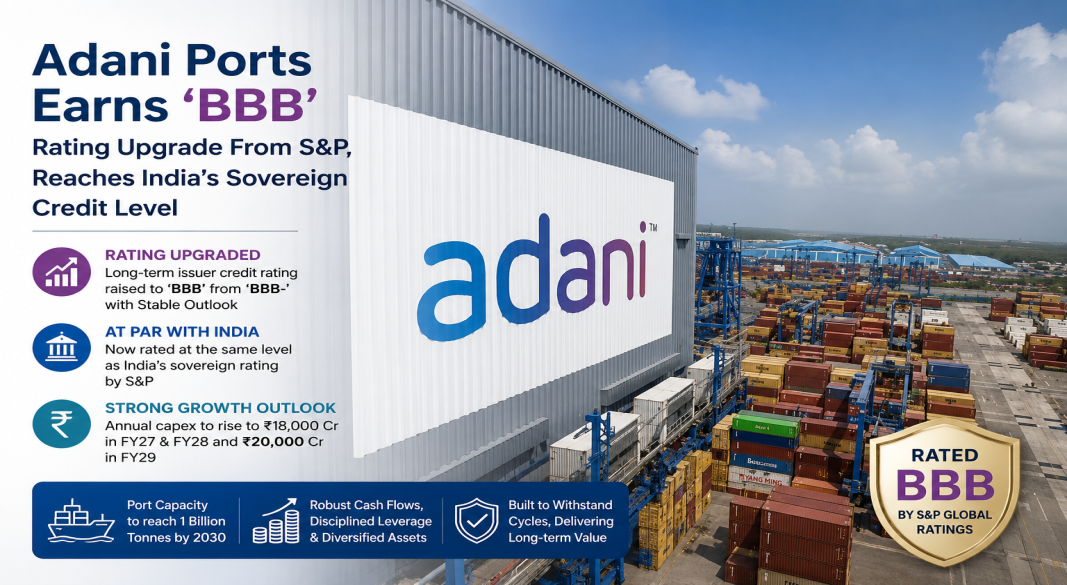
Adani Ports and Special Economic Zone Ltd. (APSEZ) has secured a significant credit rating upgrade from S&P Global Ratings, with its long-term issuer credit rating and senior unsecured notes being revised upward from 'BBB-' to 'BBB'. The agency has maintained a Stable Outlook, highlighting the company's strong financial profile, healthy cash generation, and disciplined approach towards funding its long-term expansion plans.
With this revision, APSEZ's credit rating now stands at the same level as India's sovereign rating assigned by S&P, marking a notable milestone for the country's largest private port operator.
According to S&P, the upgrade reflects confidence in the company's ability to undertake substantial capital investments without putting excessive pressure on its balance sheet. The agency believes APSEZ's resilient cash flows, prudent leverage management, and diversified infrastructure portfolio provide a solid foundation to support its aggressive growth roadmap over the coming years.
As part of its expansion strategy, Adani Ports plans to increase its annual capital expenditure to nearly Rs 18,000 crore during FY2027 and FY2028, followed by around Rs 20,000 crore in FY2029. This represents a significant rise from its historical annual spending of roughly Rs 13,000 crore. The investments will primarily support capacity enhancement and strategic infrastructure development across its logistics and port network.
The company is targeting an increase in its domestic port handling capacity from the current 653 million tonnes to one billion tonnes by 2030, reinforcing its long-term ambition of expanding India's maritime and logistics infrastructure.
Commenting on the achievement, Ashwani Gupta, Whole-time Director and CEO of APSEZ, described the upgrade as a landmark moment for the company. He said receiving a credit rating equivalent to India's sovereign rating reflects the strength of APSEZ's business model, resilient cash flows, world-class infrastructure assets, and consistent financial discipline.
Gupta further noted that the upgrade comes at a crucial stage, as the company is executing one of the most ambitious expansion programmes in the global ports and logistics industry. He added that the recognition also validates APSEZ's disciplined capital allocation strategy and long-term financial management.
S&P also pointed to the company's tightening leverage policy and growing portfolio of diversified assets as important factors behind the upgrade. The agency believes these strengths will continue supporting robust earnings and operational stability even as APSEZ accelerates investments across its business.
The company stated that the latest rating action recognises its ability to consistently generate strong operating cash flows despite fluctuations in global trade conditions and competitive pressures within the transportation and logistics sector. Its resilient business model, the company said, has enabled it to navigate multiple economic cycles while maintaining financial strength.
Earlier this year, APSEZ had also received international recognition from the Japanese Credit Rating Agency (JCR), which assigned the company an 'A-/Stable' rating. The assessment was considered noteworthy as it placed the company above the sovereign threshold—an achievement rarely awarded to an Indian corporate by an international rating agency.

Prime Minister Narendra Modi has inaugurated development projects and laid foundation stones for infrastructure initiatives worth more than ₹13,000 crore across Tamil Nadu, highlighting the state’s strategic role in strengthening India’s maritime logistics, transport connectivity and industrial growth. The announcements, made in Chennai on October 11, 2026, include port infrastructure upgrades, road and railway projects, and urban transport development. A key highlight was the proposed transformation of V O Chidambaranar (VOC) Port in Thoothukudi into a world-class mega container and green energy hub, backed by an investment of approximately ₹17,000 crore. The planned development is intended to enhance the port’s capacity to handle ultra-large container vessels, strengthen maritime connectivity and position Tamil Nadu as a more competitive gateway for international trade. VOC Port Expansion to Strengthen Maritime Logistics The proposed mega container hub at VOC Port is expected to support India’s ambitions to expand its container-handling capabilities and improve integration with global shipping networks. Greater capacity for large vessels could help strengthen trade connectivity, improve operational efficiency and support cargo movement through southern India. The Prime Minister emphasised the importance of modernising port infrastructure to enable the shipping sector to grow. He also highlighted improvements in port efficiency, noting that reduced vessel turnaround times have helped Indian goods reach international markets faster. Alongside the long-term expansion plan, projects worth ₹517.19 crore were included for a container terminal at VOC Port. The terminal forms part of eight projects at the port with a combined investment of ₹753.68 crore. Separately, port infrastructure works worth ₹640 crore at Chennai and Kamarajar ports are aimed at expanding cargo-handling capacity and strengthening logistics infrastructure. The proposed ₹17,000-crore VOC Port transformation is a strategic development distinct from the projects worth over ₹13,000 crore launched during the Chennai visit. Connectivity and Infrastructure Development The wider investment programme spans ports, highways, railways, petroleum infrastructure, urban transport and scientific research. Among the major initiatives, Modi inaugurated the Poonamallee–Vadapalani stretch of Chennai Metro Phase II, developed at a cost of approximately ₹4,900 crore. The new section is expected to improve connectivity across western Chennai and support smoother urban mobility. Road and railway infrastructure projects are also intended to strengthen regional connectivity, facilitate passenger and freight movement, and support industrial activity across Tamil Nadu. Supporting Trade, Jobs and Economic Growth The infrastructure push reflects the importance of coordinated investment across transport modes to improve logistics efficiency and economic competitiveness. Modern ports, supported by efficient road and rail links, can help reduce bottlenecks, improve cargo evacuation and connect manufacturing centres with domestic and international markets. The VOC Port mega container and green energy hub proposal also aligns with the broader ambition to strengthen India’s maritime capabilities while advancing cleaner energy infrastructure. Its long-term impact will depend on project execution, capacity creation and effective integration with inland logistics networks. Together, the announced initiatives are expected to support employment generation, improve connectivity and reinforce Tamil Nadu’s position as an important industrial and logistics centre. For India’s supply chain sector, the port investments are particularly significant as the country seeks to expand trade capacity and build more efficient links with global markets. 𝐒𝐭𝐚𝐲 𝐓𝐮𝐧𝐞𝐝 𝐭𝐨 CARGOCONNECT 𝐟𝐨𝐫 𝐥𝐚𝐭𝐞𝐬𝐭 𝐮𝐩𝐝𝐚𝐭𝐞𝐬!

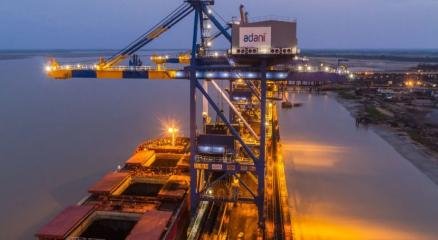
Dhamra Port in Odisha, operated by Adani Ports and Special Economic Zone (APSEZ), has transitioned its entire electricity consumption to renewable power, making it India’s first large-scale private multi-cargo port to operate fully on renewable electricity. The transition, effective from August 2026, forms part of APSEZ’s long-term Net-Zero strategy. The port currently meets more than 90 lakh units of monthly electricity demand through renewable sources, with annualised renewable power consumption exceeding 108 gigawatt-hours (GWh). Renewable electricity now supports its round-the-clock operations, including cargo handling, storage, rail-linked activities and other critical port infrastructure. Dhamra’s renewable electricity supply is structured through a combination of captive generation, third-party access and green-power procurement under Odisha’s regulatory framework. Around 25–30% of its renewable power comes from APSEZ’s captive hybrid power plant at Khavda in Gujarat, while another 10–15% is sourced through third-party access. The remaining requirement is met through a Green Consumer arrangement with Odisha’s distribution utility. The shift is expected to reduce emissions associated with purchased electricity while improving the environmental performance of the port’s energy-intensive operations. It also strengthens Dhamra’s position as a major logistics infrastructure asset supporting the decarbonisation of India’s maritime and supply chain ecosystem. Located on Odisha’s coast between Haldia and Paradip, Dhamra is one of eastern India’s key deep-draft ports. It has an installed cargo-handling capacity of 60 million tonnes (MT) and handled 48.8 MT of cargo during the financial year ended March 2026. The port has six dry-cargo berths, rapid-loading silos, wagon tipplers, track hoppers, mechanised storage yards and jetty equipment. Additionally, the port is also connected by rail and road with mineral-rich hinterlands across Odisha, Jharkhand and West Bengal, making it an important gateway for the region’s industrial and bulk cargo flows. Its renewable electricity transition places the port among large-scale logistics and industrial facilities increasingly adopting cleaner energy to lower operational emissions and advance long-term decarbonisation goals. 𝐒𝐭𝐚𝐲 𝐓𝐮𝐧𝐞𝐝 𝐭𝐨 CARGOCONNECT 𝐟𝐨𝐫 𝐥𝐚𝐭𝐞𝐬𝐭 𝐮𝐩𝐝𝐚𝐭𝐞𝐬!

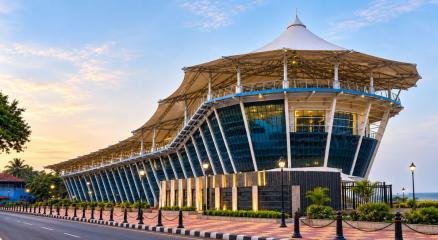

India is stepping up efforts to establish itself as a global hub for ship ownership, leasing and maritime finance, with GIFT City in Gujarat emerging as a key platform for developing an integrated maritime financial ecosystem. Union Minister for Ports, Shipping and Waterways Sarbananda Sonowal outlined the government’s ambition at the India Ship Leasing and Financing Summit held at GIFT City, Gandhinagar. Organised by the International Financial Services Centres Authority (IFSCA) in collaboration with the Ministry of Ports, Shipping and Waterways, the summit brought together shipowners, lessors, charterers, financiers, policymakers and other maritime stakeholders. Sonowal said the objective is to build a comprehensive ecosystem covering ship ownership, leasing, financing, insurance, brokering and allied services. “This gathering marks a significant milestone in our collective journey to position India, and particularly GIFT City, as a global maritime hub for a comprehensive maritime value chain ecosystem, encompassing ship leasing, owning, financing, insurance, brokering and other ancillary services,” Sonowal said. India’s ship-leasing ecosystem has already begun expanding. According to the Minister, 38 ship lessors are currently registered in the country, collectively leasing 43 vessels with total leasing capacity exceeding 2.99 million DWT. Of these, 24 vessels fly the Indian flag. Meanwhile, 41 domestic and international banks operating in the International Financial Services Centre (IFSC) have extended nearly USD 60.1 million in funding to ship-leasing entities. Sonowal also highlighted policy reforms designed to improve the competitiveness of Indian shipping. These include exemption from licensing requirements under the Coastal Shipping Act, 2025, for foreign vessels operating on charter and permission for GIFT IFSC-based shipping companies to own foreign-flag vessels. “More fundamentally, it marks a shift in how we count our fleet, from tonnage that flies our flag to tonnage that we own and control. PM Narendra Modi's dynamic leadership has carried GIFT City from thought to fruition, and it is now poised to be the launchpad for India's next wave of maritime growth” The government is also backing the maritime sector through substantial financial measures. The ₹25,000 crore Maritime Development Fund is expected to catalyse investments of up to ₹1.5 lakh crore by 2030, while the Shipbuilding Financial Assistance Scheme (SBFAS) 2.0 has a revised outlay of ₹24,736 crore, extended to 2036. These initiatives are aimed at strengthening domestic shipbuilding, vessel ownership and the wider maritime ecosystem. The initiatives align with Maritime India Vision 2030 and Maritime Amrit Kaal Vision 2047, which seek to expand India’s fleet, strengthen port capacity and coastal shipping, and position the country among the world’s top five shipbuilding nations. Sonowal also highlighted India’s growing role in ship recycling, with its share of global ship-recycling tonnage rising from 30.1% in 2024 to 35.4% in 2025. 𝐒𝐭𝐚𝐲 𝐓𝐮𝐧𝐞𝐝 𝐭𝐨 CARGOCONNECT 𝐟𝐨𝐫 𝐥𝐚𝐭𝐞𝐬𝐭 𝐮𝐩𝐝𝐚𝐭𝐞𝐬!