
Loading...

The Union Cabinet, chaired by Prime Minister Narendra Modi, has approved the establishment of the Integrated Transport & Logistics Authority (ITLA) as a Special Purpose Vehicle (SPV) to bring greater coordination and multimodal integration to India’s transport and logistics infrastructure planning. The decision, announced on October 6, 2026 is aimed at addressing fragmented planning and implementation across multiple ministries and agencies.
ITLA will function as the national apex institution for integrated transport and logistics planning, research, project appraisal, monitoring, policy support and data analytics. A key mandate will be the preparation of a National Transport Master Plan with a planning horizon of 10 years or more. The plan will cover roads, railways, ports and shipping, civil aviation, inland waterways, coastal shipping, urban mobility and logistics.
The authority will also assess short-term sectoral plans of around five years and annual plans of transport ministries to ensure their alignment with the long-term master plan. This is expected to encourage multimodal infrastructure development and improve coordination between different modes of transport.
Another important responsibility will be the technical appraisal of Central government infrastructure projects costing ₹500 crore or more. While ITLA will undertake technical evaluation, financial appraisal will continue through existing government mechanisms. The authority will subsequently monitor the implementation of such projects, facilitate coordinated issue resolution and conduct post-implementation impact assessments to evaluate project outcomes.
The new institution will also establish a National Transport Data Repository (NTDR) by integrating transport and logistics datasets from multiple sources, including GSTN e-way bills, FASTag, Vahan, GPS-based systems and urban traffic management platforms. The consolidated data is expected to support freight-flow and origin-destination analysis, enabling more evidence-based infrastructure planning and monitoring.
ITLA will further advise and assist in reviewing and updating the National Logistics Policy, 2022, besides supporting capacity building, training and skilling in logistics. It will also promote research and innovation across transportation and logistics.
The government expects the authority to strengthen multimodal connectivity, improve infrastructure efficiency and help reduce logistics costs, while enhancing India’s competitiveness in global trade. The initiative is also positioned as an institutional mechanism supporting the country’s Vision 2047 objectives and complementing existing initiatives such as the PM GatiShakti National Master Plan and the National Logistics Policy.
𝐒𝐭𝐚𝐲 𝐓𝐮𝐧𝐞𝐝 𝐭𝐨 CARGOCONNECT 𝐟𝐨𝐫 𝐥𝐚𝐭𝐞𝐬𝐭 𝐮𝐩𝐝𝐚𝐭𝐞𝐬!

C.H. Robinson has expanded its artificial intelligence capabilities into global freight forwarding, introducing new AI agents for ocean shipping, air freight and customs brokerage. The technology aims to accelerate freight quotations, streamline booking processes and reduce the administrative workload involved in international shipments, while retaining human oversight for critical decisions and compliance-related activities. Announced on October 26, 2026, the development extends the logistics provider’s Lean AI operating model to more complex freight forwarding operations. According to the company, its AI-powered pricing technology has already generated more than 80,000 quotations for over 3,600 customers, reducing the time required to prepare quotes from one day for air shipments and two to three days for ocean freight to just two to three minutes. C.H. Robinson is deploying a network of specialised AI agents that work together to handle individual tasks across the freight forwarding process. Rather than relying on a single system, the agents can interpret shipment requirements, identify relevant routing options and account for changing charges across ports and terminals. For instance, when shipment details are incomplete, the system can help identify suitable ports of origin or destination and recommend inland transportation options involving road, rail or barge. It can also determine appropriate consolidation centres for shipments requiring cargo consolidation. These capabilities are designed to improve pricing accuracy and provide customers with faster information to make shipping decisions. Quicker quotations and booking processes can help businesses secure suitable carriers and sailing or flight schedules, particularly when disruptions or changing requirements necessitate alternative routes. The company has also begun using AI agents to manage the thousands of ocean booking requests it receives each week. The system incorporates customer-specific information to process requests more efficiently, addressing a longstanding challenge in automating bookings that originate from customers’ suppliers. The pricing technology, initially introduced in 2025 for less-than-container-load ocean freight in the United States and Canada, has since expanded to full-container-load ocean shipments and air cargo across Mexico, Europe, Latin America and Oceania. Following pilot testing in China, C.H. Robinson has outlined plans to extend the programme to Southeast Asia, India, the Middle East and Africa by the fourth quarter of 2026. The company also expects its AI-enabled ocean booking capabilities to expand globally by early 2027. Customs brokerage is another major area of deployment. International shipments require extensive documentation, accurate data classification and compliance with evolving trade agreements, tariff structures and regulatory requirements. C.H. Robinson’s AI agents can classify and associate more than four dozen document types with individual shipments, extract essential information, identify missing paperwork and initiate requests to obtain outstanding documents. The system also automates the preparation and dispatch of invoices and information packets. The company reports that these capabilities have reduced the time its customs team spends on the process by 23%, allowing customs brokers to concentrate on document validation, regulatory compliance and more complex cases. C.H. Robinson’s approach combines AI automation with lean operating principles, focusing on eliminating delays, repetitive tasks and process inefficiencies. The company says its proprietary AI agents operate across 100 trillion data points, supported by customer-specific contextual information. By extending AI across freight pricing, booking and customs documentation, C.H. Robinson aims to improve supply chain responsiveness, data consistency and operational efficiency. The development reflects the growing role of agentic AI in logistics, where specialised digital agents can coordinate complex workflows while human experts retain oversight of decisions requiring judgement and regulatory accountability. 𝐒𝐭𝐚𝐲 𝐓𝐮𝐧𝐞𝐝 𝐭𝐨 CARGOCONNECT 𝐟𝐨𝐫 𝐥𝐚𝐭𝐞𝐬𝐭 𝐮𝐩𝐝𝐚𝐭𝐞𝐬!




FedEx Europe has launched a digital booking and management portal for temperature-controlled pharmaceutical shipments across 26 European markets, aiming to simplify healthcare logistics and strengthen the management of sensitive medical products ahead of the year-end peak shipping season. Announced on 13 October 2026, the platform provides pharmaceutical manufacturers, biotechnology companies and clinical trial operators with digital access to FedEx® Temp-Assure Advantage, the company's specialised temperature-controlled shipping solution. The portal enables customers to complete onboarding, order pre-conditioned packaging, schedule shipments and manage returns through a streamlined online interface, reducing reliance on traditionally complex and manual processes. The launch comes amid growing demand for specialised logistics services to support biologics, specialty medicines and vaccines, which require stringent temperature management to preserve product efficacy and patient safety. By bringing booking and shipment management into a single digital channel, FedEx aims to give healthcare businesses greater operational control and simplify access to its temperature-sensitive shipping capabilities. Temperature Control and Shipment Integrity FedEx® Temp-Assure Advantage combines qualified packaging, tested at the company's FedEx Packaging Lab, with its integrated European transportation network to help maintain the required temperature conditions throughout transit. The solution supports three temperature ranges: frozen shipments between -25°C and -15°C, refrigerated shipments between 2°C and 8°C, and controlled room-temperature shipments between 15°C and 25°C. Advanced vacuum-insulated packaging and phase-change materials help maintain the specified temperatures for more than 96 hours, supporting the movement of sensitive pharmaceutical products across domestic and intra-European routes. CEIV Pharma-certified facilities and standardised processes further support shipment control, visibility and compliance throughout the transportation journey. These capabilities are particularly relevant to pharmaceutical and life sciences supply chains, where temperature excursions can compromise product quality and lead to costly losses or disruptions. The portal is currently available for domestic and intra-European non-freight shipments in Austria, Belgium, Bulgaria, the Czech Republic, Denmark, Estonia, Finland, France, Germany, Great Britain, Greece, Hungary, Ireland, Italy, Latvia, Lithuania, Luxembourg, the Netherlands, Norway, Poland, Romania, Slovakia, Slovenia, Spain, Sweden and Switzerland. Reusable Packaging Supports Sustainability Alongside temperature control and digital convenience, the service incorporates a reusable packaging model. Containers are collected after use, refurbished and redeployed, helping reduce packaging waste while maintaining performance standards. This approach supports efforts to improve the environmental efficiency of pharmaceutical logistics without compromising the specialised handling requirements of temperature-sensitive products. Commenting on the launch, Toby Hay, managing director international marketing at FedEx Europe, said: “As pharmaceutical supply chains become more global and increasingly focused on high-value, temperature-sensitive therapies, healthcare companies need logistics partners that can combine reliability, compliance and ease of access,” “This new portal represents an important step in simplifying access to specialized temperature-controlled capabilities, helping customers manage critical shipments more efficiently and with greater confidence, particularly as they prepare for the increased demands of the year-end Peak season.” The portal forms part of FedEx's broader digitalisation efforts to make specialised logistics services more accessible and manageable. Its introduction ahead of the year-end shipping peak is intended to help healthcare businesses prepare for higher shipment volumes while maintaining control over critical deliveries. As pharmaceutical supply chains become more specialised and geographically dispersed, digital booking tools, qualified packaging and integrated transportation networks are increasingly important to maintaining reliability. FedEx's latest initiative combines these elements to support temperature-controlled pharmaceutical shipping across Europe, with a focus on operational efficiency, product integrity and patient safety. 𝐒𝐭𝐚𝐲 𝐓𝐮𝐧𝐞𝐝 𝐭𝐨 CARGOCONNECT 𝐟𝐨𝐫 𝐥𝐚𝐭𝐞𝐬𝐭 𝐮𝐩𝐝𝐚𝐭𝐞𝐬!

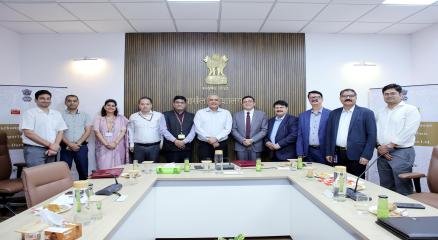


Hong Kong-based Crown Worldwide Group has strengthened its presence in India with the inauguration of a 135,000-sq-ft integrated facility at Siwari in Gurugram, Delhi-NCR. The expansion forms part of the company’s broader India growth strategy, with Crown targeting more than ₹500 crore in annual revenue from the country by 2030, compared with nearly ₹300 crore in FY2024-25. Spread across 7.5 acres, the new facility is among Crown’s largest in India and brings together information management, workspace, relocation, logistics, mobility and fine art services under its integrated ‘One Crown’ approach. The site includes an 82,000-sq-ft warehouse with capacity to accommodate up to 900,000 cartons. The facility is also green-building certified, with 20 per cent of the site dedicated to green coverage. The co-location of multiple business units is designed to enable Crown to offer customers a wider range of services through a single platform while improving operational collaboration. The facility is expected to strengthen the company’s ability to serve corporate customers across Delhi-NCR and North India, including businesses seeking integrated relocation, storage, information management and logistics solutions. “India is central to our future, and we are delighted to support a growing number of India-headquartered multinational companies,” said Jennifer Harvey, Group Chief Executive Officer, Crown Worldwide Group. She added that the company’s investment reflects its commitment to simplifying the process of living, working and doing business across markets. Crown also plans to increase its investment in India. After investing $15 million over the past two years, the company intends to invest an additional $15 million over the next two years, taking its planned investment to $30 million. Its Indian business is currently growing at an estimated 10–12 per cent annually, making the country one of its fastest-growing markets. The company is simultaneously broadening its India proposition beyond its traditional relocation logistics operations. Its strategy includes records management, document digitisation, workplace asset management and information governance, responding to growing demand from global capability centres, hybrid work models and evolving compliance requirements. Crown currently operates 36 warehouses and facilities across India, with owned facilities in Mumbai, Chennai, Bengaluru, Coimbatore and Delhi. The Gurugram expansion follows the opening of a 76,000-sq-ft centre in Bengaluru in September 2025 and a 4.5-acre facility in Coimbatore in May 2026. Globally, Crown generates more than $600 million in annual revenue. 𝐒𝐭𝐚𝐲 𝐓𝐮𝐧𝐞𝐝 𝐭𝐨 CARGOCONNECT 𝐟𝐨𝐫 𝐥𝐚𝐭𝐞𝐬𝐭 𝐮𝐩𝐝𝐚𝐭𝐞𝐬!