
Loading...

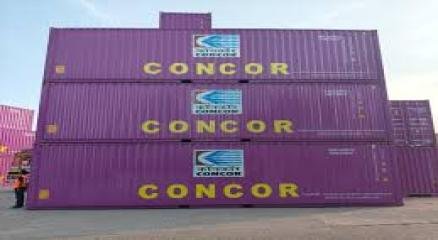
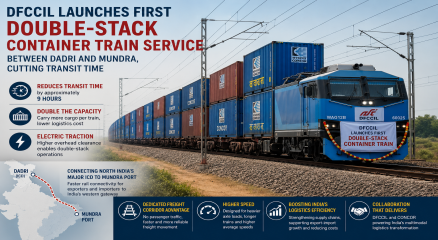
The Dedicated Freight Corridor Corporation of India Ltd. (DFCCIL), in collaboration with Container Corporation of India Ltd. (CONCOR), has commenced the operation of its first double-stack container train on the Dedicated Freight Corridor (DFC), marking a significant development in India's rail-based freight network.
The inaugural service was operated on the Dadri–New Rewari section, with the train departing from CONCOR's Inland Container Depot (ICD) at Dadri for Mundra Port in Gujarat. According to officials, the new service is expected to reduce cargo transit time by approximately nine hours compared with existing operations.
The introduction of double-stack container movement on the Western Dedicated Freight Corridor aims to improve freight efficiency by increasing the carrying capacity per train while reducing overall logistics costs. The dedicated freight infrastructure has been designed with higher overhead electrification clearance, enabling the operation of double-stack container trains under electric traction.
The service connects one of North India's largest inland container depots with Mundra Port, providing exporters and importers with faster rail connectivity to India's western gateway. Industry stakeholders expect the corridor to support more reliable cargo movement and reduce dependence on conventional rail routes, which often experience congestion due to mixed passenger and freight traffic.
The launch follows a successful trial run conducted on April 20 between ICD Dadri and Mundra Port. With commercial operations now underway, the corridor is expected to strengthen multimodal logistics by offering quicker turnaround times and higher network capacity.
The Western Dedicated Freight Corridor has been developed to accommodate heavier axle loads, longer trains and double-stack container operations, allowing freight services to move at higher average speeds than those on the conventional railway network. The infrastructure is expected to play a key role in improving supply chain efficiency for India's export-import trade and supporting the country's broader logistics modernisation efforts.
Follow CARGOCONNECT for more such updates.

Southern Railway has invited Expressions of Interest (EoIs) from private developers to establish rail-linked cargo facilities at Angamali and Karukutty in Kerala’s Ernakulam district, aiming to strengthen freight connectivity, expand logistics infrastructure and encourage greater use of rail transport. The proposed facilities will focus on warehousing, cold storage, e-commerce logistics and cargo consolidation. The initiative, led by Southern Railway’s commercial branch, falls under Indian Railways’ Gati Shakti Multi-Modal Cargo Terminals and Cargo-Related Facilities policy. It seeks to improve first- and last-mile connectivity by linking production centres with railway freight terminals and connecting them to markets through rail, road and other transport modes. Southern Railway has earmarked 4,400 square metres of railway land at Angamali and 3,240 square metres at Karukutty for the proposed facilities. Developers can indicate their specific land requirements rather than taking up the entire available area. Final land allocations and site suitability will be determined at the tender stage. The EoI process will help the railway assess market demand, potential investments and expected cargo volumes. Interested developers are expected to outline their proposed infrastructure and the types and quantities of freight they anticipate handling. Depending on demand and commercial viability, the facilities could accommodate warehouses, cold storage units for perishable goods, and storage and order-processing centres for e-commerce shipments. Additional services may include sorting, grading, packaging and labelling. Cold chain infrastructure could help preserve agricultural produce and other temperature-sensitive goods while reducing spoilage. Cargo consolidation would also enable smaller consignments to be grouped for onward rail transportation, potentially improving distribution efficiency for businesses and producers. Under the proposed framework, selected private developers will finance, develop and operate the facilities at their own cost and risk. The proposed licence period is 25 years, with applicable land charges and minimum railway freight commitments forming part of the contractual terms. The proposed facilities could strengthen Kerala’s multimodal logistics network by bringing storage, cargo handling and rail transportation closer together. Their eventual impact will depend on private-sector participation, cargo demand and the ability to integrate the sites with existing freight terminals and road networks. 𝐒𝐭𝐚𝐲 𝐓𝐮𝐧𝐞𝐝 𝐭𝐨 CARGOCONNECT 𝐟𝐨𝐫 𝐥𝐚𝐭𝐞𝐬𝐭 𝐮𝐩𝐝𝐚𝐭𝐞𝐬!

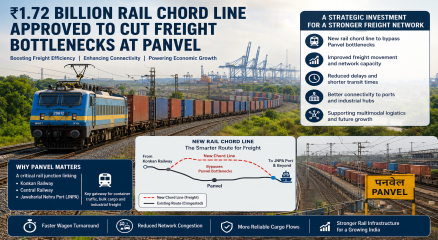
The Ministry of Railways has approved a ₹1.72 billion rail chord line project aimed at easing freight congestion around Panvel, a key rail junction serving western India and one of the country's busiest freight corridors. The new rail link is expected to improve freight train movement by providing a direct route that bypasses existing operational bottlenecks at Panvel. The project is designed to reduce delays, enhance network capacity and improve the efficiency of cargo movement to and from major ports and industrial hubs in the Mumbai Metropolitan Region. According to railway officials, the chord line will facilitate smoother train operations by separating freight traffic from heavily utilised passenger routes. The additional infrastructure is expected to increase line capacity, shorten transit times and improve operational reliability for freight services. Panvel serves as a critical rail gateway connecting the Konkan Railway, Central Railway and the Jawaharlal Nehru Port (JNPA), making it a strategic node for container traffic, bulk cargo and industrial freight. Rising cargo volumes and increasing rail traffic have placed significant pressure on the existing network, prompting the need for capacity expansion. The approved investment forms part of the Railways' broader strategy to strengthen freight infrastructure through targeted capacity enhancement projects. By eliminating operational constraints at Panvel, the new chord line is expected to improve connectivity for port-linked cargo, support multimodal logistics and increase the share of freight transported by rail. For the logistics sector, the project is expected to deliver faster wagon turnaround, reduced network congestion and more reliable cargo flows between western India's ports, manufacturing centres and inland distribution hubs. The enhanced rail connectivity is also likely to support future growth in container traffic as freight demand continues to rise. Follow CARGOCONNECT for more such updates.