
Loading...
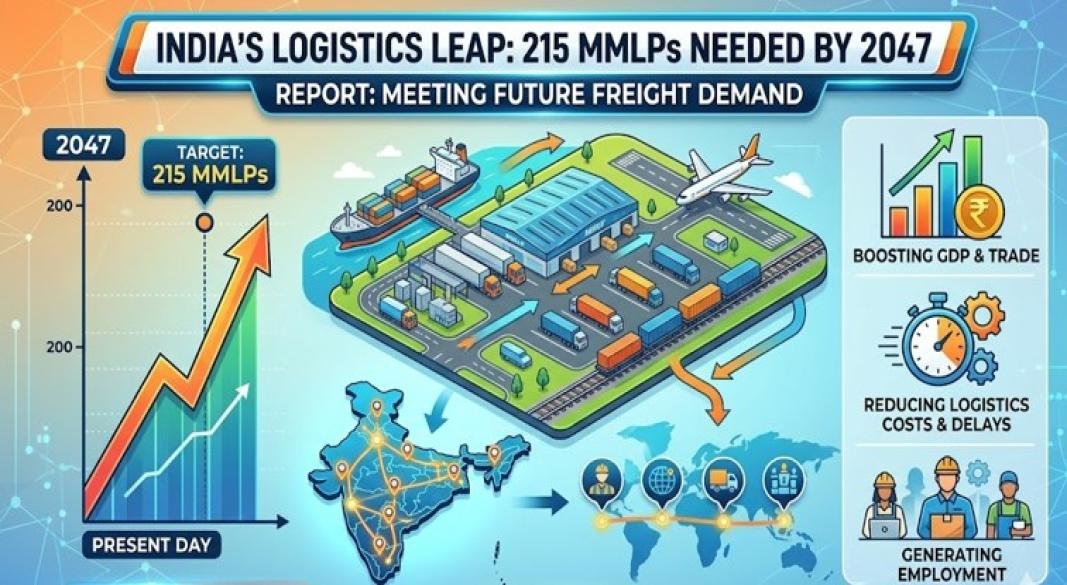
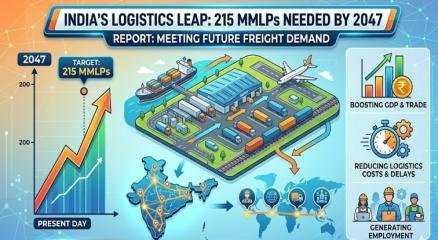
India will require around 215 multimodal logistics parks (MMLPs) by 2047 to accommodate rising freight volumes and support the shift in cargo movement from road to rail, according to a new industry report. The study highlights the critical role of next-generation logistics infrastructure in enabling the country’s long-term economic growth and logistics efficiency goals.
The report estimates that India’s freight demand will increase substantially over the next two decades, driven by industrial expansion, growing domestic consumption, infrastructure development, and rising international trade. To manage this surge efficiently, the country will need a robust network of MMLPs that can integrate multiple transport modes, including rail, road, inland waterways, and ports.
A key recommendation of the report is the development of 215 strategically located MMLPs across the country to facilitate seamless cargo movement and reduce logistics costs. These facilities are expected to serve as integrated hubs offering warehousing, cargo consolidation, value-added services, and efficient multimodal connectivity.
The proposed logistics parks are also central to India’s ambition of increasing rail’s share in freight transportation. Currently, road transport dominates cargo movement, contributing to higher logistics costs and environmental impacts. Expanding multimodal infrastructure would help shift a larger portion of freight to rail, improving fuel efficiency, reducing congestion on highways, and lowering carbon emissions.
Industry experts believe that MMLPs will play a crucial role in supporting the government’s broader logistics modernisation agenda, including initiatives such as the PM Gati Shakti National Master Plan and the National Logistics Policy. By improving connectivity between production centres, consumption hubs, ports, and industrial corridors, these facilities can significantly enhance supply chain resilience and operational efficiency.
The report also underlines the importance of coordinated planning between central and state governments, infrastructure agencies, and private sector stakeholders. Timely land acquisition, regulatory approvals, and investment support will be essential to accelerate the development of these logistics hubs.
As India targets becoming a developed economy by 2047, strengthening freight infrastructure will be a strategic priority. The creation of a nationwide network of multimodal logistics parks is expected not only to meet future freight demand but also to improve logistics competitiveness, reduce transportation costs, and support sustainable economic growth.
With freight volumes projected to rise sharply over the coming decades, investment in multimodal logistics infrastructure is increasingly being viewed as a cornerstone of India’s supply chain transformation journey.
𝐒𝐭𝐚𝐲 𝐓𝐮𝐧𝐞𝐝 𝐭𝐨 CARGOCONNECT 𝐟𝐨𝐫 𝐥𝐚𝐭𝐞𝐬𝐭 𝐮𝐩𝐝𝐚𝐭𝐞𝐬!

Pragati Group plans to invest Rs 2,500 crore in developing an industrial park in Guntur district, Andhra Pradesh, following the signing of a memorandum of understanding (MoU) at the Confederation of Indian Industry (CII) Regional Conference in Amaravati on October 17, 2026. The proposed project is expected to support industrial infrastructure development in the region and could attract manufacturing units, logistics operators and ancillary businesses as the project moves towards implementation. The investment also reflects growing interest in Andhra Pradesh as a destination for industrial development, supported by its transport networks, regional growth centres and potential to expand manufacturing and supply-chain activities. Guntur Positioned for Industrial Expansion Guntur forms part of the wider Vijayawada–Amaravati–Guntur growth region, which offers access to road and rail connectivity, agricultural production centres and emerging industrial clusters. The proposed industrial park could create opportunities for businesses seeking space for manufacturing, storage, distribution and other industrial operations. Depending on the final development plan, potential activities could include light manufacturing, packaging, warehousing and cold-chain facilities. However, the specific industries to be accommodated at the site have not yet been confirmed. Potential to Attract Manufacturing and Logistics Investments Industrial parks can support regional economic growth by providing infrastructure and facilities for businesses to establish or expand operations. If implemented as planned, Pragati Group’s proposed development could encourage downstream investment, support local suppliers and generate employment opportunities during construction and subsequent operations. The project could also create demand for logistics, transportation, warehousing and other business services, helping strengthen industrial supply chains in the Guntur region. The scale of these benefits will depend on the project's final configuration, the companies that establish operations at the park and the pace of infrastructure development. Project Details Awaited While the proposed investment has been announced through an MoU, several key details remain undisclosed. These include the exact project location within Guntur district, total land area, development schedule, expected completion date and the sectors targeted for investment. Information regarding anchor tenants, infrastructure specifications, land allocation and regulatory approvals is also awaited. Further clarity on these aspects will help establish the project's implementation timeline and its expected contribution to Andhra Pradesh's industrial capacity. Andhra Pradesh Seeks to Strengthen Its Industrial Base The proposed industrial park could add to the industrial development potential of the Vijayawada–Amaravati–Guntur region by creating additional capacity for manufacturing and logistics activities. The next stage will depend on progress towards land identification, statutory approvals, infrastructure planning and the commencement of construction. If executed successfully, the Rs 2,500 crore project could support industrial investment and strengthen Guntur's role in Andhra Pradesh's wider manufacturing and logistics ecosystem. Follow CARGOCONNECT for more such updates.
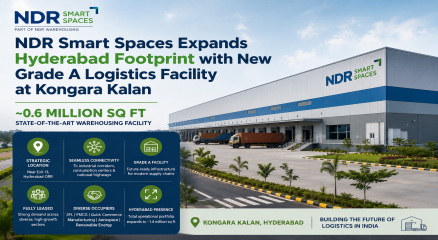
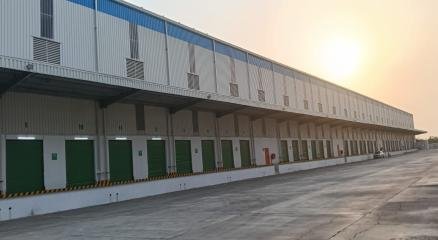
Strengthening its position in one of India's fastest-growing warehousing and logistics markets, NDR Smart Spaces has inaugurated a new Grade A warehousing facility spanning nearly 0.6 million sq ft at Kongara Kalan in Hyderabad. This development is another step in the company's long-term expansion and shows its commitment to supporting India's evolving supply chain ecosystem. The latest addition takes NDR Smart Spaces' total operational warehousing portfolio in Hyderabad to approximately 1.4 million sq ft, further enhancing its capacity to cater to the growing requirements of businesses seeking modern, technology-enabled logistics infrastructure. The newly launched park has already witnessed strong market acceptance, with the entire facility being leased before commencement of operations. The tenant mix reflects Hyderabad's emergence as a preferred logistics destination, attracting businesses from sectors such as third-party logistics (3PL), FMCG, quick commerce, and advanced manufacturing. Industry experts note that demand for high-quality warehousing continues to rise as companies focus on improving inventory management, distribution efficiency, and supply chain resilience. Hyderabad, in particular, has emerged as a key logistics gateway due to its strategic location, infrastructure development, and growing consumption base. One of the major advantages of the Kongara Kalan facility is its proximity to Exit 13 of Hyderabad's Outer Ring Road (ORR). The location provides convenient access to key industrial zones, consumption clusters, and national highway networks, enabling smoother freight movement and faster delivery timelines. By reducing transit delays and improving route accessibility, the facility is expected to help occupiers optimise logistics costs and operational efficiency. Commenting on the development, Amrutesh Reddy, Managing Director of NDR Smart Spaces, said the company views Hyderabad as a critical market in India's next phase of logistics growth. He noted that the Kongara Kalan project reflects the increasing preference among occupiers for premium Grade A warehousing infrastructure and added that the company's focus remains on creating future-ready facilities capable of addressing both current and emerging supply chain requirements. Echoing similar sentiments, Ramachandran Rajaram, Regional Business Head at NDR Smart Spaces, highlighted Hyderabad's transformation into a mature logistics and industrial destination. According to him, the wide range of occupiers operating from the facility—including companies from the manufacturing, aerospace, renewable energy, FMCG, quick commerce, and 3PL segments demonstrates the depth and diversity of demand being generated by the city. He further stated that the project's location along the Outer Ring Road places businesses at a strategic crossroads of connectivity and commercial activity, creating an ideal operating environment for efficient supply chain management. With the launch of the Kongara Kalan facility, NDR Smart Spaces continues to advance its vision of developing world-class logistics and industrial infrastructure designed to support India's rapidly expanding warehousing and distribution landscape. For more such news and updates, visit CARGOCONNECT.
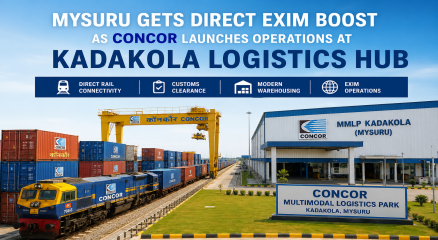
Container Corporation of India Ltd. has commenced export-import (EXIM) cargo handling at its Multimodal Logistics Park (MMLP) in Kadakola, Mysuru, strengthening logistics connectivity for industries in and around Mysuru. The facility became operational following the issuance of Bengaluru Customs Public Notice No. 04/2026 on May 18, enabling the terminal to handle international cargo movement. Located near key industrial clusters in southern Karnataka, the Kadakola logistics park is expected to support exporters and importers by offering cargo handling and multimodal transport services closer to manufacturing centres. The development is likely to reduce reliance on logistics hubs in larger metropolitan areas while improving turnaround times for cargo movement. The terminal is designed to integrate rail and road-based freight operations, helping streamline container movement for industries in and around Mysuru. Businesses in sectors such as manufacturing, engineering, textiles and agri-based exports are expected to benefit from improved access to customs-linked logistics infrastructure. Industry observers say the commissioning of the facility could strengthen Mysuru’s position in regional trade networks by enabling faster cargo clearances and lowering transportation inefficiencies in the supply chain. The project also aligns with broader efforts to expand inland logistics capacity and improve export connectivity across non-metro industrial regions in India. The Kadakola MMLP forms part of CONCOR’s wider strategy to expand multimodal freight infrastructure and support the growth of India’s EXIM trade ecosystem. Follow CARGOCONNECT for more such updates.