
Loading...
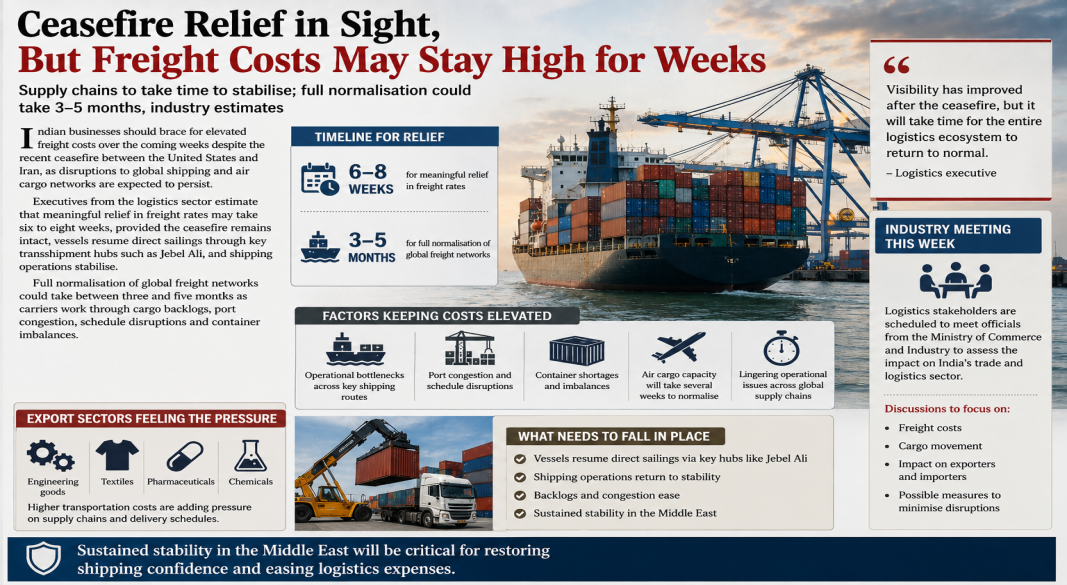
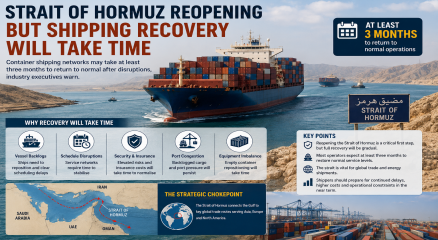
Indian businesses should brace for elevated freight costs over the coming weeks despite the recent ceasefire between the United States and Iran, as disruptions to global shipping and air cargo networks are expected to persist. Industry stakeholders say supply chains will require time to recover even after the reopening of the Strait of Hormuz.
Executives from the logistics sector estimate that meaningful relief in freight rates may take six to eight weeks, provided the ceasefire remains intact, vessels resume direct sailings through key transshipment hubs such as Jebel Ali, and shipping operations stabilise. Full normalisation of global freight networks could take between three and five months as carriers work through cargo backlogs, port congestion, schedule disruptions and container imbalances.
Industry representatives are scheduled to meet officials from the Ministry of Commerce and Industry this week to assess the impact of the recent geopolitical tensions on India's trade and logistics sector. The discussions are expected to focus on freight costs, cargo movement and possible measures to minimise disruptions for exporters and importers.
Although the ceasefire has improved visibility for shippers and logistics providers, companies say pricing pressures remain due to lingering operational bottlenecks across international shipping routes. Air cargo services are also expected to take several weeks to return to normal capacity as airlines gradually restore schedules affected by the regional conflict.
Export-oriented sectors, including engineering goods, textiles, pharmaceuticals and chemicals, continue to monitor freight developments closely, with higher transportation costs adding pressure to supply chains and delivery schedules. Industry executives noted that sustained stability in the Middle East will be critical for restoring shipping confidence and easing logistics expenses over the coming months.
Follow CARGOCONNECT for more such updates.
Indian businesses should brace for elevated freight costs over the coming weeks despite the recent ceasefire between the United States and Iran, as disruptions to global shipping and air cargo networks are expected to persist. Industry stakeholders say supply chains will require time to recover even after the reopening of the Strait of Hormuz. Executives from the logistics sector estimate that meaningful relief in freight rates may take six to eight weeks, provided the ceasefire remains intact, vessels resume direct sailings through key transshipment hubs such as Jebel Ali, and shipping operations stabilise. Full normalisation of global freight networks could take between three and five months as carriers work through cargo backlogs, port congestion, schedule disruptions and container imbalances. Industry representatives are scheduled to meet officials from the Ministry of Commerce and Industry this week to assess the impact of the recent geopolitical tensions on India's trade and logistics sector. The discussions are expected to focus on freight costs, cargo movement and possible measures to minimise disruptions for exporters and importers. Although the ceasefire has improved visibility for shippers and logistics providers, companies say pricing pressures remain due to lingering operational bottlenecks across international shipping routes. Air cargo services are also expected to take several weeks to return to normal capacity as airlines gradually restore schedules affected by the regional conflict. Export-oriented sectors, including engineering goods, textiles, pharmaceuticals and chemicals, continue to monitor freight developments closely, with higher transportation costs adding pressure to supply chains and delivery schedules. Industry executives noted that sustained stability in the Middle East will be critical for restoring shipping confidence and easing logistics expenses over the coming months. Follow CARGOCONNECT for more such updates.
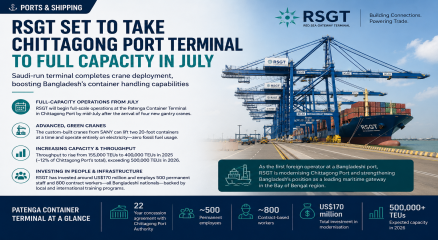
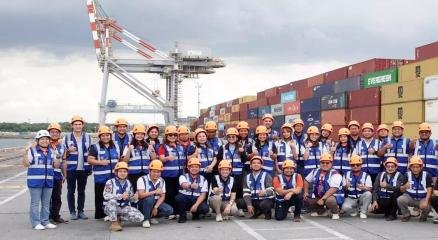
Saudi Arabia's Red Sea Gateway Terminal (RSGT) is preparing to bring its operations at Bangladesh's Patenga Container Terminal to full capacity next month, marking a major milestone in its ongoing investment in the country's maritime infrastructure. The development follows the arrival of four ship-to-shore gantry cranes, completing the terminal's planned equipment deployment and paving the way for a substantial increase in cargo-handling capability. Located within Chittagong Port, Bangladesh's busiest maritime gateway, the facility plays a critical role in supporting the nation's import and export trade. RSGT has managed the Patenga Container Terminal since June 2024 under a 22-year concession agreement with the Chittagong Port Authority. Over the past two years, the company has focused on upgrading infrastructure, implementing operational technologies, and building a skilled workforce to support long-term terminal growth. According to Sayed Aref Sarwar, Head of Commercial and Public Affairs at RSGT Bangladesh, the period since taking over operations has largely been dedicated to preparing the terminal for large-scale commercial activity. With the installation of the final batch of equipment now complete, the company expects to begin operating the new cranes by mid-July. The addition is expected to significantly improve vessel turnaround times and overall terminal productivity. Manufactured by Chinese equipment maker SANY, the cranes introduce capabilities not previously available at Bangladeshi ports. Designed to lift two 20-foot containers simultaneously, they are expected to accelerate cargo movements while supporting environmentally sustainable operations. Unlike conventional equipment, the cranes will run entirely on electricity, eliminating the need for fossil-fuel-powered operations within the terminal. The company believes its current infrastructure will be sufficient to accommodate projected cargo volumes in the near term, although further expansion remains a possibility as demand grows. RSGT's presence has already begun reshaping operations at the terminal. Container throughput is expected to rise from around 155,000 TEUs to nearly 400,000 TEUs this year, representing approximately 12 percent of Chittagong Port's overall container traffic. Looking ahead, the terminal is projected to handle more than 500,000 TEUs in 2027, potentially accounting for close to 17 percent of the port's total volumes. As the first foreign operator to manage a Bangladeshi port terminal, RSGT has also made workforce development a key part of its strategy. The company has invested roughly US$170 million in modernising the facility and currently employs around 500 permanent staff, supported by approximately 800 contract workers. Notably, all employees are Bangladeshi nationals. To build specialised expertise, RSGT has conducted training programmes both within Bangladesh and overseas, including operational training assignments at facilities in Saudi Arabia. The initiative is aimed at addressing the shortage of globally trained port professionals and strengthening the country's long-term maritime capabilities. The upcoming transition to full-capacity operations is expected to enhance Chittagong Port's efficiency and reinforce its role as a key logistics hub for the Bay of Bengal region.
Gujarat government has introduced a shipbuilding subsidy of up to ₹50 crore for shipyards operating within the state. The initiative is designed to complement the Centre’s Shipbuilding Financial Assistance Scheme and enhance Gujarat’s position as a leading maritime and shipbuilding destination. Under the newly announced incentive framework, shipyards can claim financial assistance equivalent to 8% of eligible project costs or ₹50 crore, whichever is lower, for the construction of small and large vessels. For specialised vessels, the subsidy has been enhanced to 10% of eligible costs, capped at ₹50 crore. The support is expected to improve project viability and encourage greater investment in domestic shipbuilding activities. The policy aligns with India’s broader ambition of developing a globally competitive maritime industry and reducing dependence on imported vessels. By offering an additional layer of financial support, Gujarat aims to attract both private and institutional investments into shipbuilding and ship repair infrastructure. Industry stakeholders believe the move could help improve order inflows, increase production capacity, and create new employment opportunities across the maritime value chain. Gujarat already plays a pivotal role in India’s maritime economy, supported by an extensive coastline, established port infrastructure, and a strong industrial base. The state has also been actively promoting the development of shipbuilding and repair clusters in strategic locations such as the Gulf of Kutch and Pipavav. The latest subsidy is expected to accelerate the creation of modern shipyard facilities, including dry docks, fabrication units, jetties, cranes, dredging infrastructure, and research and training centres. The announcement comes at a time when both the central and state governments are intensifying efforts to expand India’s maritime capabilities. Recent national initiatives have focused on increasing shipbuilding capacity, enhancing technological competitiveness, and supporting long-term growth in the sector. Gujarat’s latest intervention is expected to complement these efforts while strengthening the state’s position as a preferred destination for maritime investments. As global supply chains continue to diversify and demand for maritime assets grows, the subsidy could provide a timely boost to India’s shipbuilding industry. Analysts believe the policy will not only support local manufacturing but also contribute to the country’s ambition of emerging as a major global maritime hub in the coming decades. 𝐒𝐭𝐚𝐲 𝐓𝐮𝐧𝐞𝐝 𝐭𝐨 CARGOCONNECT 𝐟𝐨𝐫 𝐥𝐚𝐭𝐞𝐬𝐭 𝐮𝐩𝐝𝐚𝐭𝐞𝐬!