
Loading...
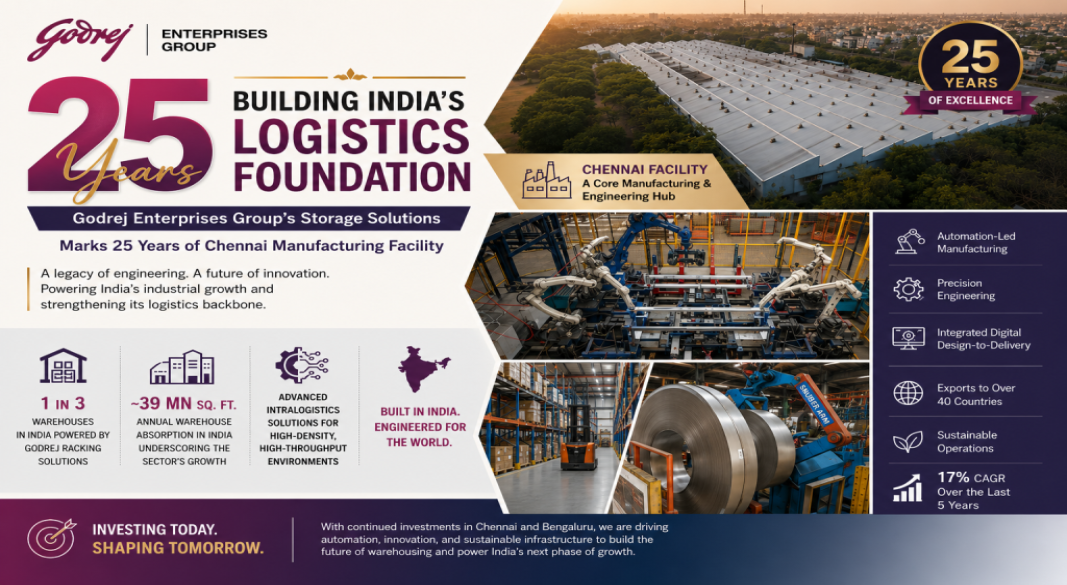
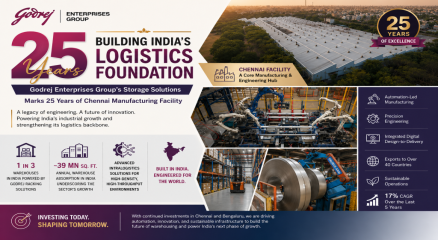
India’s warehousing and intralogistics sector is entering a new phase of growth, driven by the rapid expansion of e-commerce, quick commerce, manufacturing, and third-party logistics. Against this backdrop, Godrej Enterprises Group (GEG) has marked the 25th anniversary of its Chennai manufacturing facility, reaffirming its commitment to advancing India’s logistics infrastructure through continued investments in automation, engineering excellence, and next-generation warehousing solutions.
A cornerstone of the company’s Storage Solutions business, the Chennai facility has evolved into one of the region’s largest and most advanced intralogistics manufacturing hubs. Backed by over seven decades of expertise in intralogistics, the business has announced further investments across its Chennai and Bengaluru operations to strengthen production capabilities, accelerate innovation, and support the growing demand for intelligent warehousing infrastructure.
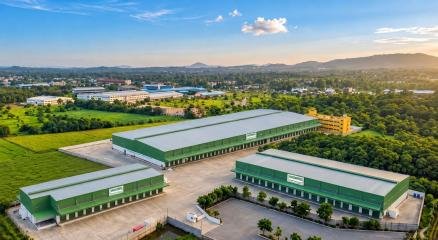
The milestone comes at a time when warehousing is becoming increasingly critical to supply chain resilience and operational efficiency. With annual warehousing absorption in India crossing approximately 39 million sq. ft., demand for automated, high-density storage systems continues to rise as businesses seek greater speed, scalability, and cost efficiency across their supply chains.
Over the past 25 years, the Chennai facility has expanded its manufacturing and engineering capabilities to deliver complex intralogistics projects with greater precision and faster execution. Today, it produces advanced systems that support automated warehouses, high-density storage environments, and large-scale distribution operations, reinforcing its role as a strategic enabler of India’s industrial growth.
Commenting on the milestone, Vikas Choudaha, Business Head – Storage Solutions, Godrej Enterprises Group stated, “As we mark 25 years of our Chennai manufacturing facility, it reflects how we have steadily scaled our capabilities to support India’s rapidly evolving logistics and warehousing ecosystem. As supply chains become faster and more complex, the need for intelligent, technology-led and future-ready infrastructure is intensifying, and at Godrej Enterprises Group, we are actively shaping this transformation through investments in advanced engineering, innovation, and automation-led capabilities.”
The company has strengthened its market position through automation-led manufacturing, precision engineering, and integrated digital design-to-delivery systems. Its portfolio includes automated racking solutions and rack-clad warehouses designed to maximise storage density, improve throughput, and optimise land utilisation. Notably, the company states that one in every three warehouses in India is powered by Godrej racking solutions.
Sustainability remains a key focus area, with manufacturing operations incorporating real-time monitoring and optimisation of energy and water consumption. These initiatives align with the company’s broader vision of delivering environmentally responsible infrastructure while enhancing operational efficiency.
Beyond India, Godrej Enterprises Group has established a strong global footprint, exporting engineering-led intralogistics solutions to more than 40 countries across the Americas, Europe, the Middle East, ASEAN, and Australia.
As India advances towards becoming a globally competitive manufacturing and logistics hub, Godrej Enterprises Group’s continued investments in automation, digital transformation, and sustainable infrastructure position it to play an increasingly important role in shaping the future of warehousing and supply chain excellence.
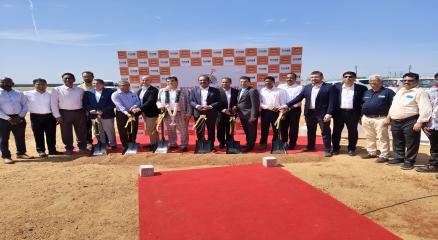
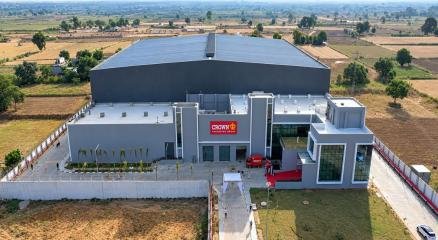
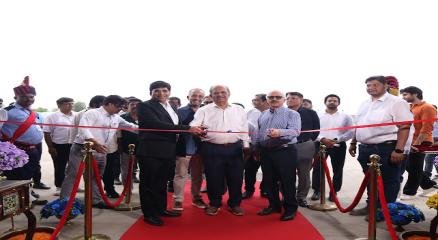
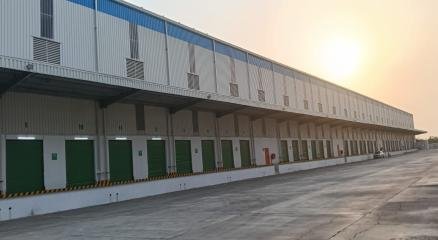
Kirby Building Systems & Structures India, a subsidiary of Alghanim Industries and a leading provider of pre-engineered steel buildings (PEB) and structural steel solutions, has commenced construction of its fourth manufacturing facility in India at Manapparai, near Trichy, Tamil Nadu. The new state-of-the-art facility will have an annual manufacturing capacity of 100,000 metric tonnes and will be developed across approximately 33.2 acres. Commercial operations are expected to commence by mid-2027. Once operational, the plant will raise Kirby India’s total annual manufacturing capacity from 300,000 metric tonnes to 400,000 metric tonnes, strengthening its ability to serve customers across Southern India and other key markets. Commenting on the investment, Sir Kutayba Y. Alghanim, Executive Chairman of Alghanim Industries, said: “Over the past 50 years, Kirby has grown under Alghanim Industries from an ambitious steel-building business into a trusted global partner. India has played an pivotal role in that journey for more than 26 years. This new investment reflects our continued confidence in the country’s long-term industrial development and our commitment to contributing meaningfully to its growth.” The groundbreaking ceremony was attended by Waleed K. Alghanim, Chief Executive Officer of Kirby International; Nizar Shawwa, Chief Operating Officer of Kirby International; James Minato, Vice President, Middle East and Africa; and P. V. Mohan, Managing Director of Kirby India. Senior leaders from Alghanim Industries and Kirby India, project consultants, civil contractors, government representatives and members of Kirby’s Southern Region team also attended the event. Waleed K. Alghanim, Chief Executive Officer of Kirby International, said: “As Kirby marks 50 years as part of Alghanim Industries, we are looking ahead to ‘The Next 50’ with confidence and ambition. This investment is an important part of that future, expanding our capacity, strengthening our presence in Southern India and bringing us closer to customers in one of the country’s most dynamic industrial regions.” P. V. Mohan, Managing Director of Kirby India, said: “Building on more than 26 years of operations in India, the new Tamil Nadu facility marks an important step in Kirby India’s growth. It will allow us to serve customers across Southern India with greater speed and flexibility while bringing advanced manufacturing capabilities closer to the markets we serve.” Kirby India said it continues to invest in advanced engineering, automation, digital technologies and manufacturing capabilities to meet the evolving requirements of India’s industrial and infrastructure sectors. The Tamil Nadu facility will complement its existing manufacturing network and enhance its ability to deliver engineered and scalable steel-building solutions with greater speed, reliability and consistency. The new facility will become Kirby India’s fourth manufacturing plant, complementing existing facilities in Hyderabad, Haridwar and Halol, Gujarat. The company has operated in India for more than 26 years and is supported by over 25 sales offices and more than 150 certified builders. It provides engineered building solutions across industrial, manufacturing, commercial, warehousing, logistics and heavy structural applications. Kirby India has completed more than 45,000 buildings in India, representing a total built-up area of approximately 50 million square metres. 𝐒𝐭𝐚𝐲 𝐓𝐮𝐧𝐞𝐝 𝐭𝐨 CARGOCONNECT 𝐟𝐨𝐫 𝐥𝐚𝐭𝐞𝐬𝐭 𝐮𝐩𝐝𝐚𝐭𝐞𝐬!

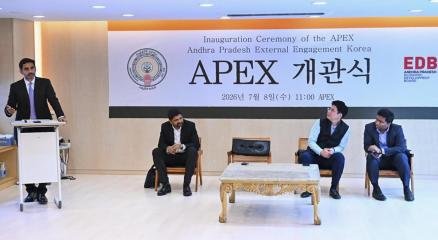
Andhra Pradesh government has inaugurated its first overseas investment facilitation centre in Busan, South Korea in a strategic move to strengthen global investment outreach and position itself as a preferred manufacturing and maritime hub. Named APEX Korea (Andhra Pradesh External Engagement – Korea), the centre has been established by the Andhra Pradesh Economic Development Board (APEDB) to serve as a dedicated platform for attracting Korean investments and supporting existing investors. The initiative marks a significant milestone in the state's international engagement strategy, creating a permanent institutional presence in one of Asia's leading industrial economies. Located in Busan, South Korea's maritime and commercial capital, APEX Korea will provide end-to-end support to Korean companies exploring investment opportunities in Andhra Pradesh, facilitate project implementation, and offer investor aftercare services to ensure long-term business partnerships. The launch coincided with Andhra Pradesh Minister for Education, IT and Electronics Nara Lokesh's investment outreach visit to South Korea, where he invited leading Korean maritime equipment manufacturers to participate in the proposed ₹30,000-crore Dugarajapatnam Shipbuilding Cluster. Speaking at a maritime investment roundtable organised by the Korea Marine Equipment Association (KOMEA), Lokesh highlighted Andhra Pradesh's strategic advantages, including its 1,053-km coastline, expanding port infrastructure, industrial ecosystem and investor-friendly policies. The state also proposed deeper collaboration between KOMEA and the Andhra Pradesh Maritime Board through initiatives such as a Korea Marine Equipment Desk, an India Ship Technology Centre, joint skill development programmes and collaborative research and innovation projects. These initiatives aim to strengthen technology transfer and build a globally competitive maritime manufacturing ecosystem. Beyond maritime manufacturing, Andhra Pradesh expanded its engagement with South Korean companies in the footwear and financial services sectors. During discussions with the Hwaseung Group, the government encouraged the company to expand its proposed ₹900-crore footwear manufacturing project in Kuppam by establishing component manufacturing facilities, an advanced R&D centre and an integrated footwear cluster. The Boo Young Group also expressed interest in exploring manufacturing opportunities in the state. The delegation also met representatives of BNK Financial Group, inviting the institution to explore financing opportunities across infrastructure, innovation and industrial development while connecting global investors with projects in Andhra Pradesh. With dedicated support for foreign investors and targeted outreach to globally competitive industries, the initiative is expected to strengthen foreign direct investment inflows while supporting the state's ambitions of becoming a leading hub for maritime manufacturing, shipbuilding, logistics and export-oriented industries. 𝐒𝐭𝐚𝐲 𝐓𝐮𝐧𝐞𝐝 𝐭𝐨 CARGOCONNECT 𝐟𝐨𝐫 𝐥𝐚𝐭𝐞𝐬𝐭 𝐮𝐩𝐝𝐚𝐭𝐞𝐬!
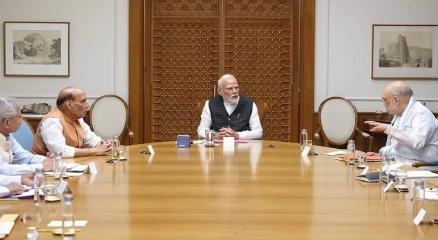
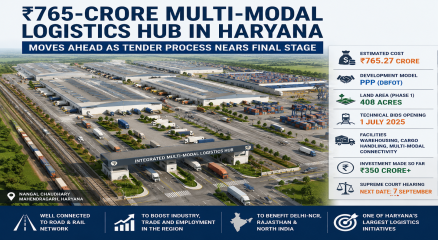
Technical bids for the Mahendragarh logistics project are scheduled to be opened on July 1, bringing one of Haryana’s largest infrastructure initiatives closer to execution. The proposed Integrated Multi-Modal Logistics Hub (IMLH) at Nangal Chaudhary in Mahendragarh district has reached an important milestone, with technical bids for its global tender set to be opened on July 1 in Chandigarh. Estimated at ₹765.27 crore, the project is expected to significantly strengthen logistics and freight infrastructure across northern India. The tender, floated in August 2025 by Haryana Multi-Modal Logistics Hub Project Limited, seeks a private developer under the Public-Private Partnership (PPP) framework using the Design, Build, Finance, Operate and Transfer (DBFOT) model. Interested firms have until 5 pm on June 30 to submit their online bids before the technical evaluation begins. The first phase of the project will be developed over around 408 acres, where modern cargo handling, warehousing and freight distribution facilities will be established. Once operational, the hub is expected to improve supply chain efficiency by integrating road and rail connectivity, reducing logistics costs and enabling faster movement of goods. Preparatory infrastructure for the project has already seen substantial progress. Rail connectivity through the New Dabla Railway Station, a 220 kV dedicated power line, a canal-based water supply from Narnaul, and road access from the National Highway have already been created. Construction of the internal railway track and cargo platform is also nearing completion. The rail infrastructure developed during the first phase has involved an investment of nearly ₹200 crore, laying the groundwork for large-scale freight operations. Authorities expect the logistics hub to attract fresh industrial investment and strengthen manufacturing activity across the region. Besides enhancing freight movement, the project is anticipated to generate considerable direct and indirect employment opportunities. It is also expected to benefit industries located in Delhi-NCR, Rajasthan, Haryana, and other parts of North India by offering modern logistics and warehousing infrastructure. Despite steady progress, a portion of the project remains subject to legal proceedings. The Supreme Court, while hearing a petition filed by 91 farmers, recently ordered a temporary stay on construction activities across 129 acres of the project land until September 7. At the same time, the court clarified that the order does not restrict the Haryana government from continuing statutory procedures under the Right to Fair Compensation and Transparency in Land Acquisition, Rehabilitation and Resettlement Act, 2013. The next hearing in the matter is scheduled for September 7. The logistics hub is being implemented through a special purpose vehicle (SPV), NICDC Haryana Multi-Modal Logistics Hub Project Limited. Since the project's inception in 2018, nearly 1,000 acres have been acquired. Around ₹150 crore has been spent on land acquisition, while another ₹200 crore has gone into developing enabling infrastructure. With the global tender process now entering its concluding phase, the project is moving closer to construction and is expected to become a major logistics gateway supporting industrial growth and multimodal transportation across the region.