
Loading...
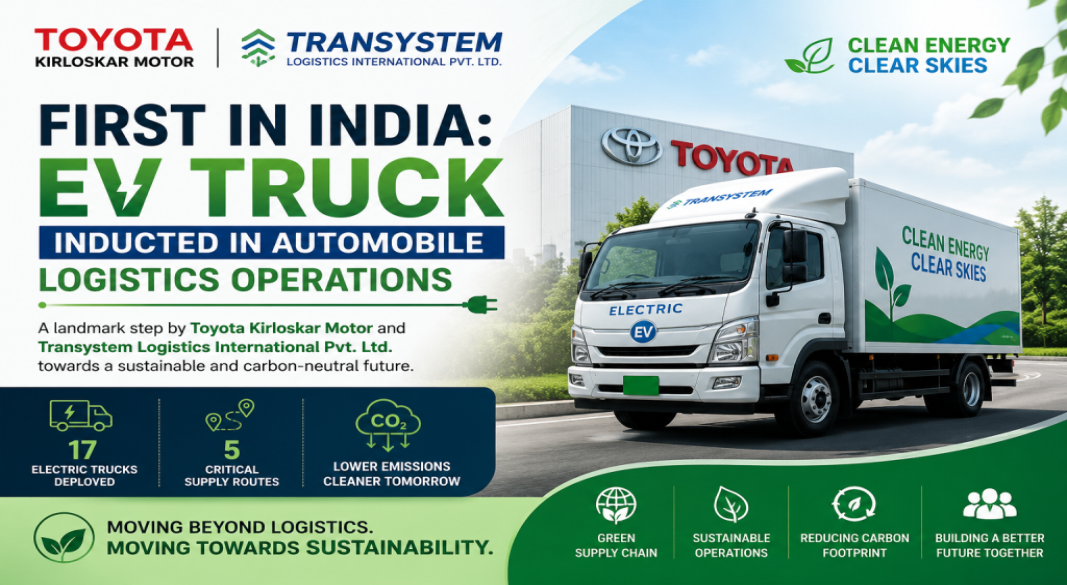
Toyota Kirloskar Motor and Transystem Logistics International Pvt. Ltd. have marked a major milestone in sustainable transportation with the induction of India’s first electric truck for automobile logistics operations.
The initiative, launched as part of Toyota Kirloskar Motor’s Environment Month 2025 activities, introduces electric trucks into both local and long-haul automotive logistics routes, reinforcing the company’s broader commitment to carbon-neutral supply chain operations.
A total of 17 electric trucks have been deployed across five key logistics corridors, supporting Toyota’s global Environmental Challenge 2050 strategy focused on reducing lifecycle carbon emissions through cleaner manufacturing, transportation and supply chain practices.
The development represents a significant advancement for India’s automotive logistics sector, where large-scale freight movement has traditionally relied on diesel-powered transportation. The companies stated that the initiative aligns with their shared vision of “Clean Energy, Clear Skies” while accelerating the transition toward greener logistics infrastructure.
The EV truck deployment builds upon Toyota Kirloskar Motor’s earlier green logistics initiatives, including mixed logistics models, return logistics optimisation to reduce empty miles, and the adoption of compressed natural gas (CNG) vehicles within its transport network.
Alongside the logistics initiative, the company also conducted a series of sustainability-focused programmes involving over 3,100 participants across its ecosystem, including employees, suppliers, dealers and community stakeholders.
Activities included environmental awareness campaigns, tree plantation drives, sustainability innovation exhibitions and student-led eco-project showcases focused on waste management, energy efficiency and water conservation.
The initiative further highlights the growing momentum toward low-emission logistics and sustainable supply chain transformation within India’s automotive and industrial sectors as companies increasingly align operational strategies with global environmental commitments.
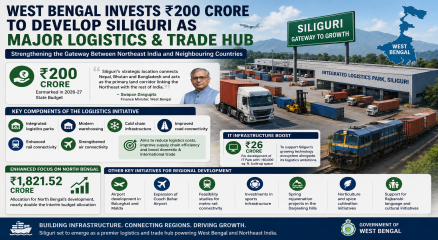
The West Bengal government has earmarked ₹200 crore in its 2026-27 state budget to develop Siliguri into a major logistics and trade hub, strengthening the city's role as a strategic gateway connecting Northeast India with neighbouring countries. The investment forms part of a broader infrastructure push aimed at improving regional supply chains and boosting cross-border commerce. Presenting the state budget, Finance Minister Swapan Dasgupta said Siliguri's geographical position offers significant advantages due to its connectivity with Nepal, Bhutan and Bangladesh, alongside its role as the primary land corridor linking the Northeast with the rest of India. The government plans to leverage this location by expanding logistics infrastructure and multimodal transport facilities. The proposed development includes integrated logistics parks, modern warehousing, cold chain infrastructure, and improvements to road, rail and air connectivity. The government expects these investments to reduce logistics costs, improve supply chain efficiency and support both domestic and international trade. In addition to the logistics initiative, the budget allocates ₹26 crore for the expansion of Siliguri's IT infrastructure through the development of an IT park with approximately 50,000 square feet of built-up space. The project is intended to support the city's growing technology ecosystem alongside its logistics ambitions. The state has also increased overall funding for North Bengal's development to ₹1,821.52 crore, nearly doubling the allocation made in the interim budget earlier this year. Other regional initiatives announced include airport development in Balurghat and Malda, expansion of Cooch Behar Airport, feasibility studies for metro rail connectivity, investments in sports infrastructure, spring rejuvenation projects in the Darjeeling hills, horticulture and spice cultivation, and support for the Rajbanshi language and cultural initiatives. Industry representatives welcomed the logistics-focused allocation, noting that improved multimodal infrastructure and warehousing capacity could strengthen Siliguri's position as a key distribution centre for eastern and northeastern India while facilitating greater regional trade. Follow CARGOCONNECT for more such updates.
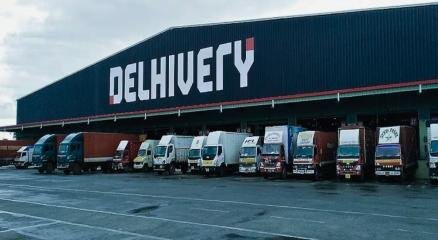
Delhivery has introduced a new geospatial technology platform, Delhivery Maps, marking its entry into the commercial mapping and navigation solutions space. The logistics company announced that the AI-driven suite of mapping APIs, previously developed and deployed exclusively for its own operations, will now be available to enterprises, developers, and gig-economy businesses. The launch reflects Delhivery’s broader effort to commercialise technology built in-house over years of operating one of India's largest logistics networks. The company originally created the mapping infrastructure to reduce dependence on external map providers while improving efficiency across its express parcel, freight, and supply chain businesses. According to the company, Delhivery Maps offers a comprehensive range of geospatial services, including address auto-completion, geocoding, reverse geocoding, navigation, route optimisation, distance matrix calculations, map tiles, and vehicle-aware routing. Unlike conventional mapping platforms, the solution has been designed specifically for logistics and commercial transportation requirements. The platform incorporates operational considerations such as heavy-vehicle movement patterns, road restrictions, commercial routing rules, and landmark-based navigation to improve route planning and delivery execution. Delhivery said the system has been trained and refined using operational data accumulated over years of deliveries across the country. The accuracy of the platform is backed by historical information generated from more than 200 crore shipments and over one billion daily GPS signals collected from a fleet exceeding one lakh vehicles. This extensive dataset enables the platform to better understand India's complex addressing ecosystem and transportation network. At the core of the offering is Naksha LLM, Delhivery’s proprietary geospatial reasoning model. Built to process unstructured and incomplete address information, the model uses advanced reasoning capabilities to interpret location data more effectively. Naksha LLM is also available through the Delhivery Maps MCP ecosystem. The company believes the platform can address a variety of use cases across sectors such as ecommerce, quick commerce, ride-hailing, and on-demand services. Businesses can leverage the APIs for tasks including address validation, dispatch optimisation, route planning, and more accurate delivery time predictions. Commenting on the launch, Delhivery Chief Technology Officer Kapil Bharati said the solution was born out of operational necessity, helping the company manage commercial routing complexities and unstructured addresses at scale while running India's largest logistics network. The launch comes as Delhivery continues to diversify its business portfolio. In recent months, the company established Delhivery Financial Services, a wholly-owned subsidiary focused on financial products for truck drivers, fleet operators, riders, and MSMEs. The offerings are expected to include credit-linked services, fuel cards, and insurance solutions. The company has also been strengthening newer business verticals such as Delhivery Direct and Rapid. While Delhivery Direct caters to hyperlocal, on-demand deliveries through two-wheelers as well as larger vehicles, Rapid supports quick-commerce fulfilment by managing dark-store operations for brands, retailers, and direct-to-consumer businesses. Financially, Delhivery maintained stable profitability during the March quarter, posting a consolidated net profit of ₹72.4 crore. Revenue from operations climbed 30 per cent year-on-year to ₹2,850 crore. For FY26, the company reported a net profit of ₹321 crore, up 8 per cent from the previous year, while service revenue increased 17 per cent to ₹10,486 crore. For more such news and updates, visit CARGOCONNECT.


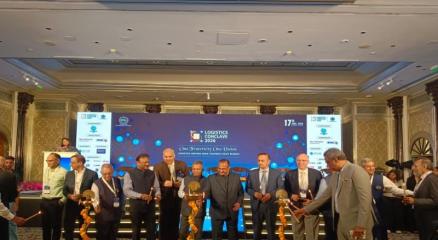
The Brihanmumbai Custom Brokers’ Association (BCBA), the apex body of the customs-broking fraternity in Mumbai, successfully hosted the second edition of its flagship policy forum, the India Logistics Conclave 2026, on June 17, 2026, at The Taj Mahal Palace, Mumbai. Building on the massive success of the inaugural 2024 edition, the high-profile, single-day gathering united over 550 industry stakeholders, senior policymakers, and logistics leaders. The landmark event was held under the powerful theme, “One Fraternity, One Vision — Logistics Driving India Towards Viksit Bharat.” Designed as a coherent dialogue on the transformative forces reshaping India’s trade-and-logistics ecosystem, the conclave focused heavily on digital customs, the strategic "China Plus One" opportunity, Free Trade Agreement (FTA) utilisation, infrastructure delivery policies, and the evolving role of the licensed intermediary. The core discussions reflected the BCBA’s firm conviction that customs brokers and freight forwarders have transitioned from traditional back-office facilitators into front-line, equal growth partners in the nation’s economic story. Underscoring this vision, the association’s leadership emphasised the sector's crucial contribution to national development. Mr. Sanjeev Harale, President of BCBA, highlighted that with falling logistics costs and maturing policies, the sector now sits at the heart of national growth, requiring stakeholders to actively shape industry changes. Mr. Dushyant Mulani, Immediate Past President, noted that the conclave has evolved from an idea in 2024 into a powerful movement, proving the fraternity's readiness to sit at the high table of national policy. Further reinforcing this stance, Mr. Paresh Thakkar, Senior Vice President, described the customs broker as the vital thread holding the entire EXIM chain together, declaring their commitment to leading, innovating, and helping build the Viksit Bharat of 2047. The prestigious Inaugural Session brought together an eminent cross-section of leaders from Indian Customs and the country’s premier ports ecosystem. The distinguished dais featured key government and port authority heads, including Shri Yogendra Garg, Member (Customs), CBIC; Shri Gaurav Dayal, IAS, Chairman, JNPA; Dr M Angamuthu, IAS, Chairman, Mumbai Port Authority; and Shri Shyam Jagannathan, IAS, Director General of Shipping. Joining them were industry captains Capt. Deepak Tiwari, Managing Director, MSC India and Chairman, CSLA; Capt. BVJK Sharma, CEO, Navi Mumbai International Airport; and Shri Niraj Ambani, Group President — Supply Chain, Reliance Industries. Additionally, Shri Vivek Chaturvedi, Chairman, CBIC, addressed the massive gathering online, while the session also took the opportunity to felicitate industry veterans for their distinguished, lifelong contributions to the EXIM community. Throughout the day, panel sessions drew prominent voices from policy, shipping lines, terminals, and academia to deliberate on the long-horizon roadmap for Viksit Bharat 2047. The conclave concluded with a highly impactful Valedictory Session titled “Custom Brokers and Freight Forwarders — Growth Partners.” The concluding keynote address was delivered by Mr. Dhimant Parekh, Founder of The Better India, who emphasised the critical role of brokers as front-line trade-facilitation partners within the CBIC, DGFT, and PGA frameworks. For more such news and updates, visit CARGOCONNECT.