
Loading...
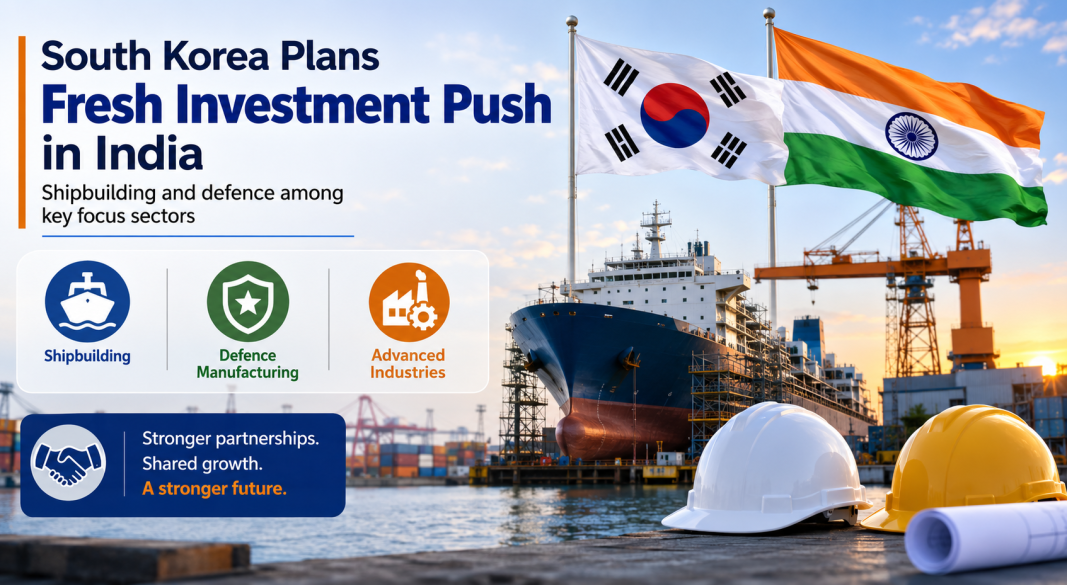
South Korea is preparing a new phase of investments in India, with shipbuilding, defence manufacturing and advanced industrial collaboration emerging as key priority sectors. The move reflects Seoul's strategy to deepen economic ties with India while diversifying its global manufacturing and investment footprint.
South Korean Ambassador Lee Seong-ho said the proposed "second wave" of investments will build on the success of Korean companies already operating in India and expand cooperation into strategic industries that align with both countries' long-term economic and security objectives. Shipbuilding, defence production and high-value manufacturing are expected to lead the next phase of engagement.
The renewed focus comes as India seeks to strengthen its domestic manufacturing capabilities through initiatives such as Make in India and expand its maritime and defence industrial base. South Korea, one of the world's leading shipbuilding nations, is seen as a key technology and investment partner for India's ambitions to become a major global shipbuilding hub.
Officials from both countries are also working towards upgrading the Comprehensive Economic Partnership Agreement (CEPA) to improve market access, reduce trade barriers and encourage greater bilateral investment. Discussions are expected to cover emerging sectors, including semiconductors, green technologies and critical manufacturing, alongside traditional industries.
The two countries have already expanded cooperation in shipbuilding through partnerships between Indian and South Korean companies, while defence collaboration has gained momentum with joint manufacturing projects and technology partnerships. Recent agreements have also explored opportunities in commercial shipbuilding, naval platforms and industrial innovation.
Trade and maritime cooperation have become central pillars of the India-South Korea relationship. During recent bilateral engagements, India invited South Korean shipbuilders, port developers and logistics companies to participate in major infrastructure projects, including new shipbuilding clusters, port modernisation and maritime logistics initiatives.
Industry observers believe the planned investment push could strengthen supply chain resilience, support technology transfer and create new manufacturing opportunities in India, while providing South Korean companies with access to one of the world's fastest-growing industrial markets.
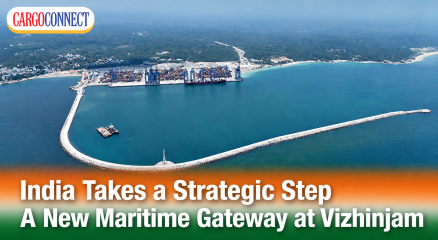
Thiruvananthapuram: Vizhinjam International Seaport has officially commenced full-scale Export-Import (EXIM) operations, opening a direct maritime gateway for cargo from South India to global markets. The launch was marked by the flag-off of the port’s first commercial export consignment to Valencia, Spain. The shipment, comprising frozen traditional food products from Thiruvananthapuram-based Nilamel Exporters, highlights the potential for the port to reduce transit times for exporters by eliminating overseas transhipment points. According to the port, shipments to European markets that previously took nearly 60 days could now reach their destinations in around 24 days by avoiding transhipment through hubs such as Colombo, Singapore and Dubai. The commencement of direct EXIM services marks a significant expansion of Vizhinjam’s role, positioning it not only as a transhipment facility but also as a gateway for inbound and outbound international cargo from the region. Ashwani Gupta, CEO and Director, Adani Ports and Special Economic Zone Ltd (APSEZ), said the company plans to invest an additional ₹16,000 crore to expand the port’s container-handling capacity from 1.6 million TEUs to 5.7 million TEUs. The expanded capacity is expected to strengthen Vizhinjam’s position as a major container hub in the Indian Ocean region as cargo volumes increase. The direct EXIM connectivity is also expected to benefit exporters across Kerala, Tamil Nadu and Karnataka by reducing transhipment-related costs and shortening supply chain turnaround times. Key commodities from the region include spices, cashew, marine products, handlooms and manufactured goods. Vizhinjam’s location further supports its role as an international gateway. The port has a natural depth of around 20–24 metres and is located approximately 10 nautical miles from the major east-west international shipping route, allowing it to accommodate large container vessels with limited dredging requirements. The port also uses an automated container-handling system supported by artificial intelligence and algorithm-driven operations, aimed at improving cargo-handling efficiency and safety. With direct EXIM operations now underway and a major capacity expansion planned, Vizhinjam is emerging as an important addition to India’s maritime infrastructure and its efforts to connect domestic exporters more directly with global trade routes. Follow CARGOCONNECT for more such news

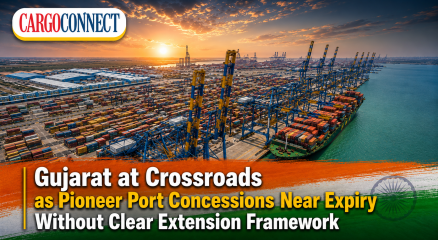
AHMEDABAD - Decisive policy updates are approaching for India's maritime sector as the initial 30-year concession periods for Gujarat’s premier private ports near completion without a formal state extension policy in place. The Build-Own-Operate-Transfer (BOOT) agreements for Gujarat's first generation of private ports which helped turn the state into India's largest maritime portalare entering their final years: APM Terminals Pipavav: Concession signed in 1998 ends on September 29, 2028. Mundra Port (APSEZ): Concession ends on February 16, 2031. Policy Uncertainty Hits Investment Commitments Despite repeated extension requests submitted by APM Terminals Pipavav (in 2011 and 2021) and Adani Ports and Special Economic Zone (APSEZ) (in 2015 and 2021), the Gujarat Maritime Board (GMB) has yet to announce a formal policy framework. GMB officials noted that discussions are ongoing and Union government approval has been sought, but no final decisions have been published. This lack of visibility creates hesitation around committing long-term capital. For example, APM Terminals Pipavav signed a non-binding ₹17,000-crore investment memorandum with the state government in late 2025, but explicitly indicated that major outlays depend on securing concession extension clarity. Evolving Concession Landscape While Gujarat’s original 1997 framework set a 30-year limit, neighboring maritime states have increasingly adopted longer operational horizons: Andhra Pradesh (Gangavaram & Krishnapatnam): 30-year initial period with potential 20-year extensions (50 years total). Kerala (Vizhinjam): 40-year initial period with 20-year extension provisions (60 years total). Odisha (Dhamra): 34-year initial concession period including construction. Recent decisions by Gujarat signal a shift toward alignment with these longer tenures. The state's updated shipbuilding policy extended waterfront concessions to up to 50 years. Additionally, GMB announced that six upcoming greenfield ports along the coastline will offer flexible BOOT concession terms ranging between 30 and 50 years. How the state resolves the extension of its flagship ports will serve as a crucial benchmark for private infrastructure partnerships nationwide. Follow CARGOCONNECT for more such updates

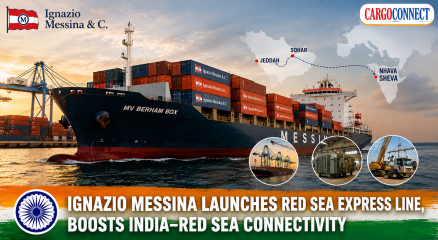
Italian shipping company Ignazio Messina & C. has launched the Red Sea Express Line, expanding its India–Red Sea service network to increase sailing frequency and cargo capacity on a trade corridor that connects India with the Gulf and Saudi Arabia. The new service is scheduled to begin operations from Nhava Sheva on 27 August 2026. The Red Sea Express will operate alongside the company's existing Jolly Line service, providing additional departures and greater schedule flexibility for cargo moving between the Indian subcontinent and the Red Sea region. The move comes as shipping lines continue to strengthen service offerings on regional trade lanes amid growing demand for reliable connections. To support the new service, Ignazio Messina has deployed the MV Berham Box, a vessel dedicated exclusively to the Red Sea Express route. The service will follow a rotation of Nhava Sheva – Sohar – Jeddah – Nhava Sheva, operating on a 20-day frequency. The route is expected to provide regular connectivity between India, Oman and Saudi Arabia, supporting the movement of containerised cargo as well as industrial equipment, machinery and project cargo. Increased sailing options are also expected to improve supply chain planning for exporters and importers serving the region. The launch strengthens Ignazio Messina's presence in the Indian Ocean–Red Sea corridor, a market that has seen sustained demand for dependable shipping services. By adding capacity and dedicated vessel deployment, the carrier aims to improve network resilience while expanding its regional liner service portfolio. Follow CARGOCONNECT for more such updates.