
Loading...
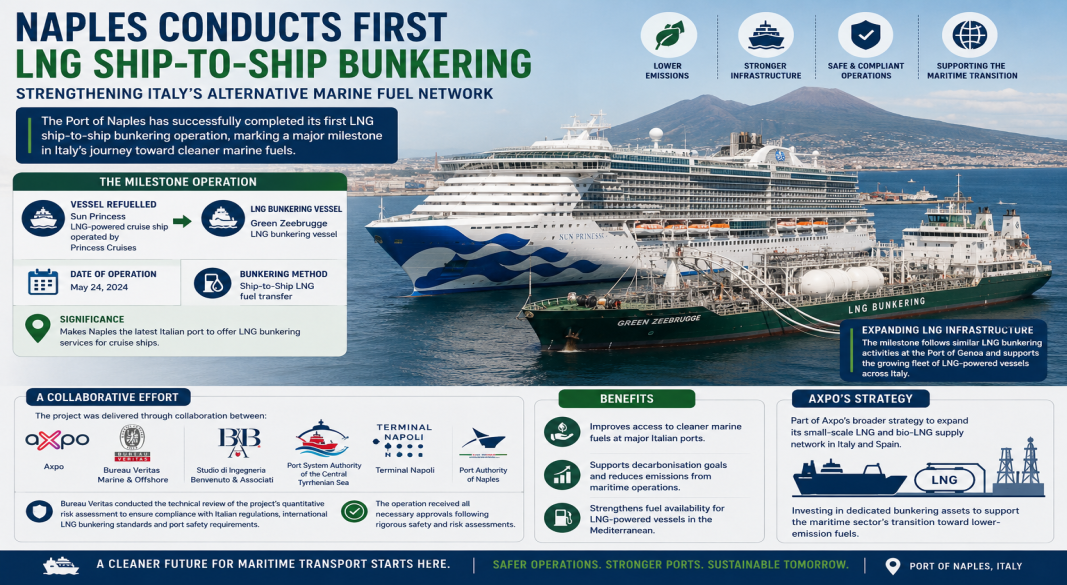
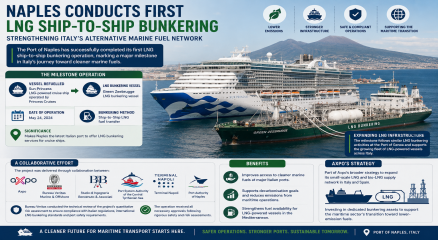
The Port of Naples has completed its first ship-to-ship liquefied natural gas (LNG) bunkering operation, marking a significant step in expanding alternative marine fuel infrastructure across Italy and supporting the growing fleet of LNG-powered vessels.
The operation involved the refuelling of Sun Princess, an LNG-powered cruise ship operated by Princess Cruises, using the LNG bunkering vessel Green Zeebrugge. The fuel transfer was carried out on May 24 through a ship-to-ship bunkering process, making Naples the latest Italian port to introduce LNG bunkering services for cruise ships.
The milestone follows similar LNG bunkering activities introduced at the Port of Genoa and reflects the gradual expansion of LNG supply infrastructure across Italy. Industry stakeholders say broader access to LNG at major ports will improve fuel availability for vessels operating on lower-emission propulsion systems.
The project was delivered through collaboration between energy company Axpo, Bureau Veritas Marine & Offshore, Studio di Ingegneria Benvenuto & Associati, the Port System Authority of the Central Tyrrhenian Sea, Terminal Napoli and the Port Authority of Naples. Bureau Veritas carried out the technical review of the project's quantitative risk assessment to ensure compliance with Italian regulations, international LNG bunkering standards and port safety requirements before the operation received the necessary approvals.
According to the participating organisations, the successful operation establishes an operational and regulatory framework that can support future LNG bunkering activities at Naples and other Italian ports. The project also highlights the coordination required between fuel suppliers, engineering firms, classification societies, port authorities and ship operators to introduce alternative marine fuels safely.
The latest development forms part of Axpo's wider strategy to expand its small-scale LNG and bio-LNG supply network in Italy and Spain. The company has been investing in dedicated bunkering assets to support the maritime sector's transition toward lower-emission fuels while strengthening fuel availability at key Mediterranean ports.
Follow CARGOCONNECT for more such update.
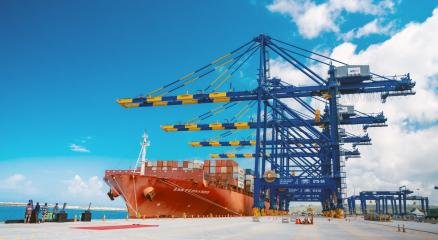
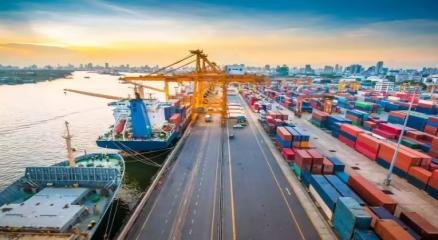
Kerala’s Vizhinjam International Seaport is set to commence full export-import (EXIM) operations from August 18. The transition marks the port’s evolution from a dedicated transshipment hub into a comprehensive international cargo gateway capable of handling both transshipment and gateway cargo, strengthening India’s position in global shipping and supply chains. Since commercial operations began, Vizhinjam has primarily focused on transshipment cargo, enabling containers to be transferred between mother vessels and feeder services. The introduction of full EXIM operations will now allow exporters and importers to move cargo directly through the port, reducing dependence on overseas hubs such as Colombo, Singapore and Dubai for gateway shipments. This is expected to improve transit efficiency, lower logistics costs and shorten cargo movement timelines for businesses across southern India. The commencement of EXIM services is expected to provide a major boost to Kerala’s export ecosystem, while also benefiting neighbouring manufacturing and industrial centres. Direct handling of import and export cargo is likely to enhance supply chain reliability, create new business opportunities for logistics service providers, freight forwarders, customs brokers and transport operators, and improve multimodal connectivity in the region. Developed under a public-private partnership between the Government of Kerala and Adani Ports and Special Economic Zone (APSEZ), Vizhinjam is India’s first dedicated deep-water transshipment port. Its strategic location, just a short distance from one of the world’s busiest east-west international shipping routes, enables ultra-large container vessels to berth without significant deviation from their sailing path. The port’s natural deep draft and modern automated infrastructure further strengthen its competitiveness as a global maritime gateway. The launch of full EXIM operations will coincide with the state government’s ‘Mission Samudra’ initiative, aimed at attracting investments across shipping, logistics, warehousing, port-led industries and allied infrastructure. Industry stakeholders expect the initiative to accelerate industrial growth, generate employment and reinforce Kerala’s role as an emerging logistics hub on India’s western coast. For India’s logistics sector, the development represents another step towards enhancing domestic port infrastructure, reducing cargo diversion to foreign ports and strengthening the country’s ambition of becoming a leading maritime and global supply chain hub. As gateway cargo operations commence, Vizhinjam is expected to play a pivotal role in improving trade competitiveness and supporting India’s long-term vision of expanding its maritime economy. 𝐒𝐭𝐚𝐲 𝐓𝐮𝐧𝐞𝐝 𝐭𝐨 CARGOCONNECT 𝐟𝐨𝐫 𝐥𝐚𝐭𝐞𝐬𝐭 𝐮𝐩𝐝𝐚𝐭𝐞𝐬!
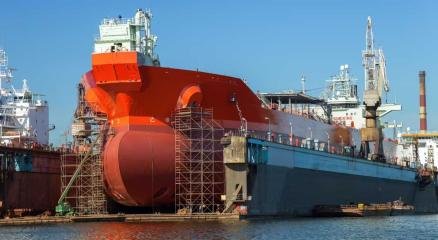
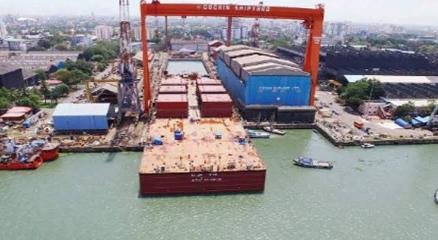
The Ministry of Ports, Shipping and Waterways (MoPSW) has granted in-principal approval for the development of a Greenfield Shipbuilding Cluster in Porbandar, Gujarat. The project, approved under the Shipbuilding Development Scheme is expected to enhance domestic shipbuilding capabilities, improve supply chain resilience and position India as a competitive global maritime manufacturing hub. The integrated shipbuilding cluster will be developed at Kuchhadi in Porbandar through the National Shipbuilding and Heavy Industries Park, Gujarat (NSHIP-Gujarat), jointly promoted by the Ministry of Ports, Shipping and Waterways and the Gujarat Maritime Board. Spread across nearly 2,000 acres, the facility will house modern shipyards, ancillary manufacturing units, common infrastructure and capability development centres to support large-scale vessel production. With an estimated annual shipbuilding capacity of 1.2 to 1.5 million gross tonnage (GT), the cluster is expected to significantly expand India’s indigenous manufacturing capabilities while creating a robust ecosystem for marine engineering, heavy fabrication, equipment manufacturing and logistics services. The project is also expected to generate substantial employment opportunities and attract investments across the maritime value chain. Alongside the Porbandar project, the ministry has also approved a state-of-the-art ship repair facility at Vadinar in the Gulf of Kutch. The ₹1,570-crore project, to be jointly developed by Cochin Shipyard Limited and Deendayal Port Authority, will receive financial assistance under the Shipbuilding Development Scheme for eligible infrastructure. The facility is expected to reduce dependence on overseas ship repair yards, improve vessel turnaround times and strengthen India’s maritime service capabilities. The twin projects form a key part of the government’s Maritime Amrit Kaal Vision 2047, which aims to transform India into a leading global maritime nation by developing world-class infrastructure, promoting indigenous manufacturing and enhancing competitiveness across the shipping sector. According to the ministry, these initiatives will support the growth of domestic shipbuilding and repair industries while improving integration with global supply chains. For the logistics and supply chain industry, the development is expected to create new opportunities for steel manufacturers, component suppliers, heavy engineering companies, port operators and multimodal logistics providers. By strengthening backward linkages and encouraging localisation of marine equipment manufacturing, the projects are likely to reduce import dependence and improve the efficiency of India’s maritime logistics ecosystem, supporting the country’s long-term ambitions of becoming a global shipping and manufacturing powerhouse. 𝐒𝐭𝐚𝐲 𝐓𝐮𝐧𝐞𝐝 𝐭𝐨 CARGOCONNECT 𝐟𝐨𝐫 𝐥𝐚𝐭𝐞𝐬𝐭 𝐮𝐩𝐝𝐚𝐭𝐞𝐬!


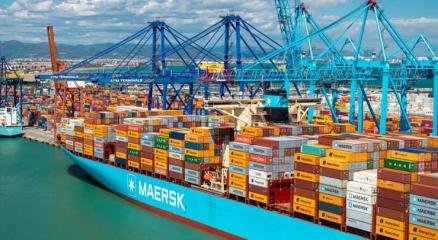
The Government of India and A.P. Moller-Maersk have reaffirmed their commitment to strengthening India's maritime sector through deeper collaboration across shipping, port infrastructure, shipbuilding, repair, container manufacturing and workforce development. The discussions reflect the country's growing focus on building a globally competitive maritime ecosystem while enhancing supply chain resilience and trade connectivity. Union Minister of Commerce and Industry, Piyush Goyal recently met Ahmed Hassan, Head of Asset Strategy at A.P. Moller-Maersk Group, to explore opportunities that align with India's long-term vision of becoming a leading maritime and logistics hub. The meeting highlighted the importance of public-private partnerships in accelerating investments, innovation and capacity building across the maritime value chain. The discussions covered multiple areas of collaboration, including port modernization, ship repair and maintenance, vessel flagging under the Indian registry, development of container manufacturing capabilities and strengthening maritime infrastructure. Both sides also emphasized the need to enhance India's competitiveness in global shipping while creating new employment and skill development opportunities. Maersk has been steadily expanding its engagement with India's maritime sector through strategic initiatives aimed at supporting the country's logistics transformation. The company has already partnered with Indian shipyards to explore repair, maintenance and shipbuilding opportunities while also evaluating the local sourcing and manufacturing of seaworthy containers. These initiatives are expected to encourage technology transfer, develop domestic capabilities and strengthen India's position in the global maritime supply chain. The collaboration also supports the Government of India's broader agenda of improving multimodal connectivity, modernizing ports and creating a resilient logistics network that can support the country's growing manufacturing and export ambitions. A stronger maritime sector is expected to reduce logistics costs, improve trade efficiency and enhance India's integration with global supply chains. Industry observers believe partnerships between the government and Maersk will play a critical role in driving investment, sustainability and operational excellence across India's maritime ecosystem. As international trade patterns continue to evolve, collaborative initiatives focused on infrastructure, technology and skills are expected to position India as a preferred destination for global shipping and logistics operations. The engagement between the Government of India and A.P. Moller-Maersk underscores a shared vision of creating a future-ready maritime sector capable of supporting economic growth, strengthening supply chain resilience and reinforcing India's emergence as a global logistics powerhouse. 𝐒𝐭𝐚𝐲 𝐓𝐮𝐧𝐞𝐝 𝐭𝐨 CARGOCONNECT 𝐟𝐨𝐫 𝐥𝐚𝐭𝐞𝐬𝐭 𝐮𝐩𝐝𝐚𝐭𝐞𝐬!