
Loading...
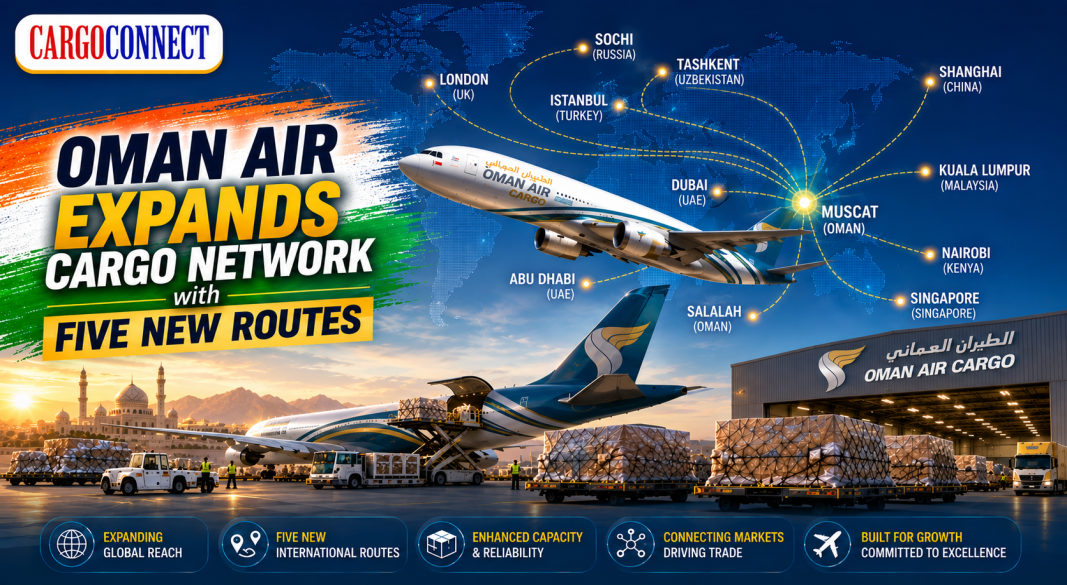
Oman Air has strengthened its global cargo footprint by launching five new routes within a single week, marking one of the airline’s most ambitious network expansion initiatives in recent years. The move is expected to improve cargo connectivity across Asia, Central Asia, the Middle East and Russia while enhancing the carrier’s ability to transport time-sensitive, high-value and temperature-sensitive shipments.
The expansion introduces new services from Muscat to Singapore, Tashkent, Sochi and Abu Dhabi, alongside a new Salalah-Dubai connection. Operated using Boeing 737 MAX 8 aircraft, the additional services provide greater flexibility for freight forwarders and shippers by increasing belly cargo capacity across strategically important trade corridors.
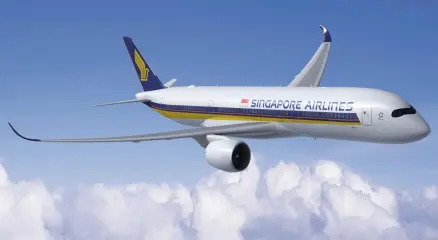
Among the newly launched destinations, Singapore and Tashkent are expected to play a pivotal role in supporting regional trade. Singapore serves as one of Asia’s leading logistics and transshipment hubs, while Tashkent strengthens Oman Air’s access to Central Asian markets. The Sochi route extends the airline’s reach into Russia, and the Abu Dhabi and Dubai connections further reinforce cargo flows within the Gulf Cooperation Council (GCC) region.
The expanded network also aligns with Oman Air Cargo’s strategy of growing its capabilities in transporting perishables and other temperature-controlled commodities. Improved connectivity is expected to facilitate the movement of fresh produce, seafood, pharmaceuticals and other high-value cargo requiring fast and reliable transit.
According to Michael Duggan, Head of Cargo at Oman Air, the new destinations provide customers with broader network options while supporting the efficient movement of time-critical shipments. He noted that expanding the airline’s perishables offering remains a strategic priority as customer demand for specialised cargo solutions continues to increase.
The new schedule includes four weekly services to Singapore, two weekly flights to Tashkent, daily operations to Abu Dhabi, and additional frequencies linking Salalah with Dubai and Muscat with Sochi. These services are designed to improve network flexibility while enabling smoother connections across Oman Air’s wider international network.
The latest expansion reflects Oman Air’s broader strategy of positioning Muscat as a regional logistics gateway connecting East and West. By strengthening its route network and increasing access to emerging trade markets, the airline aims to offer customers improved supply chain resilience, faster transit times and enhanced cargo solutions.
As global supply chains continue to diversify, expanded air cargo connectivity will play a crucial role in supporting international trade. Oman Air’s latest network additions are expected to strengthen its competitive position while creating new opportunities for exporters, importers and logistics providers seeking efficient access to high-growth markets across Asia and the Middle East.
𝐒𝐭𝐚𝐲 𝐓𝐮𝐧𝐞𝐝 𝐭𝐨 CARGOCONNECT 𝐟𝐨𝐫 𝐥𝐚𝐭𝐞𝐬𝐭 𝐮𝐩𝐝𝐚𝐭𝐞𝐬!
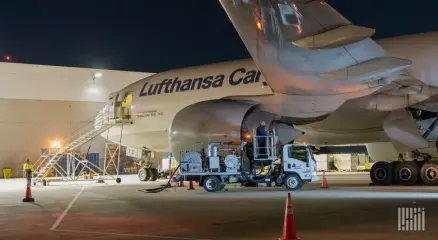
Lufthansa Cargo is reinforcing its focus on Asia as the region's manufacturing activity and export demand continue to underpin global air freight growth, with the Asia–Europe trade lane remaining a key component of its network strategy. Speaking about the carrier's regional priorities, Ashwin Bhat, Chief Executive Officer of Lufthansa Cargo, identified Asia as a major driver of air cargo demand, citing its strong production base and expanding trade flows. "Asia was and is and will be the powerhouse of air cargo in terms of production," Bhat said, underlining the airline's intention to align its network with emerging business opportunities across the region. The strategy is reflected in Lufthansa Cargo's expanded winter 2026/27 flight schedule, effective October 25. The carrier is offering up to 46 weekly freighter rotations to 17 destinations across Asia-Pacific, strengthening connections within the region as well as links to Europe and North America. Its network expansion includes additional intra-Asian and transpacific connections, with Singapore incorporated into an existing Frankfurt–Taipei freighter rotation. Additional services to Taipei and Chengdu, alongside the continuation of the Frankfurt–Ho Chi Minh City–Shanghai–Los Angeles route, are also supporting capacity across key trade corridors. India remains an important market in this expansion. Bhat confirmed that Lufthansa Cargo has increased capacity to the country in recent months, alongside its established presence in China, Japan and South Korea. The carrier has also shifted its Mumbai freighter operations to Navi Mumbai International Airport from October 12, citing infrastructure upgrades at the existing airport. The move is intended to maintain connectivity for industrial and manufacturing centres in the region. The airline is also strengthening its international partnerships. In November, Lufthansa Cargo, SWISS WorldCargo, All Nippon Airways and Nippon Cargo Airlines signed a Memorandum of Understanding to enhance cooperation in the Japan–Europe air cargo market, reflecting the importance of coordinated networks in serving major trading economies. The wider Lufthansa logistics division, which includes Lufthansa Cargo, time:matters, Jettainer, HeyWorld and a 50% stake in AeroLogic, recorded an 11% increase in volumes in the third quarter of 2026. The company attributed part of the growth to continued strong business in Asia-Pacific and the Americas. Disruptions to Middle Eastern airspace and airport operations earlier in the year also benefited direct Asia–Europe freighter services. With passenger belly capacity affected by cancellations and airspace restrictions, freighter operators were able to capture shipments that would otherwise have moved through Middle Eastern hubs. However, the resulting shift in cargo flows also highlighted the importance of network flexibility and alternative routing options. Meanwhile, regulatory changes in Europe are creating uncertainty for e-commerce shipments originating in China and Hong Kong. Following the introduction of a €3 charge on low-value imports from July 1, and an EU-wide handling fee on small parcels from November 1, Lufthansa Cargo is closely monitoring the implications for e-commerce volumes and conventional air freight flows. To support future demand, the carrier is also preparing to expand its freighter fleet. Its existing order book includes seven Boeing 777Fs, which will supplement the 18 aircraft already in its fleet, as well as seven next-generation Boeing 777-8 freighters, with the model's rollout to customers expected to begin in 2028. With Asia continuing to anchor global manufacturing and export activity, Lufthansa Cargo's strategy points to sustained investment in regional capacity, partnerships and long-haul freighter operations, even as shifting trade regulations and geopolitical disruptions reshape established air cargo corridors. Follow CARGOCONNECT for more such updates
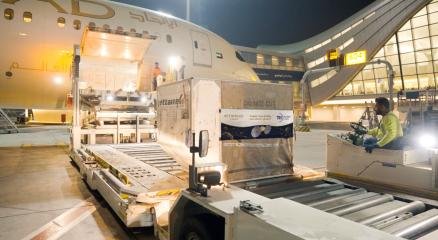


Newcastle Airport has strengthened its air cargo infrastructure with the opening of a new government-approved Border Control Post (BCP), enhancing its ability to handle regulated imports and expand its role as an international trade gateway in North East England. Worldwide Flight Services (WFS), a global air cargo logistics and ground handling provider, has opened the facility at its operational hub within the airport’s freight village. The new Border Control Post will enable regulated goods, including flowers, plants and plant products, fruits and vegetables, to undergo mandatory inspections and clearance directly at the airport. The facility is expected to improve the movement of time-sensitive and perishable consignments by allowing goods to be cleared closer to their final destinations. This will help importers and businesses reduce transit times, minimise logistics costs and improve supply chain efficiency. It also broadens the range of products that can enter the UK directly through Newcastle Airport, offering businesses across the region an additional route for international imports. The development forms part of Newcastle Airport’s wider strategy to strengthen its cargo handling capabilities. The airport currently handles more than 5,000 tonnes of freight annually and continues to invest in infrastructure and operational capacity to support growing demand. Earlier in 2026, Samson Aviation, the airport’s executive jet centre and handling partner, expanded its equipment fleet with the addition of a main deck loader and supporting ground service equipment. The investment has enhanced the airport’s ability to accommodate a wider range of narrowbody and widebody passenger, charter and cargo aircraft, while supporting specialised and oversized shipments, including heavy machinery and luxury vehicles. With 24-hour operations, on-site refuelling facilities, professional cargo handling services and direct access to the region’s strategic road network, Newcastle Airport is strengthening its proposition for cargo operators and freight forwarders. Commenting on the development, Leon McQuaid, Director of Aviation Development at Newcastle Airport, said: "The new Border Control Post marks another important milestone in the growth of Newcastle Airport's cargo services, strengthening our position as a gateway for international trade." He added that the investment by WFS would help businesses move goods more efficiently, provide faster market access and support economic growth across North East England and beyond. The latest development reinforces Newcastle Airport’s ambition to expand its cargo operations and attract further aviation and logistics businesses, positioning it as an increasingly important gateway for regional and international trade. 𝐒𝐭𝐚𝐲 𝐓𝐮𝐧𝐞𝐝 𝐭𝐨 CARGOCONNECT 𝐟𝐨𝐫 𝐥𝐚𝐭𝐞𝐬𝐭 𝐮𝐩𝐝𝐚𝐭𝐞𝐬!

Glasgow Prestwick Airport (PIK) is in discussions to establish a new cargo route with Nanjing Lukou International Airport (NKG) in China in 2027, as it looks to expand its direct connections with East Asia. The proposed link was discussed during a meeting in Nanjing involving PIK Chief Executive Officer Jules Matteoni, Regional Director Colin Dai, Ma Shiguang, Vice Governor of the People’s Government of Jiangsu Province, and local officials. The provincial government confirmed its backing for the proposed route. “China is an increasingly important part of our cargo network, and a direct link with Nanjing would strengthen the options available to businesses moving goods between the United Kingdom and one of China’s largest provincial economies,” said Matteoni. He added that PIK is working with partners in Jiangsu to develop a route capable of supporting long-term demand, strengthening trade links and creating economic opportunities at both ends. Discussions will now focus on the commercial and operational requirements of the proposed service. Details on the operator and launch schedule are expected to be announced in the coming months. Dai said the connection could provide businesses in Scotland and across the United Kingdom with greater access to the Chinese market, while supporting cargo flows in both directions. He also highlighted Jiangsu’s substantial manufacturing base as an opportunity to deepen trade and supply-chain links. PIK currently hosts more than 20 weekly scheduled services to China, with direct links to Ürümqi (URC), Guangzhou (CAN), Chengdu (CTU) and Shanghai (PVG). The proposed Nanjing connection would further strengthen the airport’s cargo links with China and build on its role as a freight and e-commerce gateway serving the United Kingdom and northwest Europe.