
Loading...
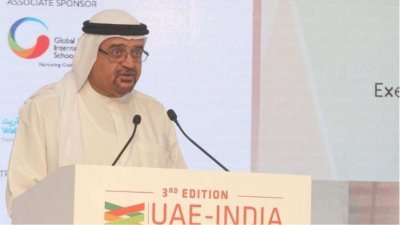
Dubai’s Sharaf Group has announced ambitious plans to expand its investments in India’s logistics, infrastructure, and food segments, capitalising on the country’s evolving business-friendly climate. Speaking at the UAE-India Economic Forum, Salah Sharaf, Group Executive Director of Sharaf Group, highlighted the company’s long-term strategy to enhance its presence in these key sectors over the next few years.
Sharaf Group has been actively involved in India’s logistics and railway sectors for several years, with operations in five logistics parks across the country. According to Salah Sharaf, the company is now looking to diversify and expand its logistics operations to ten more cities, seeing vast potential in India’s infrastructure landscape. “The two infrastructure-related fields will be the next areas of focus for the group,” he said, noting the significant room for development within the country’s logistics and infrastructure sectors.
Sharaf emphasised the need for enhanced infrastructure in India, pointing out existing inefficiencies that present opportunities for growth. “Although the country has evolved, it still has insufficient means,” Sharaf noted, adding that these challenges are precisely where Sharaf Group sees the greatest potential for expansion.
Beyond logistics and infrastructure, the Sharaf Group is setting its sights on the food industry, particularly in light of the growing UAE-India partnership on food security. This sector is seen as a strategic investment opportunity aligning with food security commitments made by both nations. Salah Sharaf announced that the company has signed a Memorandum of Agreement (MoA) to participate in the World Food India exhibition, an event that aims to foster partnerships within the food sector.
The strengthened UAE-India relations have been a driving factor behind Sharaf Group’s investment plans, bolstered by high-level diplomatic exchanges between the two countries. Sharaf praised the Indian government for its recent reforms, which have significantly reduced bureaucratic barriers that once deterred foreign direct investment (FDI). “The Indian government’s stance on foreign investment has changed 180 degrees from what it was nearly a decade ago,” he said, expressing optimism about the more favorable investment climate.
Sharaf Group’s focus on food security also aligns with the UAE’s growing interest in securing its food supply chain. Vice-Chairman Sharafuddin Sharaf noted the importance of the World Food India exhibition in enhancing cooperation between the two nations. “Being a partner in the World Food India exhibition shows how vital the food sector is in the relationship between the two countries,” he stated, adding that India’s positive stance toward FDI has been a significant factor in attracting foreign investors.
The Group’s expansion plans are a testament to the Indian government’s efforts to make the country an attractive destination for foreign investment, particularly in logistics, infrastructure, and food security. Both Salah and Sharafuddin Sharaf expressed optimism about their investments in India, crediting recent policy reforms for creating a more conducive environment for foreign investors.
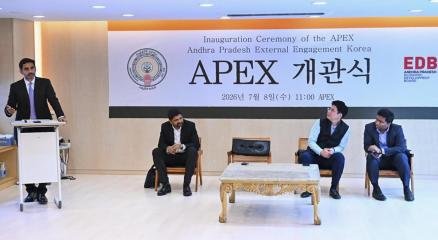
Andhra Pradesh government has inaugurated its first overseas investment facilitation centre in Busan, South Korea in a strategic move to strengthen global investment outreach and position itself as a preferred manufacturing and maritime hub. Named APEX Korea (Andhra Pradesh External Engagement – Korea), the centre has been established by the Andhra Pradesh Economic Development Board (APEDB) to serve as a dedicated platform for attracting Korean investments and supporting existing investors. The initiative marks a significant milestone in the state's international engagement strategy, creating a permanent institutional presence in one of Asia's leading industrial economies. Located in Busan, South Korea's maritime and commercial capital, APEX Korea will provide end-to-end support to Korean companies exploring investment opportunities in Andhra Pradesh, facilitate project implementation, and offer investor aftercare services to ensure long-term business partnerships. The launch coincided with Andhra Pradesh Minister for Education, IT and Electronics Nara Lokesh's investment outreach visit to South Korea, where he invited leading Korean maritime equipment manufacturers to participate in the proposed ₹30,000-crore Dugarajapatnam Shipbuilding Cluster. Speaking at a maritime investment roundtable organised by the Korea Marine Equipment Association (KOMEA), Lokesh highlighted Andhra Pradesh's strategic advantages, including its 1,053-km coastline, expanding port infrastructure, industrial ecosystem and investor-friendly policies. The state also proposed deeper collaboration between KOMEA and the Andhra Pradesh Maritime Board through initiatives such as a Korea Marine Equipment Desk, an India Ship Technology Centre, joint skill development programmes and collaborative research and innovation projects. These initiatives aim to strengthen technology transfer and build a globally competitive maritime manufacturing ecosystem. Beyond maritime manufacturing, Andhra Pradesh expanded its engagement with South Korean companies in the footwear and financial services sectors. During discussions with the Hwaseung Group, the government encouraged the company to expand its proposed ₹900-crore footwear manufacturing project in Kuppam by establishing component manufacturing facilities, an advanced R&D centre and an integrated footwear cluster. The Boo Young Group also expressed interest in exploring manufacturing opportunities in the state. The delegation also met representatives of BNK Financial Group, inviting the institution to explore financing opportunities across infrastructure, innovation and industrial development while connecting global investors with projects in Andhra Pradesh. With dedicated support for foreign investors and targeted outreach to globally competitive industries, the initiative is expected to strengthen foreign direct investment inflows while supporting the state's ambitions of becoming a leading hub for maritime manufacturing, shipbuilding, logistics and export-oriented industries. 𝐒𝐭𝐚𝐲 𝐓𝐮𝐧𝐞𝐝 𝐭𝐨 CARGOCONNECT 𝐟𝐨𝐫 𝐥𝐚𝐭𝐞𝐬𝐭 𝐮𝐩𝐝𝐚𝐭𝐞𝐬!
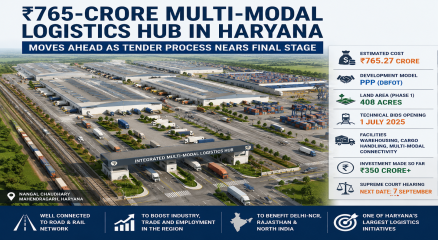
Technical bids for the Mahendragarh logistics project are scheduled to be opened on July 1, bringing one of Haryana’s largest infrastructure initiatives closer to execution. The proposed Integrated Multi-Modal Logistics Hub (IMLH) at Nangal Chaudhary in Mahendragarh district has reached an important milestone, with technical bids for its global tender set to be opened on July 1 in Chandigarh. Estimated at ₹765.27 crore, the project is expected to significantly strengthen logistics and freight infrastructure across northern India. The tender, floated in August 2025 by Haryana Multi-Modal Logistics Hub Project Limited, seeks a private developer under the Public-Private Partnership (PPP) framework using the Design, Build, Finance, Operate and Transfer (DBFOT) model. Interested firms have until 5 pm on June 30 to submit their online bids before the technical evaluation begins. The first phase of the project will be developed over around 408 acres, where modern cargo handling, warehousing and freight distribution facilities will be established. Once operational, the hub is expected to improve supply chain efficiency by integrating road and rail connectivity, reducing logistics costs and enabling faster movement of goods. Preparatory infrastructure for the project has already seen substantial progress. Rail connectivity through the New Dabla Railway Station, a 220 kV dedicated power line, a canal-based water supply from Narnaul, and road access from the National Highway have already been created. Construction of the internal railway track and cargo platform is also nearing completion. The rail infrastructure developed during the first phase has involved an investment of nearly ₹200 crore, laying the groundwork for large-scale freight operations. Authorities expect the logistics hub to attract fresh industrial investment and strengthen manufacturing activity across the region. Besides enhancing freight movement, the project is anticipated to generate considerable direct and indirect employment opportunities. It is also expected to benefit industries located in Delhi-NCR, Rajasthan, Haryana, and other parts of North India by offering modern logistics and warehousing infrastructure. Despite steady progress, a portion of the project remains subject to legal proceedings. The Supreme Court, while hearing a petition filed by 91 farmers, recently ordered a temporary stay on construction activities across 129 acres of the project land until September 7. At the same time, the court clarified that the order does not restrict the Haryana government from continuing statutory procedures under the Right to Fair Compensation and Transparency in Land Acquisition, Rehabilitation and Resettlement Act, 2013. The next hearing in the matter is scheduled for September 7. The logistics hub is being implemented through a special purpose vehicle (SPV), NICDC Haryana Multi-Modal Logistics Hub Project Limited. Since the project's inception in 2018, nearly 1,000 acres have been acquired. Around ₹150 crore has been spent on land acquisition, while another ₹200 crore has gone into developing enabling infrastructure. With the global tender process now entering its concluding phase, the project is moving closer to construction and is expected to become a major logistics gateway supporting industrial growth and multimodal transportation across the region.

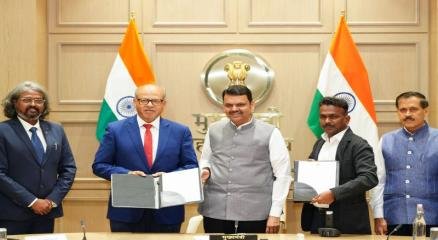
RSA Global has signed a Memorandum of Understanding with the Government of Maharashtra to develop India's largest automated empty container yard, a 62-acre facility worth ₹2,580 crore at Uran, Raigad, built within the heart of the Jawaharlal Nehru Port (JN Port) ecoystem, reinforcing the nation’s efforts to modernise port-led logistics and improve container management efficiency. The project is expected to set new benchmarks in automation, sustainability, and operational productivity. The facility will be developed on a 62-acre land parcel near JN Port under a long-term concession agreement. Designed as a state-of-the-art automated storage and retrieval system (ASRS)-based yard, the project aims to address one of the most persistent challenges in container logistics—the efficient handling, storage, maintenance, and repositioning of empty containers. JN Port currently handles around one million TEUs of empty containers annually, making the development strategically important for optimising container flows, and reducing congestion across the port ecosystem. The automated yard will leverage advanced technologies, including mechanised container stacking systems, gate automation, terminal operating systems, and real-time container tracking capabilities. These features are expected to significantly improve yard productivity, minimize turnaround times, and enhance visibility across the container supply chain. The project will also incorporate a truck appointment system to streamline vehicle movement and reduce traffic bottlenecks in and around the port area. RSA Global, a Dubai-headquartered logistics and supply chain solutions provider, plans to transform the facility into a future-ready logistics asset capable of supporting India’s rapidly growing export-import trade. The company has indicated that the project aligns with its broader strategy of deploying technology-driven logistics infrastructure that enhances supply chain resilience and efficiency. Ajay I. Shah, Chairman & Co-Founder, RSA Global, said, "India's trade ambitions are written in its ports, and empty container handling as long been the unglamorous bottleneck holding them back. We're investing to fix exactly that bringing automation, transparency and world-class infrastructure to the JNPA ecosystem, in partnership with the Government of Maharashtra.” For JN Port, India’s largest container gateway, the development represents another milestone in its ongoing infrastructure expansion and digital transformation agenda. The port has been actively investing in capacity augmentation, multimodal connectivity, and technology adoption to strengthen its position as a leading trade hub in South Asia. The automated empty container yard is expected to complement these initiatives by creating a centralised, high-capacity facility for managing empty containers more effectively. Industry stakeholders believe the project could significantly reduce logistics costs, improve equipment availability for exporters, and support the government’s broader objective of enhancing ease of doing business through world-class logistics infrastructure. Once operational, the facility is expected to emerge as a critical node in India’s container logistics network, setting a new standard for automated container yard operations in the country. 𝐒𝐭𝐚𝐲 𝐓𝐮𝐧𝐞𝐝 𝐭𝐨 CARGOCONNECT 𝐟𝐨𝐫 𝐥𝐚𝐭𝐞𝐬𝐭 𝐮𝐩𝐝𝐚𝐭𝐞𝐬!