
Loading...
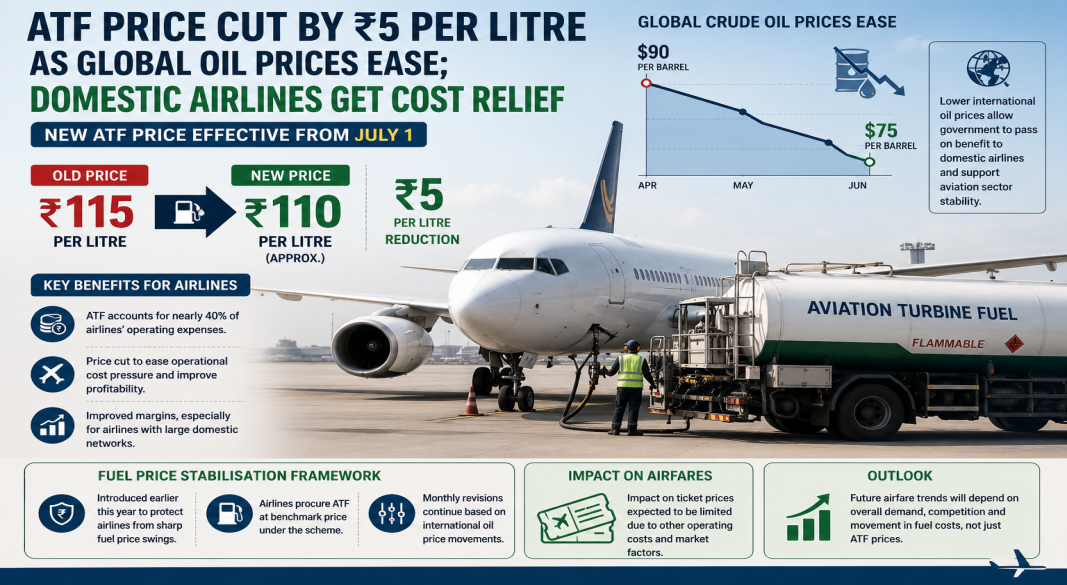
Domestic airlines will pay less for aviation turbine fuel (ATF) from July 1 after the government reduced jet fuel prices by nearly ₹5 per litre, bringing the rate to around ₹110 per litre. The revision follows a decline in international crude oil prices and is expected to provide operational cost relief to airlines after a period of elevated fuel prices.
ATF is one of the largest cost components for airlines, accounting for nearly 40% of their operating expenses. The latest reduction is expected to ease financial pressure on carriers, although industry observers say the impact on passenger airfares is likely to be limited as airlines continue to manage other operating costs.
The monthly revision comes after the government introduced a fuel price stabilisation framework earlier this year to shield domestic airlines from sharp swings in global jet fuel prices. Under the mechanism, participating carriers procure ATF at a benchmark price, while periodic adjustments continue to reflect movements in international oil markets.
The reduction follows a moderation in global crude oil prices after recent volatility linked to geopolitical tensions. Lower international fuel prices have allowed authorities to pass on part of the benefit to domestic airlines while maintaining the broader objective of ensuring fare stability and uninterrupted air connectivity.
Industry experts believe the latest price cut will improve airline margins, particularly for carriers operating large domestic networks. However, any significant reduction in ticket prices will depend on overall market demand, competition and future movements in fuel costs rather than ATF prices alone.
Follow CARGOCONNECT for more such updates.

Delhi’s Indira Gandhi International Airport has expanded its transshipment cargo network to four additional domestic origin stations and two international destinations, strengthening its role as a potential air cargo hub between eastern and western markets. Civil Aviation Minister Ram Mohan Naidu on August 19 flagged off the scaled-up phase of India’s transshipment cargo reform at Delhi International Airport Limited’s (DIAL) Transshipment Excellence Centre (TEC) at Terminal 2. The expanded network will now connect Bengaluru, Ahmedabad, Mumbai and Hyderabad with London and Copenhagen, following the successful completion of a proof-of-concept project on the Chennai-Delhi-Frankfurt route. The proof of concept for domestic-to-international transshipment began on June 20, 2026, with Air India operating the service end-to-end. Since its launch, around 280 metric tonnes of cargo have been transshipped through the Delhi facility, while aircraft capacity utilisation increased from 75 per cent to nearly 100 per cent. According to the Civil Aviation Ministry, the expansion is expected to increase Air India’s monthly cargo carriage on the covered routes from 1,763 metric tonnes to 3,183 metric tonnes, representing an increase of nearly 80 per cent. Speaking at the Transshipment Excellence Centre at Terminal 2 of IGI Airport, Naidu said the reform was aimed at reducing turnaround time, handling costs and congestion at cargo terminals. The proof-of-concept exercise demonstrated a significant reduction in average end-to-end transit time on the Chennai-Delhi-Frankfurt route, from around 60 hours to 20 hours. The government was working to expand the model further and eventually establish India as a global air cargo transshipment hub by leveraging the country’s geographical position between eastern and western markets, he said “While our immediate focus is on Domestic-to-International transshipment, our larger ambition is to position India as a global cargo transshipment hub,” Naidu said, adding that the framework would subsequently be expanded to International-to-International and International-to-Domestic transshipment. The reform follows a revised framework notified through Addendum-II to AVSEC Circular No. 6/2024 by the Bureau of Civil Aviation Security (BCAS) on July 21, 2025. Under the framework, secured transshipment cargo can be moved through dedicated Transfer Cargo Security Hold Areas (TCSHAs) without mandatory re-screening, subject to prescribed security safeguards. Naidu said the removal of mandatory re-screening had addressed a long-standing industry concern and was helping improve the efficiency and competitiveness of India’s air cargo ecosystem. He also said the initiative was part of the government’s broader effort to develop major Indian airports as global transit hubs. Following the strengthening of hub-and-spoke operations for passengers, similar measures are being undertaken to build India’s air cargo hub capabilities. The Minister congratulated Delhi International Airport Limited (DIAL), BCAS, CISF, airlines, Customs and other stakeholders for their coordination in implementing the reform. The ministry said additional domestic origin stations and international destinations are expected to be brought under the framework in the coming months, further expanding India’s air cargo connectivity and strengthening its position as a competitive global aviation hub. The event was attended by Civil Aviation Secretary Samir Kumar Sinha, Airports Authority of India Chairman Vipin Kumar, Joint Secretary in the Ministry of Civil Aviation Asangba Chuba Ao, BCAS Joint Director General Pratibha Ambedkar and senior officials from the ministry, AAI, BCAS, DIAL, Air India and other stakeholders. 𝐒𝐭𝐚𝐲 𝐓𝐮𝐧𝐞𝐝 𝐭𝐨 CARGOCONNECT 𝐟𝐨𝐫 𝐥𝐚𝐭𝐞𝐬𝐭 𝐮𝐩𝐝𝐚𝐭𝐞𝐬!



Air India has announced the appointment of Tewolde Gebremariam as its new Chief Executive Officer (CEO) and Managing Director (MD), marking a leadership transition as the Tata Group-owned airline advances its long-term transformation strategy. The appointment, approved by the airline's Board, follows an extensive global search and comes after the resignation of Campbell Wilson, who will continue in his role until September 30, 2026, to ensure a smooth leadership handover. Gebremariam, one of the aviation industry's most respected executives, brings more than three decades of airline leadership experience. He is best known for leading Ethiopian Airlines Group for over a decade, during which he transformed the carrier into Africa's largest and one of its most successful airlines through fleet expansion, network growth, operational excellence and strong financial performance. His career also includes senior leadership roles across commercial operations, cargo, ground services and strategic planning, making him well-equipped to steer Air India's next growth phase. Welcoming the appointment, N. Chandrasekaran, Chairman of Tata Sons and Air India, said: "On behalf of the Board, I am delighted to welcome Tewolde to Air India. Having completed the initial phase of stabilization, integration, and fleet commitments under Campbell's guidance, Air India is now entering a critical execution and expansion era. Tewolde’s operational expertise, commitment to safety, and vision for hub development will be instrumental as we establish Air India as a premier global carrier and a source of national pride." Expressing his enthusiasm, Tewolde Gebremariam, Incoming CEO & Managing Director, said: "It is a profound honour to be entrusted with leading Air India at such a historic moment in its journey. Air India carries an incredible legacy, and the opportunity to build a world-class global airline that reflects India’s extraordinary economic potential is uniquely exciting. I look forward to working closely with Chairman Chandrasekaran, the Board, our employees, and all government and industry partners to deliver exceptional operational reliability, warm Indian hospitality, and sustained long-term growth." The appointment comes at a pivotal time for Air India as it continues its multi-year transformation following its return to the Tata Group in 2022. Over the past four years, the airline has consolidated four carriers, modernised its operations, strengthened its leadership team, initiated a large-scale fleet renewal programme, introduced upgraded cabin products and significantly expanded its aircraft order book. For the aviation, supply chain and air cargo ecosystem, Gebremariam's appointment is expected to strengthen Air India's operational efficiency and network capabilities. His proven expertise in airline turnaround, fleet planning and cargo development is likely to support the carrier's ambition of becoming a globally competitive full-service airline while reinforcing India's growing position in international aviation and logistics. 𝐒𝐭𝐚𝐲 𝐓𝐮𝐧𝐞𝐝 𝐭𝐨 CARGOCONNECT 𝐟𝐨𝐫 𝐥𝐚𝐭𝐞𝐬𝐭 𝐮𝐩𝐝𝐚𝐭𝐞𝐬!
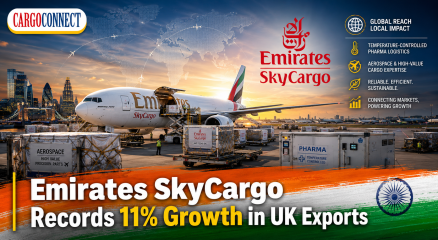
Emirates SkyCargo has reported an 11% increase in export volumes from the United Kingdom, underscoring the growing global demand for high-value and time-sensitive cargo such as aerospace components, pharmaceutical products and premium food items. The growth reflects the airline’s expanding role in facilitating international trade while strengthening supply chain connectivity between the UK and key markets across the Middle East, Asia, Africa and Australasia. The carrier currently serves the UK through a combination of scheduled passenger flights and dedicated freighter operations, linking seven major gateways with its global network via Dubai. This extensive connectivity has enabled British exporters to move critical shipments efficiently to more than 145 destinations, supporting industries that rely on speed, reliability and product integrity. According to Emirates SkyCargo, aerospace shipments have emerged as one of the fastest-growing cargo segments, driven by increasing global demand for aircraft components, engines and maintenance parts. The airline has continued to invest in specialised logistics capabilities for the aerospace industry, ensuring secure handling and rapid transportation of high-value equipment. This aligns with the broader recovery and expansion of the global aviation sector, which continues to fuel demand for precision logistics solutions. Pharmaceutical exports have also witnessed robust growth, with UK manufacturers leveraging Emirates SkyCargo’s temperature-controlled infrastructure and certified cold-chain services to transport vaccines, medicines and life sciences products. The carrier has consistently expanded its pharma logistics capabilities to meet stringent quality and compliance requirements for healthcare shipments worldwide. In addition to industrial and healthcare products, premium British food exports, including fresh berries, seafood, dairy products and gourmet ingredients have seen rising demand across international markets. Fast transit times and dedicated perishables handling have enabled exporters to preserve product freshness while reaching consumers in distant markets within short delivery windows. Hence, the latest growth in UK exports highlights the increasing importance of resilient air cargo networks as businesses seek faster and more dependable logistics solutions for high-value goods. For Emirates SkyCargo, the performance also reinforces its strategy of investing in specialised cargo products, expanded freighter capacity and industry-focused logistics services to support evolving global trade patterns. 𝐒𝐭𝐚𝐲 𝐓𝐮𝐧𝐞𝐝 𝐭𝐨 CARGOCONNECT 𝐟𝐨𝐫 𝐥𝐚𝐭𝐞𝐬𝐭 𝐮𝐩𝐝𝐚𝐭𝐞𝐬!