
Loading...
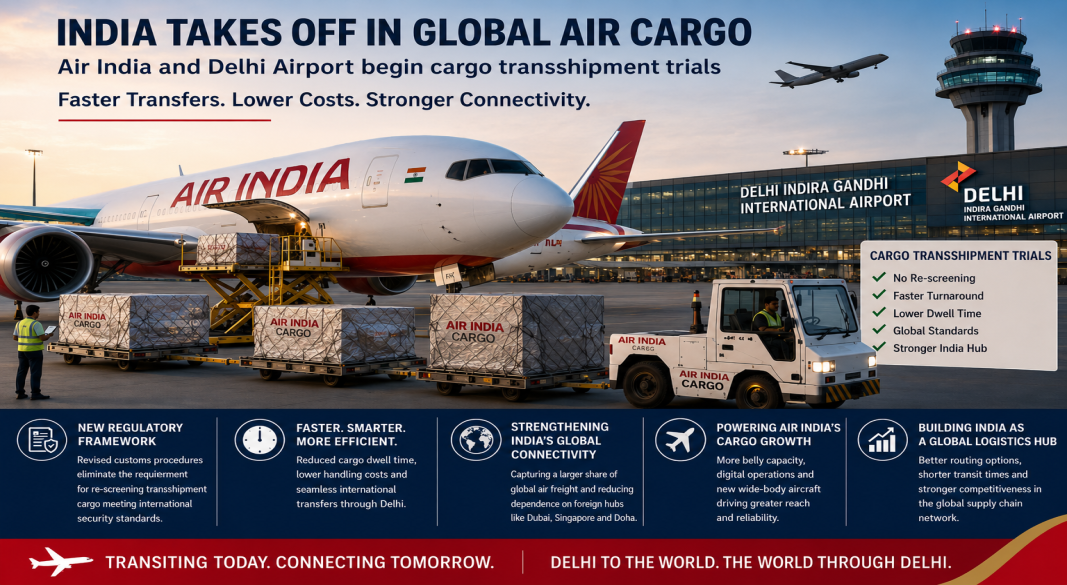
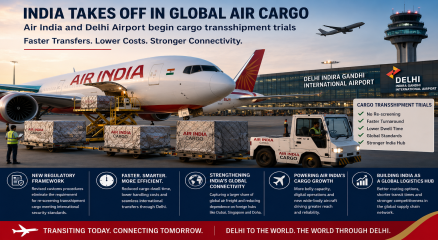
Air India and Delhi's Indira Gandhi International Airport have started cargo transshipment trials under a new regulatory framework aimed at increasing India's share of global air freight by simplifying the movement of international transit cargo through the country.
The trials are being conducted following the introduction of revised customs procedures that eliminate the requirement for re-screening transshipment cargo at Indian airports, provided shipments meet prescribed international security standards. The change is expected to reduce cargo dwell time, lower handling costs and improve the efficiency of international cargo transfers.
Under the pilot, inbound international cargo arriving in Delhi will be transferred to connecting Air India flights for onward movement to overseas destinations without undergoing repeated security checks. The initiative is designed to test operational readiness and establish standard operating procedures before scaling up transshipment operations.
India currently handles only a small proportion of global air cargo transshipment, with a significant volume of international freight routed through established hubs such as Dubai, Singapore and Doha. By enabling faster cargo transfers through Delhi, Air India and airport operator DIAL aim to capture a larger share of transit cargo while strengthening the airport's role as a regional logistics gateway.
The initiative also supports Air India's broader cargo expansion strategy, which includes increasing belly cargo capacity through the induction of new wide-body aircraft and enhancing digital cargo operations. Improved transshipment capabilities are expected to provide exporters and freight forwarders with additional routing options while reducing dependence on foreign hub airports.
If the trials prove successful, the new transshipment process could improve cargo connectivity, shorten transit times and strengthen India's competitiveness in the global air cargo and supply chain network as the country seeks to establish itself as a major international logistics hub.
Follow CARGOCONNECT for more such updates.

Air India Cargo has successfully completed the first international export shipment from Navi Mumbai International Airport (NMIA), marking a significant milestone in India's evolving air cargo landscape. The inaugural shipment, comprising premium Ratnagiri Alphonso mangoes sourced from Maharashtra's Konkan region, was transported to Abu Dhabi aboard an Air India Express flight, highlighting the airport's growing role as a strategic cargo gateway for western India. The milestone comes shortly after Navi Mumbai International Airport commenced international passenger and cargo operations, reinforcing its position as a critical logistics hub designed to complement and decongest Mumbai's existing aviation infrastructure. Industry observers believe the development will significantly enhance export connectivity for perishable goods, pharmaceuticals, engineering products and other high-value cargo originating from Maharashtra and neighbouring states. The first export consignment reflects Air India Cargo's focus on strengthening India's agricultural exports by providing faster and more reliable access to international markets. Fresh Alphonso mangoes, renowned globally for their superior quality and flavour, require temperature-controlled handling and rapid transit to preserve freshness. The direct air cargo link to Abu Dhabi is expected to reduce transit time while improving product quality upon arrival. According to Air India, the shipment underscores the airline's commitment to supporting Indian exporters by leveraging its expanding cargo network and the operational capabilities of Air India Express. The initiative also aligns with the government's broader objective of improving multimodal logistics infrastructure and boosting agricultural exports through enhanced air freight connectivity. The commencement of international cargo operations at NMIA is expected to create new opportunities for exporters across sectors. Besides perishables, the airport is well-positioned to handle pharmaceuticals, electronics, textiles, automotive components and express cargo, benefiting from its proximity to industrial clusters and major manufacturing centres in western India. Logistics experts believe Navi Mumbai's modern cargo infrastructure, combined with dedicated handling facilities and improved road connectivity, will ease congestion at Mumbai's Chhatrapati Shivaji Maharaj International Airport while offering exporters additional capacity and operational flexibility. The airport is also expected to play an increasingly important role as freighter operations gradually shift to Navi Mumbai in the coming months. As India's air cargo market continues to expand, the successful launch of international export operations from Navi Mumbai represents more than just an inaugural shipment. It signals the emergence of a new logistics gateway capable of supporting India's export ambitions, strengthening supply chains and improving global market access for Indian businesses. 𝐒𝐭𝐚𝐲 𝐓𝐮𝐧𝐞𝐝 𝐭𝐨 CARGOCONNECT 𝐟𝐨𝐫 𝐥𝐚𝐭𝐞𝐬𝐭 𝐮𝐩𝐝𝐚𝐭𝐞𝐬!


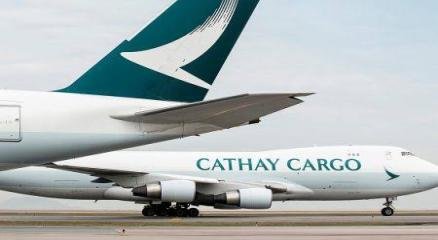
Cathay Cargo has become the first international airline to formally shift its dedicated freighter operations from Mumbai’s Chhatrapati Shivaji Maharaj International Airport (CSMIA) to Navi Mumbai International Airport (NMIA), marking a significant milestone in India’s evolving air cargo landscape. The transition, scheduled to take effect from August 3, is expected to set the stage for other global cargo carriers as Mumbai undergoes major airport infrastructure upgrades. The relocation is a temporary operational measure necessitated by extensive runway rehabilitation, taxiway development and apron reconstruction at CSMIA. The airport has announced the suspension of dedicated freighter operations between August 2026 and May 2027, with cargo flights being redirected to NMIA, which has been developed to accommodate the shift without disrupting cargo connectivity. Cathay Cargo confirmed that its existing three-times-a-week summer freighter service to Mumbai will continue without any change in frequency, with only the operating airport shifting to NMIA. The airline stated that the move is subject to operational requirements and aims to ensure uninterrupted cargo services during the infrastructure enhancement period at Mumbai’s primary airport. The development is being viewed as a landmark moment for NMIA, which is preparing to commence international cargo operations alongside international passenger services. Designed with modern cargo handling infrastructure and future expansion capabilities, the airport is expected to strengthen western India’s position as a key logistics gateway for global trade. Industry observers believe the migration of freighter services will accelerate the creation of a robust cargo ecosystem around NMIA, attracting airlines, freight forwarders, ground handlers and logistics service providers. Cathay Cargo’s decision also reflects its long-term commitment to the Indian market. The Hong Kong-based carrier has consistently expanded its presence in India, recognising the country’s growing importance as a global manufacturing and export hub. With dedicated freighter services connecting major Indian cities to its Hong Kong hub and onward global network, the airline continues to support sectors such as electronics, pharmaceuticals, perishables, engineering goods and e-commerce. As additional international cargo airlines prepare to relocate operations in the coming months, NMIA is expected to emerge as a strategic air cargo gateway capable supporting India's international trade growth. 𝐒𝐭𝐚𝐲 𝐓𝐮𝐧𝐞𝐝 𝐭𝐨 CARGOCONNECT 𝐟𝐨𝐫 𝐥𝐚𝐭𝐞𝐬𝐭 𝐮𝐩𝐝𝐚𝐭𝐞𝐬!

A new, entry-level, cabin bag-only fare for Economy Class across IndiGo's direct domestic and international flights. IndiGo, India’s preferred airline, has announced a new fare option - ‘IndiGo Lite’, for its Economy Class customers, as an addition to its fit-for-purpose product portfolio. This entry level fare allows customers with only cabin-baggage to pay just for the utilized services offering greater flexibility and control over their travel spends. IndiGo Lite fare will be available for booking exclusively on IndiGo’s direct channels including the website, mobile application and contact centre, starting 1 July 2026 for travel effective 15 July 2026. It will be applicable across domestic and international, non-stop routes for one-way, roundtrip, and multicity journeys, for both adult and child passengers. IndiGo Lite builds on IndiGo’s continued focus on delivering tailored offerings to cater to the evolving needs of diverse travellers across India and globally. Customers will enjoy a lower base price with an auto-assigned seat at no additional cost, and a cabin bag allowance of up to 7 kgs. It also offers customers the flexibility to personalize their journey through optional add-ons, enabling them to purchase services such as check-in baggage, preferred seats, meals, or priority services like Fast Forward. These services can be added up to one hour prior to departure through IndiGo’s website or at the airport. IndiGo Lite travellers will continue to earn and redeem IndiGo BluChip points ensuring that the benefits of IndiGo's loyalty programme remain accessible across every fare type. Aloke Singh, Chief Strategy Officer, IndiGo, said, “At IndiGo, we continuously evolve our product offerings to stay aligned with the changing expectations of our diverse customer segments. Designed for customers who travel light and would like to pay only for the services they need, IndiGo Lite is another step towards building a strong, fit-for-purpose product portfolio. This reflects our agility in responding to the market dynamics while reinforcing our commitment to making travel more accessible and affordable for our customers.” With this addition, IndiGo’s 6E Ways to Fly portfolio now offers a wider spectrum of choices along with Saver, Flexi Plus, IndiGo UpFront, IndiGoStretch and Stretch+. This brings greater customization, empowering customers to select the combination that best suits their travel preferences, comfort and budget.