
Loading...
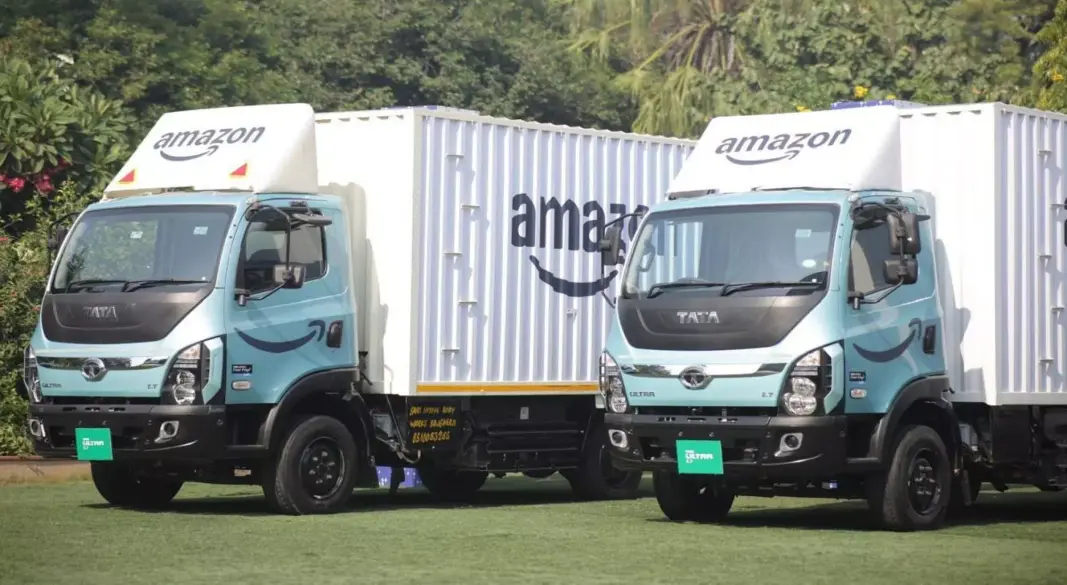
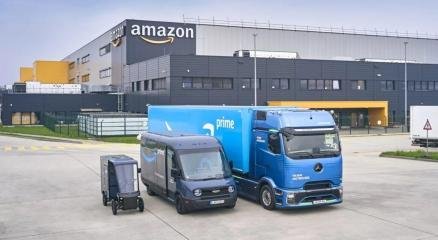
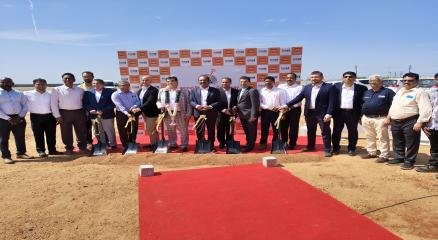
Amazon has partnered with Tata Motors to deploy 3,000 electric trucks across its transportation network in India, marking what the companies describe as the largest electric-truck deployment by an e-commerce company in the country. The rollout will begin in Delhi during the festive season, with light- and medium-duty electric trucks, including the Tata Ultra E.7, operating across Amazon's middle-mile logistics network. The vehicles will transport shipments between fulfilment and logistics facilities and support freight movement within and between cities.
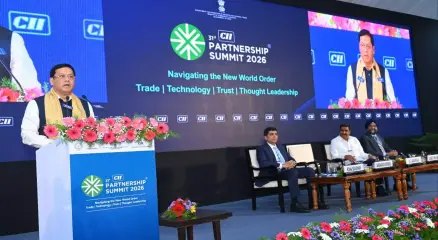
The next phase is planned to extend electric truck operations along a 2,800-km freight corridor connecting Delhi, Bengaluru and Chennai via National Highway 48 (NH48), linking major commercial and e-commerce markets across northern and southern India. Tata Motors will supply the vehicles, while Amazon's transportation service partners will own and operate the trucks. Union Minister for Heavy Industries and Steel H.D. Kumaraswamy flagged off the initial batch in Delhi.
Electric trucking expands beyond last-mile delivery
The partnership marks a significant expansion of Amazon's fleet electrification programme, extending its focus beyond delivery vans and smaller electric vehicles to commercial freight transportation. Amazon said it already operates more than 15,000 electric vehicles across over 500 cities in India. The planned electric truck deployment will add capacity to its middle-mile network, which connects logistics facilities and supports the movement of shipments between operational hubs.
Abhinav Singh, Vice President of Operations at Amazon, said electrifying the company's transportation network was an important part of its commitment to achieve net-zero carbon emissions by 2040. He noted that scaling electric trucking would require collaboration across vehicle manufacturing, charging infrastructure and logistics operations, with the partnership intended to support deployment across additional routes.
Tata Motors to supply trucks and operational support
Tata Motors will provide the electric trucks, including the Tata Ultra E.7, designed for urban and regional freight operations. Features include fast-charging capability and regenerative braking. Rajesh Kaul, Vice President and Business Head – Trucks at Tata Motors, said electric trucking was moving beyond pilot projects towards wider commercial adoption. He highlighted vehicle localisation, operating economics and total cost of ownership as factors supporting the business case for electric commercial vehicles. The partnership will also extend beyond vehicle supply, with charging infrastructure, servicing and operational support forming part of the wider deployment effort.
Charging infrastructure to support expansion
The companies are working to develop the infrastructure needed to support electric truck operations along urban routes and longer freight corridors. Amazon is working with charging infrastructure provider Yahhvi, with 10 charging yards developed across India to support electric vehicle operations.
Reliable charging access will be important as deployment expands from shorter middle-mile routes towards longer intercity freight operations. Fleet performance will depend on the availability of charging facilities, route planning, vehicle utilisation and coordination between charging and delivery schedules. The planned Delhi–Bengaluru–Chennai corridor is intended to connect major commercial hubs and provide a framework for expanding electric freight operations across key highways.
Policy support and freight decarbonisation
The initiative comes amid wider efforts to promote electric mobility in commercial transport. Delhi's Electric Vehicle Policy 2026 included a provision exempting the first 1,000 eligible privately owned N2 electric trucks, purchased and registered within three months of the policy's notification, from normal no-entry timing restrictions for 10 years.
The policy was notified on 30 June 2026. The three-month registration window should therefore not be treated as an ongoing incentive without updated official guidance. Amazon is also supporting freight decarbonisation through initiatives such as Laneshift, developed in collaboration with C40 Cities, and SUPEREV, which seeks to simplify commercial electric vehicle adoption by connecting relevant services and stakeholders.
Scaling operations will be the next test
Large-scale electric freight deployment depends on more than vehicle availability. Charging access, vehicle uptime, maintenance support, fleet economics and reliable operating schedules will all influence how quickly electric trucks can be integrated into commercial logistics.
For Amazon and Tata Motors, the 3,000-truck plan represents an effort to move electric freight towards wider operational adoption. The initial rollout in Delhi will be followed by plans to extend operations to major highway corridors, including the proposed Delhi–Bengaluru–Chennai route. The success of the initiative will ultimately depend on how effectively the trucks and supporting infrastructure deliver reliable, cost-efficient freight movement at scale.
Follow CARGOCONNECT for more such updates

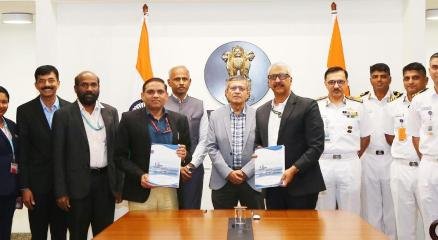
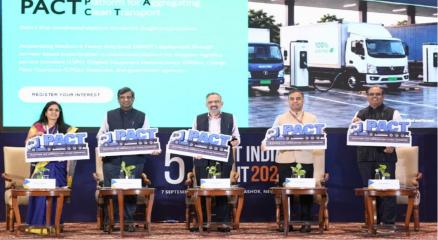
NITI Aayog and Germany’s international cooperation agency, Deutsche Gesellschaft für Internationale Zusammenarbeit (GIZ) GmbH, have signed an implementation agreement to accelerate the decarbonisation of India's road freight sector, with a focus on promoting electric medium- and heavy-duty trucks. The agreement was signed on November 3, 2026, under the second phase of the Nationally Determined Contribution–Transport Initiative for Asia (NDC-TIA II). The regional initiative is supported by the German Government's International Climate Initiative (IKI) and aims to support participating countries in reducing transport-related emissions and advancing their climate commitments. The collaboration comes at a time when India is seeking to transition towards a more sustainable, energy-efficient and low-carbon transportation ecosystem. Road freight remains critical to the country's supply chain and logistics operations, making the adoption of cleaner commercial vehicles an important part of its broader decarbonisation strategy. However, the electrification of medium- and heavy-duty freight vehicles remains at an early stage. Limited charging infrastructure, high upfront vehicle costs, access to financing and the need for supportive regulations continue to present challenges to wider adoption. The NITI Aayog–GIZ partnership will focus on addressing these structural barriers by supporting the development of adequate charging infrastructure, exploring innovative financing mechanisms and strengthening the regulatory framework required to facilitate electric truck deployment. The initiative brings together several knowledge and implementation partners, including World Resources Institute (WRI) India, the International Council on Clean Transportation (ICCT) India and Agora Energiewende. Their participation is expected to support policy development, technical expertise and coordinated efforts towards cleaner freight transportation. The regional programme also covers China and Vietnam, encouraging collaboration on transport decarbonisation across Asia. For India's logistics industry, the partnership could help create a more conducive environment for fleet electrification, particularly across high-volume freight corridors connecting manufacturing centres, ports and distribution hubs. Improved charging access and financing options will be essential to building confidence among fleet operators and logistics service providers. The agreement marks another step in India's efforts to advance green freight mobility, strengthen energy efficiency and meet its Nationally Determined Contribution (NDC) targets. By addressing infrastructure, financing and policy challenges together, the collaboration aims to support the gradual transition towards a commercially viable and lower-emission road freight ecosystem. 𝐒𝐭𝐚𝐲 𝐓𝐮𝐧𝐞𝐝 𝐭𝐨 CARGOCONNECT 𝐟𝐨𝐫 𝐥𝐚𝐭𝐞𝐬𝐭 𝐮𝐩𝐝𝐚𝐭𝐞𝐬!
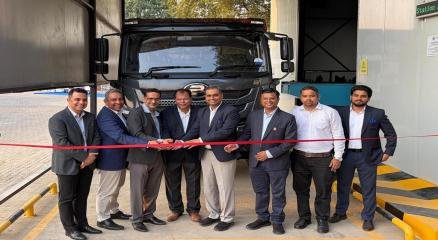
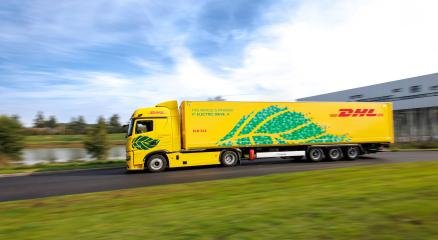
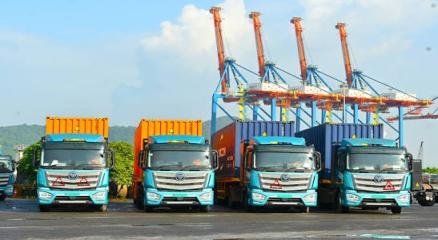
Energy In Motion Ltd (EIM) has inaugurated a ₹500-crore electric heavy commercial vehicle manufacturing complex in Talegaon, Pune to expand electric freight mobility in India. The facility integrates vehicle assembly, lithium-ion battery-pack manufacturing and battery testing, with an initial annual assembly capacity of 5,000 vehicles per shift. Inaugurated by Maharashtra Chief Minister Devendra Fadnavis, the complex forms part of EIM’s planned ₹1,000-crore investment in the state. The project is expected to generate more than 2,000 direct and indirect jobs, while supporting the development of capabilities in engineering, research and development, and information technology. Located at Ambi near Talegaon, the facility brings key stages of electric commercial vehicle production under one roof. The company aims to strengthen domestic assembly capabilities and develop a local supplier network as it expands its presence in the heavy-duty electric vehicle segment. The complex also houses a dedicated lithium-ion battery-pack assembly unit and an independent battery-testing laboratory. EIM has allocated ₹60 crore for the first phase of its battery-testing facility, which is being developed in collaboration with Automotive Test Systems. The laboratory will support testing across electrical performance, thermal management, mechanical durability, environmental conditions and battery safety. EIM plans to introduce two additional electric heavy commercial vehicles over the next 15 months: an electric tipper for mining and road construction, and a rigid-body truck designed for freight transportation. These models will expand the company’s portfolio beyond its existing Ashwa 4x2 electric tractor, which targets heavy freight applications, including container movement and port logistics. The company has a technology licensing and supply agreement with BAIC Foton Motor for electric commercial vehicles above 18 tonnes in India. Its battery technology partnership with Contemporary Amperex Technology Co. Ltd (CATL) will support the development of higher-capacity battery packs for heavy-duty applications. EIM is preparing to assemble its 400.5-kWh Luna lithium iron phosphate (LFP) battery system locally. The company estimates that the battery could deliver a driving range of more than 200 km, compared with approximately 150 km for its existing 282-kWh battery configuration. CATL has agreed to supply 500 MWh of LFP battery cells and pack kits. Beyond manufacturing, EIM is developing a nationwide network of megawatt-scale charging and battery-swapping stations along major highways, ports and industrial clusters. Its battery-swapping technology is designed to replace batteries in compatible vehicles in less than seven minutes, while charging infrastructure will support vehicles using the CCS-2 direct-current fast-charging standard. Therefore, the integrated approach aims to address key operational considerations for freight operators, including vehicle utilisation, charging downtime and energy infrastructure availability. By combining vehicle assembly, battery systems and supporting infrastructure, EIM is positioning itself to serve logistics fleets seeking alternatives to diesel-powered heavy transport as India’s logistics sector explores electric trucks to improve freight efficiency and reduce transport-related emissions. 𝐒𝐭𝐚𝐲 𝐓𝐮𝐧𝐞𝐝 𝐭𝐨 CARGOCONNECT 𝐟𝐨𝐫 𝐥𝐚𝐭𝐞𝐬𝐭 𝐮𝐩𝐝𝐚𝐭𝐞𝐬!
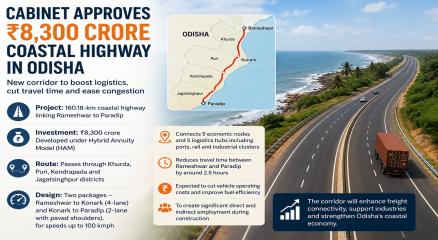
The Union Cabinet has approved the construction of a new coastal highway linking Rameshwar and Paradip in Odisha, a project expected to improve freight movement, reduce transit times and strengthen connectivity across key economic centres along the state's coastline. The project carries an estimated investment of ₹8,300 crore and will be developed under the Hybrid Annuity Model (HAM). Approved by the Cabinet Committee on Economic Affairs (CCEA), the 160.18-km corridor will pass through the districts of Khurda, Puri, Kendrapada and Jagatsinghpur. The new route is designed to address capacity and operational constraints on existing road links that currently handle a mix of local and long-distance traffic. The project will be executed in two phases. The first package includes a four-lane access-controlled highway between Rameshwar and Konark, while the second package involves the development of a two-lane road with paved shoulders from Konark to Paradip. Both sections have been designed for vehicle speeds of up to 100 kmph. From a logistics perspective, the highway is expected to improve access to major economic and transport assets across the region. Government estimates indicate that the corridor will connect nine economic nodes and five logistics hubs, including ports, rail infrastructure and industrial clusters. The project aligns with the PM GatiShakti framework, which focuses on integrated multimodal infrastructure development. Officials said the existing road network, particularly stretches connecting Puri, Satapada and Konark, faces operational challenges due to heavy local traffic and roadside development. The new corridor is intended to provide a more efficient route for both passenger and cargo transportation while reducing congestion on existing highways. Upon completion, travel time between Rameshwar and Paradip is expected to be reduced by approximately two and a half hours. The government also expects the project to lower vehicle operating costs, improve fuel efficiency and support more reliable freight movement along Odisha's coast. The corridor is expected to support industries including fisheries, food processing, manufacturing and export-oriented businesses by providing improved access to ports and logistics infrastructure. It is also projected to generate substantial employment during the construction phase through both direct and indirect jobs. Follow CARGOCONNECT for more such updates.