
Loading...
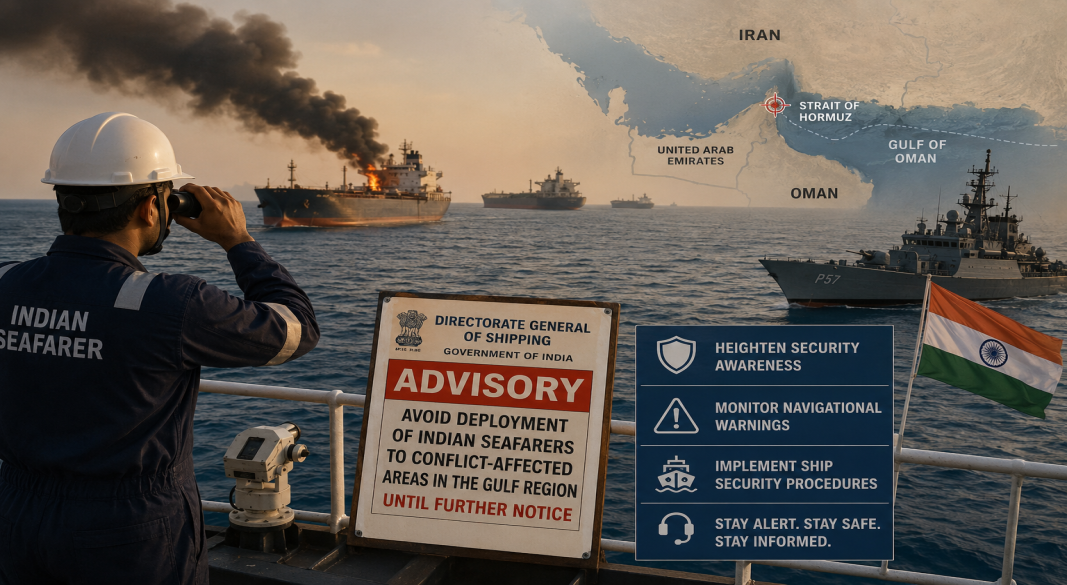
India has advised shipping companies and maritime recruitment agencies to restrict the deployment of Indian seafarers to conflict-affected areas in the Gulf region, following a series of security incidents involving merchant vessels operating near the Strait of Hormuz and the Gulf of Oman.
The Directorate General of Shipping (DG Shipping) issued the advisory amid growing concerns over the safety of Indian crew members after recent attacks on commercial vessels in the region. The directive asks Recruitment and Placement Service Licence (RPSL) holders and shipping companies to avoid sending Indian seafarers to conflict zones until further notice.
The move follows several maritime incidents in Gulf waters, including attacks on vessels carrying Indian crew members. The issue gained urgency after three Indian seafarers lost their lives aboard the tanker MT Settebello during a strike off the coast of Oman earlier this month. The incident has intensified concerns over the risks faced by merchant shipping operating in one of the world's most strategically important trade corridors.
In its advisory, DG Shipping instructed vessel masters, ship managers and operators transiting through the Gulf region to maintain heightened security awareness, closely monitor navigational warnings, and implement all prescribed ship security procedures. The regulator said recent incidents involving commercial vessels have highlighted the increasing operational risks in the area.
Indian authorities are closely monitoring developments in coordination with the Ministry of Ports, Shipping and Waterways, the Ministry of External Affairs, the Indian Navy and Indian missions abroad. The government has also placed relevant agencies on high alert to ensure timely assistance and support for Indian seafarers working in the region.
The Gulf region remains a critical route for global energy and container trade, with the Strait of Hormuz handling a significant share of international oil shipments. Any disruption to vessel movements in the area has implications for shipping operations, crew safety and global supply chains. As geopolitical tensions continue to affect maritime security, shipping companies are expected to review crew deployment and risk-management strategies for voyages through the region.
Follow CARGOCONNECT for more such updates.
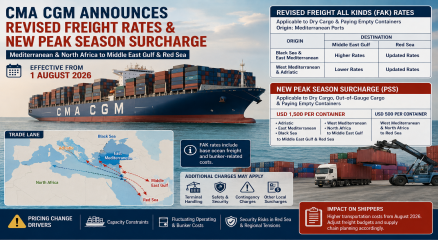
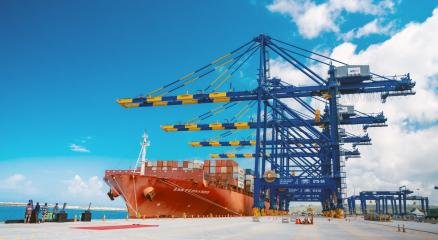
Global container carrier CMA CGM will implement revised Freight All Kinds (FAK) rates and introduce a new Peak Season Surcharge (PSS) for shipments from the Mediterranean and North Africa to the Middle East Gulf and Red Sea, effective 1 August 2026, as carriers continue to adjust pricing in response to evolving market conditions and regional operational challenges. The revised FAK rates will apply to dry cargo and paying empty containers originating from Mediterranean ports. Freight charges will vary depending on the origin and destination, with shipments to the Middle East Gulf attracting higher rates from the Black Sea and East Mediterranean than those from the West Mediterranean and Adriatic regions. Cargo destined for Red Sea ports will also be subject to updated tariffs based on the port of origin. Alongside the rate revision, CMA CGM will introduce a Peak Season Surcharge on the same trade lanes. A surcharge of USD 1,500 per container will apply to dry cargo, out-of-gauge cargo and paying empty containers moving from the Adriatic, East Mediterranean and Black Sea to both the Middle East Gulf and the Red Sea. Shipments from the West Mediterranean and North Africa to the Middle East Gulf will incur the same surcharge, while cargo bound for the Red Sea from those origins will attract a lower USD 500 per container charge. The carrier said the published FAK rates cover base ocean freight and bunker-related costs. However, customers should expect additional charges, including terminal handling, safety and security fees, contingency charges and other local surcharges, where applicable. The pricing changes come as shipping lines continue to respond to capacity constraints, fluctuating operating costs and ongoing security risks affecting trade through the Red Sea and surrounding maritime corridors. Recent geopolitical tensions in the region have also contributed to higher bunker costs, prompting carriers to revise pricing across multiple services. For shippers and freight forwarders operating on Mediterranean–Middle East trade lanes, the revised freight rates and seasonal surcharges are expected to increase transportation costs from August, requiring adjustments to freight budgets and supply chain planning. Follow CARGOCONNECT for more such updates.

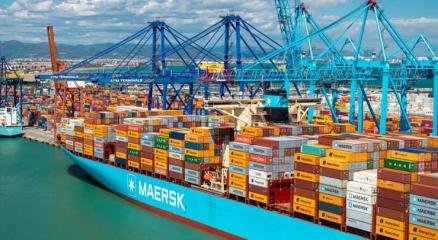
Maersk has announced an increase in its Emergency Contingency Surcharge (ECS) for cargo moving from the Indian subcontinent to North Europe and the Mediterranean, with the revised charges coming into effect from August 1, 2026. The move is expected to raise ocean freight costs for exporters across India and neighbouring South Asian markets, adding further pressure on supply chains already navigating volatile global shipping ecosystem. The revised ECS applies to cargo transported on Maersk's E3W (North Europe) and E4W (Mediterranean) services originating from North West India, South and East India, Nepal, Pakistan, Bangladesh, Sri Lanka and the Maldives. According to the carrier, the surcharge revision follows a review of prevailing market conditions aimed at maintaining the stability and reliability of its ocean freight. Under the new tariff structure, the ECS for shipments from North West India and Pakistan to North Europe will increase to US$3,500 per container across dry and reefer equipment, up from US$2,500. Similarly, shipments from South and East India and Nepal to North Europe will attract an ECS of US$3,800 for 20-foot containers and US$4,400 for 40-foot containers and reefers. Bangladesh-bound exports to North Europe will see the surcharge rise to US$4,000 for 20-foot containers and US$4,800 for 40-foot dry containers. Comparable increases have also been announced for shipments destined for the Mediterranean. The surcharge increase effectively adds US$1,000 per container across most trade lanes, making exports to Europe more expensive for manufacturers and shippers. Industry observers believe sectors such as textiles, engineering goods, chemicals, pharmaceuticals and automotive components, which rely heavily on Europe-bound container traffic, are likely to witness higher logistics costs in the coming months. The announcement comes amid continued uncertainty in global shipping markets, where carriers are adjusting freight rates and surcharges to offset elevated operating costs, capacity constraints and network disruptions. Shipping lines have increasingly relied on emergency and contingency surcharges to recover additional expenses arising from changing trade dynamics and operational challenges. In a separate advisory issued on July 17, Maersk also introduced a Heavy Load Surcharge (HWS) for cargo moving from North West India to North Europe and Israel-bound Mediterranean destinations, indicating a broader review of pricing across its regional services. For Indian exporters, the revised ECS is expected to translate into higher freight bills from August, prompting many to reassess logistics budgets, negotiate shipping contracts and explore cost optimisation strategies as Europe remains one of India's largest export markets. 𝐒𝐭𝐚𝐲 𝐓𝐮𝐧𝐞𝐝 𝐭𝐨 CARGOCONNECT 𝐟𝐨𝐫 𝐥𝐚𝐭𝐞𝐬𝐭 𝐮𝐩𝐝𝐚𝐭𝐞𝐬!

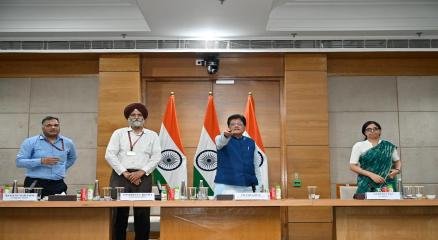
India has reaffirmed its growing influence in global maritime governance through an active and policy-driven participation at the 137th Session of the International Maritime Organization (IMO) Council, held in London from July 6 to 10. The country's delegation engaged in key discussions on maritime safety, governance reforms, digitalisation, seafarer welfare and international cooperation, reinforcing India's commitment to shaping the future of global shipping. Led by Shyam Jagannathan, IAS, Director General of Maritime Administration, the Indian delegation advocated a balanced, consensus-based approach to reforms within the IMO. India stressed that any amendments to the organisation's rules should preserve its technical and collaborative character while ensuring greater transparency and consistency in maritime governance. The delegation also highlighted the need for contextual interpretation of audit outcomes under the IMO Member State Audit Scheme, cautioning against simplistic country rankings. Seafarer welfare remained a key focus during the session. India called for stronger international collaboration to ensure timely repatriation, effective financial security mechanisms and improved implementation of the Maritime Labour Convention. The delegation showcased several digital initiatives, including the 24x7 e-Navik Seafarer Assistance Portal and an integrated crisis response framework designed to provide faster grievance redressal and support to Indian seafarers across the world. On the sidelines of the Council meeting, the Indian delegation held high-level discussions with IMO Secretary-General Arsenio Dominguez, the International Chamber of Shipping (ICS), the International Transport Workers' Federation (ITF) and representatives from Kenya. The engagements focused on maritime digitalisation, global standards for seafarer welfare, capacity building, maritime education and stronger international partnerships. India also highlighted its progress in digitising maritime administration through online certification systems, upgraded recruitment and training platforms and measures to curb fraudulent crewing practices. These initiatives are expected to enhance the global recognition and competitiveness of Indian seafarers while supporting efficient maritime compliance. Addressing geopolitical concerns, India emphasised the importance of restoring peace and ensuring safe navigation through critical shipping routes, particularly the Strait of Hormuz. The delegation underlined that disruptions in strategic maritime corridors have significant implications for global supply chains, trade continuity and shipping costs, reiterating that dialogue and diplomacy remain the most effective means of resolving regional conflicts. India's constructive interventions at the 137th IMO Council underscore its emergence as a responsible maritime nation that is actively contributing to safer, greener and more resilient global shipping. For the logistics and supply chain industry, India's growing role at the IMO is expected to support stronger maritime governance, improved seafarer welfare and enhanced resilience across international trade networks. 𝐒𝐭𝐚𝐲 𝐓𝐮𝐧𝐞𝐝 𝐭𝐨 CARGOCONNECT 𝐟𝐨𝐫 𝐥𝐚𝐭𝐞𝐬𝐭 𝐮𝐩𝐝𝐚𝐭𝐞𝐬!