
Loading...
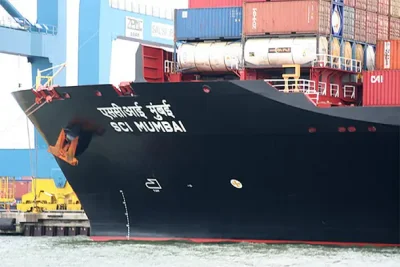
The government is likely to invite financial bids for Shipping Corporation of India (SCI) by September, after the process of the demerger of non-core assets is completed, an official said. As part of the strategic-sale process, the government is hiving off Shipping House and the training institute in Pune and some other non-core assets of Shipping Corporation of India (SCI).''The process of demerger is time consuming. We would be ready to invite financial bids in 3-4 months,'' the official said. The board of Shipping Corporation met last week and approved an updated demerger scheme for hiving off the non-core assets of SCI to Shipping Corporation of India Land and Assets Ltd (SCILAL) including Shipping House, Mumbai and MTI (Maritime Training Institute), Powai to complete the process of de-merging all the non-core assets to the new company SCILAL.As per the balance sheet of SCI, the value of non-core assets held for demerger as of March 31, 2022, stood at Rs 2,392 crore.
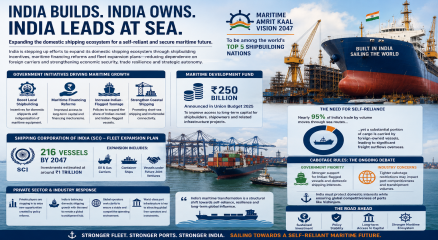
India is stepping up efforts to expand its domestic shipping ecosystem through a combination of shipbuilding incentives, maritime financing reforms and fleet expansion plans aimed at reducing dependence on foreign carriers. The push reflects a broader policy shift in which maritime infrastructure is increasingly being viewed through the lens of economic security, trade resilience and strategic autonomy. Government initiatives unveiled over the past three years have focused on boosting local ship construction, increasing Indian-flagged tonnage and strengthening coastal shipping capabilities. Under the Maritime Amrit Kaal Vision 2047, the government aims to position India among the world’s top five shipbuilding nations while significantly expanding domestic shipbuilding capacity. The Union Budget for 2025 also introduced a ₹250 billion Maritime Development Fund intended to improve access to long-term capital for shipbuilders, shipowners and related infrastructure projects. Although nearly 95 percent of India’s trade by volume moves through sea routes, a substantial portion of cargo continues to be carried by foreign-owned vessels, resulting in significant freight outflows overseas. The Shipping Corporation of India (SCI), the country’s largest state-owned shipping company, has outlined aggressive fleet expansion plans as part of this transition. According to company officials, SCI intends to acquire 216 vessels by 2047 through investments estimated at around ₹1 trillion. The expansion includes oil and gas carriers, container ships and additional vessels under future joint ventures. Private sector players are beginning to respond to the policy changes as well as India continues to balance competing priorities between promoting domestic shipping interests and maintaining the competitiveness of its ports as international transhipment hubs. The debate has intensified following recent changes to cabotage rules governing foreign participation in coastal cargo movement. While the government has signalled stronger support for Indian-flagged vessels, global shipping operators have raised concerns that tighter restrictions could affect the attractiveness of Indian ports such as Vizhinjam for transhipment operations. Logistics experts argue that India’s long-term success will depend not only on protecting domestic shipping interests but also on developing world-class port infrastructure capable of attracting global liner operators. Industry executives say the transformation of India’s maritime sector will require sustained investment, policy stability and long-term access to capital. However, they believe the country’s growing focus on shipbuilding, vessel ownership and maritime finance marks a structural shift in how India approaches global trade and supply chain security. Follow CARGOCONNECT for more such updates.

India and Italy have elevated their bilateral relationship to a “Special Strategic Partnership,” marking a significant step toward stronger maritime cooperation, trade connectivity, and resilient global supply chains. The announcement followed high-level talks between Prime Minister Narendra Modi and Italian Prime Minister Giorgia Meloni in Rome, where both leaders reaffirmed their commitment to advancing the India-Middle East-Europe Economic Corridor (IMEC) and deepening collaboration across strategic sectors. For the logistics and shipping industry, the development signals growing alignment between two major economies seeking to diversify trade routes and build more secure maritime supply chains amid geopolitical uncertainty. IMEC, first announced during the G20 Summit in 2023, is envisioned as a transformative trade corridor connecting India with Europe through the Middle East via integrated rail and maritime networks. Italy’s geographic position in the Mediterranean is expected to make it a critical European gateway for the initiative. The two countries reviewed progress under the India-Italy Joint Strategic Action Plan 2025-2029 and agreed to intensify cooperation in ports, shipping, logistics infrastructure, advanced manufacturing, and maritime technologies. Both governments emphasized the importance of resilient and sustainable connectivity corridors to support global commerce and reduce vulnerabilities in traditional supply chain routes. A major outcome of the Rome meeting was the announcement of a target to increase bilateral trade to €20 billion by 2029. Industry observers believe this could create new opportunities for freight movement, warehousing, multimodal logistics, and industrial collaboration between Indian and European companies. Discussions also covered defence manufacturing, critical minerals, clean energy, innovation, and digital technologies — all sectors closely linked to modern supply chain ecosystems. The maritime dimension of the partnership is particularly noteworthy. Both nations stressed the need for secure sea lanes and stronger cooperation in the Indo-Mediterranean region, reflecting the growing strategic importance of maritime trade networks. Analysts view the India-Italy partnership as part of a broader effort by India and European nations to strengthen economic resilience and reduce dependence on concentrated trade corridors. Italy’s expertise in shipbuilding, maritime engineering, and port management could complement India’s expanding logistics and port modernisation initiatives under programmes such as Sagarmala and PM Gati Shakti. The collaboration may also accelerate investments in smart ports, green shipping technologies, and digital freight systems. With IMEC gaining traction and India-EU trade negotiations progressing, the India-Italy strategic partnership is increasingly being viewed as a long-term framework that could reshape trade flows between Asia and Europe. For the global shipping and logistics industry, the partnership represents more than diplomacy — the emergence of a new connectivity architecture designed to support faster, diversified, and future-ready supply chains. 𝐒𝐭𝐚𝐲 𝐓𝐮𝐧𝐞𝐝 𝐭𝐨 https://cargoconnect.co.in/ 𝐟𝐨𝐫 𝐥𝐚𝐭𝐞𝐬𝐭 𝐮𝐩𝐝𝐚𝐭𝐞𝐬!
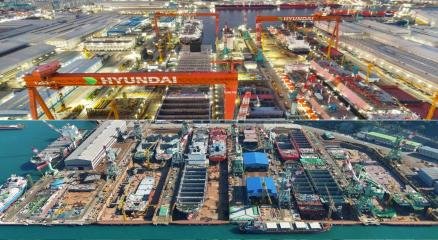
South Korean shipbuilders have secured fresh orders for 10 liquefied natural gas (LNG) carriers valued at nearly $1.8 billion, reinforcing the country’s leadership in the global LNG vessel construction market. The latest contracts highlight growing demand for energy transportation capacity as nations diversify fuel supply chains and invest heavily in cleaner marine fuels. Industry leaders including HD Korea Shipbuilding & Offshore Engineering, Samsung Heavy Industries, and Hanwha Ocean continue to dominate the high-value LNG carrier segment, supported by advanced shipbuilding technology and strong global demand for eco-friendly vessels. According to industry reports, the three companies collectively captured the majority of LNG carrier orders placed worldwide this year. The latest round of orders comes amid heightened geopolitical uncertainty and a global push to strengthen energy security. Rising LNG trade volumes, particularly in Asia and Europe, are driving long-term investments in modern LNG fleets capable of transporting cleaner-burning fuel across global markets. Analysts note that LNG carriers remain among the most technologically sophisticated and profitable vessels in commercial shipbuilding. HD Korea Shipbuilding & Offshore Engineering has emerged as a major beneficiary of the surge, securing multiple LNG carrier contracts in recent weeks. The company recently announced orders for two LNG carriers from a North American shipping company, adding to a growing order backlog for eco-friendly vessels. Meanwhile, Samsung Heavy Industries has also expanded its LNG carrier portfolio with new contracts from international shipping firms. The company said steady LNG demand and selective bidding on high-value vessels are helping improve profitability and long-term order visibility. South Korea’s shipbuilders currently command a dominant share of the global LNG carrier market, supported by expertise in membrane containment systems, fuel efficiency technologies, and compliance with tightening environmental regulations. Industry estimates suggest global LNG carrier demand could remain robust through the decade as energy companies increase LNG exports and replace aging fleets. The strong order momentum is also expected to benefit the broader maritime supply chain, including steel manufacturers, marine equipment suppliers, logistics providers, and port infrastructure developers. As global shipping transitions toward lower-emission fuels, Korean shipyards appear well-positioned to capitalize on the next phase of the maritime energy transition. 𝐒𝐭𝐚𝐲 𝐓𝐮𝐧𝐞𝐝 𝐭𝐨 https://cargoconnect.co.in/ 𝐟𝐨𝐫 𝐥𝐚𝐭𝐞𝐬𝐭 𝐮𝐩𝐝𝐚𝐭𝐞𝐬!