
Loading...
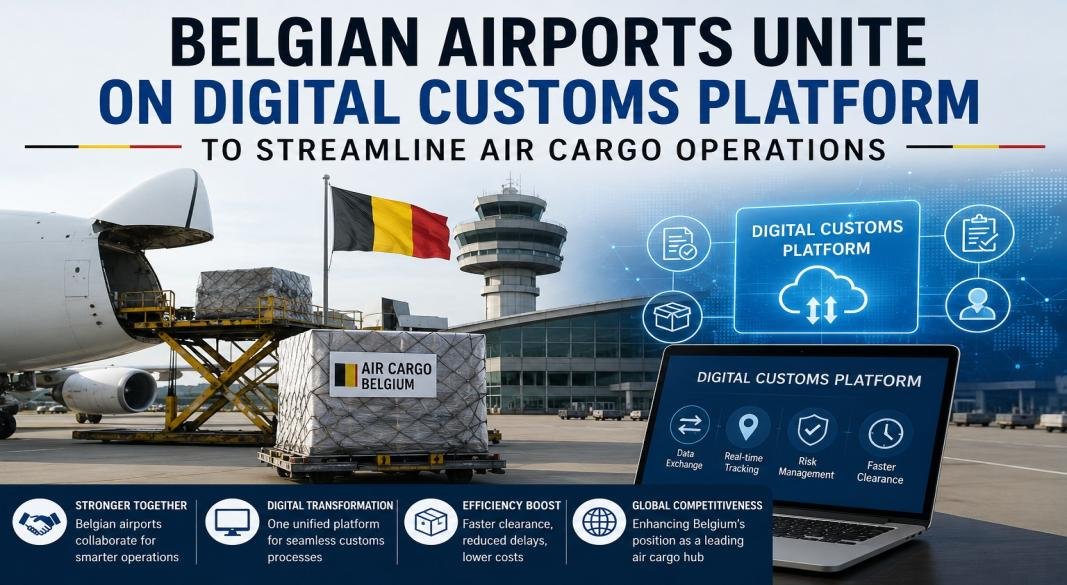
Belgium's major air cargo hubs are joining hands to modernise customs handling through a unified digital platform aimed at streamlining cargo operations and strengthening the country’s position as a European logistics hub.
Brussels Airport, Liège Airport and Ostend-Bruges Airport have announced a collaborative initiative to standardise and digitise customs procedures for import, export and transit cargo movements. The project is being coordinated by Air Cargo Belgium in partnership with LGG Connect, reflecting an industry-wide push toward smarter and more integrated cargo processing systems.
The initiative comes as European customs authorities continue transitioning toward the Multi-Annual Strategic Plan for Customs (MASP-C), a broader EU programme designed to modernise customs operations through digitalisation. Under the new Belgian framework, cargo stakeholders will be able to exchange customs declarations electronically through airport community platforms using harmonised interfaces and processes.
For operators, the move is expected to significantly reduce administrative complexity and improve cargo visibility across airport ecosystems. Air cargo companies will be able to submit Temporary Storage Declarations digitally via dedicated portals integrated into existing cargo community systems such as BRUCloud at Brussels Airport and LGG Tracking at Liège Airport. Both platforms will follow the same operational logic while remaining individually connected to Belgian customs systems for declaration processing and status updates.
Industry observers view the collaboration as a notable development in a sector where airport communities often operate independently. By aligning customs procedures across multiple gateways, Belgium aims to create a more seamless experience for freight forwarders, handlers and international shippers moving cargo through the country.
The initiative is also expected to enhance Belgium’s attractiveness as a transit and e-commerce hub. Brussels Airport has already established itself as a major European cargo gateway with strong pharmaceutical, perishables and express freight capabilities, while Liège Airport has emerged as a leading e-commerce and full-freighter hub connected to multiple Asian markets.
Executives involved in the project say the standardised approach will support faster customs clearance, improve operational efficiency and enable better coordination between cargo stakeholders and customs authorities. The digital infrastructure is also aligned with broader sustainability and trade facilitation goals, as paper-based procedures continue to be phased out across the logistics sector.
Belgium has been actively investing in digital cargo solutions over recent years, including earlier initiatives such as the BE-GATE customs platform developed to simplify cross-border e-commerce shipments. The new airport collaboration builds on those foundations while extending interoperability across the national cargo network.
Development of the unified platform will continue over the coming months, with the participating airports targeting operational readiness before the end of 2026. As global supply chains increasingly depend on data-driven logistics infrastructure, Belgium’s coordinated approach could serve as a model for cross-airport customs integration in Europe.
𝐒𝐭𝐚𝐲 𝐓𝐮𝐧𝐞𝐝 𝐭𝐨 https://cargoconnect.co.in/ 𝐟𝐨𝐫 𝐥𝐚𝐭𝐞𝐬𝐭 𝐮𝐩𝐝𝐚𝐭𝐞𝐬!

Blue Dart has completed 30 years of aviation operations, marking a significant milestone for the express logistics company as it continues to expand its air cargo network across India. Since 1996, the company has operated more than 2.15 lakh flights and transported over 20.5 lakh tonnes of air cargo, underscoring the scale of its dedicated air express network. The aviation division forms a key part of Blue Dart’s integrated logistics infrastructure, supporting time-definite deliveries and enabling nationwide connectivity for businesses and consumers. Over the past three decades, Blue Dart’s air network has played an important role in serving a broad range of industries, including life sciences, banking and financial services, manufacturing, automotive, e-commerce and small and medium-sized enterprises. The company said its aviation capabilities have contributed to improved supply chain efficiency and strengthened logistics connectivity across the country. The network also supported the movement of critical supplies during the COVID-19 pandemic, including vaccines, personal protective equipment (PPE) and other essential goods, helping maintain the flow of healthcare and emergency shipments during a period of severe disruption. Commenting on the milestone, Balfour Manuel, Managing Director of Blue Dart Express Limited, said the company’s aviation infrastructure has been instrumental in supporting next-day and under-24-hour delivery services across India. “Blue Dart’s aviation capability has strengthened the speed, reliability and certainty that customers associate with the brand, while connecting businesses, markets and communities,” Manuel said. Today, Blue Dart operates a dedicated fleet of eight Boeing 737 and 757 freighter aircraft. The fleet serves as a critical component of the company’s logistics network, facilitating the movement of shipments between major metropolitan centres and emerging economic hubs. Capt. Nikhil B. Ved, Managing Director of Blue Dart Aviation Limited, said the milestone reflects the company’s long-standing role in supporting India’s air express logistics network. “The journey has been defined by operational excellence, safety and a relentless focus on customer needs. As we enter the next decade, our focus remains on strengthening capabilities and building a future-ready aviation network,” Ved said. Looking ahead, the company said it will focus on strengthening network resilience, improving operational efficiency and expanding the use of technology and automation across its aviation operations. These efforts are expected to support growing cargo demand and the evolving requirements of India’s logistics sector as the country continues to expand its economic footprint. As Blue Dart enters the fourth decade of its aviation business, the company remains focused on enhancing air cargo capabilities and supporting faster, more reliable movement of goods across domestic markets. Follow CARGOCONNECT for more such updates.


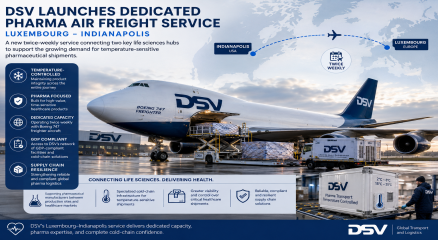
Global logistics provider DSV has launched a dedicated air freight service connecting Luxembourg and Indianapolis to support the growing demand for temperature-sensitive pharmaceutical shipments between Europe and the United States. The new route will operate twice weekly and is designed to provide pharmaceutical manufacturers with additional capacity and tighter control over shipments requiring strict temperature management. The service links two major life sciences hubs, enabling faster movement of medicines, vaccines and other healthcare products across the Atlantic. The flights will be operated using Boeing 747 freighter aircraft and will connect Luxembourg, one of Europe's largest pharmaceutical logistics gateways, with Indianapolis, a key healthcare and distribution center in the US Midwest. The route is expected to strengthen supply chain resilience for pharmaceutical companies by offering a dedicated transportation option outside traditional passenger and cargo networks. According to DSV, the service has been developed to address increasing demand for reliable and compliant transportation solutions as pharmaceutical supply chains become more complex and regulatory requirements continue to tighten. Maintaining product integrity during transit remains a critical priority for manufacturers, particularly for high-value and temperature-sensitive medicines. The logistics company said the new corridor will support shipments moving between production sites, distribution centers and healthcare markets in both regions. The service also provides access to DSV's network of GDP-compliant facilities and cold-chain infrastructure designed for pharmaceutical cargo handling. Industry demand for specialized healthcare logistics has continued to grow in recent years, driven by expanding biologics production, increased movement of clinical trial materials and rising global demand for temperature-controlled medicines. As a result, logistics providers have been investing heavily in dedicated cold-chain capacity and pharmaceutical-focused transportation services. The Luxembourg–Indianapolis connection forms part of DSV's broader strategy to expand its healthcare logistics capabilities and strengthen its position in the high-value pharmaceutical freight market. The company expects the dedicated route to improve transit reliability while providing customers with greater visibility and control over critical healthcare shipments. The launch underscores the increasing importance of specialized air cargo services as pharmaceutical manufacturers seek secure, compliant and resilient supply chain solutions amid growing global demand for healthcare products. Follow CARGOCONNECT for more such updates.


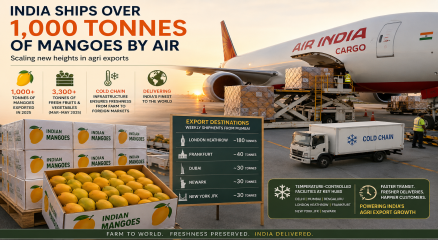
Air India transported more than 1,000 tonnes of mangoes to international destinations reflecting the increasing role of airfreight networks in supporting India's perishable goods trade. The shipments were part of a broader movement of over 3,300 tonnes of fresh fruits and vegetables handled by the airline between March and May. Mangoes accounted for nearly one-third of the total perishables volume moved during the period, driven by strong overseas demand for Indian varieties. The export season saw cargo volumes rise sharply as harvests peaked across western India. Air India carried 805 tonnes of fruits and vegetables in March, increasing to 1,275 tonnes in April before easing slightly to 1,233 tonnes in May. Much of the produce originated from Maharashtra and Gujarat, two of the country's largest mango-producing states. The movement of mangoes to overseas markets underscores the operational challenges associated with transporting perishable agricultural products. Maintaining freshness requires a coordinated supply chain involving farmers, exporters, freight operators, ground handlers and airlines, supported by temperature-controlled storage and transportation throughout the journey. Cold chain management has become increasingly important as exporters target distant markets where transit times can directly affect product quality. Perishable cargo is typically moved from farms in refrigerated vehicles before being stored in temperature-controlled airport facilities and loaded onto aircraft. Similar handling procedures are followed at destination airports before distribution to wholesalers and retailers. Industry observers note that air cargo continues to play a crucial role in India's agricultural export sector, particularly for high-value products with limited shelf life. Faster transit times allow exporters to access premium overseas markets while reducing spoilage risks and maintaining product quality.The latest mango season highlights how investments in airfreight capacity, cold chain infrastructure and international connectivity are strengthening India's ability to move fresh produce to global consumers. As demand for Indian agricultural products grows in overseas markets, efficient logistics networks are expected to remain a key factor in supporting export growth. Follow CARGOCONNECT for more such updates.