
Loading...
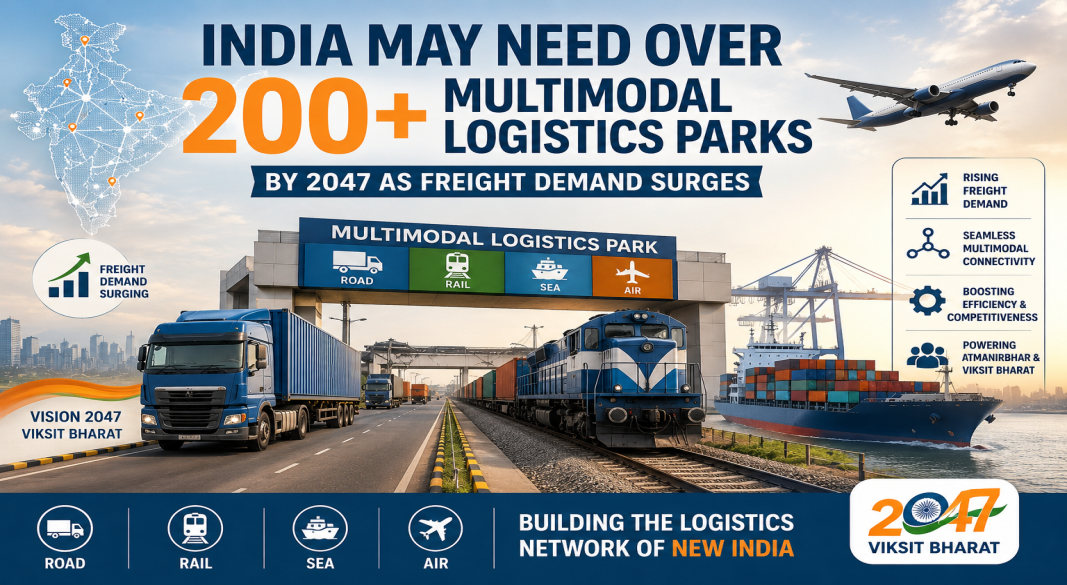
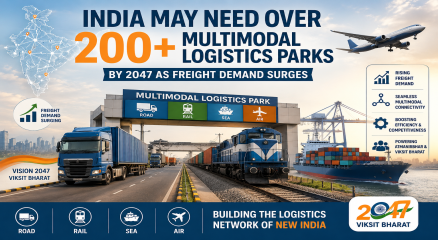
India will require more than 200 next-generation multimodal logistics parks (MMLPs) over the next two decades to handle rising freight volumes, improve cargo movement efficiency and support the country’s long-term manufacturing and trade ambitions, according to a new industry assessment.
The report, prepared by the Confederation of Indian Industry (CII) and property consultancy Knight Frank India, estimates that the country will need approximately 215–216 integrated logistics hubs by 2047 as freight demand expands alongside industrial growth, urbanisation and increasing consumption.
India’s freight movement is projected to reach nearly 28 billion tonnes by 2047, creating significant pressure on existing transport infrastructure. The report argues that large-scale logistics parks connected to rail, road, ports and industrial corridors will be essential to manage future cargo volumes while reducing dependence on road transport.
According to the study, multimodal logistics parks integrated with Dedicated Freight Corridors (DFCs) could reduce door-to-door freight costs by as much as 43% compared with conventional road-based transportation. Such facilities are expected to improve cargo aggregation, lower handling costs, shorten transit times and reduce congestion across major freight routes.
The findings come as India accelerates investments in logistics infrastructure under initiatives such as PM Gati Shakti and the National Logistics Policy. Policymakers have identified logistics efficiency as a key factor in improving export competitiveness and attracting manufacturing investments.
Over the past decade, infrastructure spending worth nearly $360 billion has helped reduce India’s logistics costs to an estimated 10–10.7% of GDP from around 13–14% previously, according to the report. Despite this progress, industry experts argue that further gains will depend on the development of integrated freight ecosystems capable of supporting multimodal transportation networks.
The report highlights inadequate rail connectivity between industrial clusters and freight terminals as one of the major structural challenges facing the sector. Expanding multimodal logistics infrastructure is expected to encourage a larger shift of cargo from roads to railways, which are generally more cost-efficient for long-distance freight movement.
The government has already identified 35 multimodal logistics park projects under the Bharatmala programme, although implementation has faced challenges including land acquisition delays, financing constraints and connectivity issues. Several states have recently advanced logistics park projects near key industrial and port locations, reflecting growing recognition of their role in strengthening supply chain networks.
Industry stakeholders believe the next phase of logistics development will increasingly focus on integrated infrastructure rather than standalone warehousing assets. Modern logistics parks are expected to combine freight terminals, container depots, warehousing facilities, cold-chain infrastructure and digital cargo management systems within a single networked ecosystem.
As India targets higher manufacturing output and export growth over the coming decades, the scale and pace of logistics infrastructure development are expected to become critical determinants of supply chain competitiveness. The report suggests that without substantial expansion of multimodal freight facilities, existing transport networks could face mounting pressure from rising cargo volumes, potentially increasing logistics costs and limiting economic efficiency.
Follow CARGOCONNECT for more such updates.
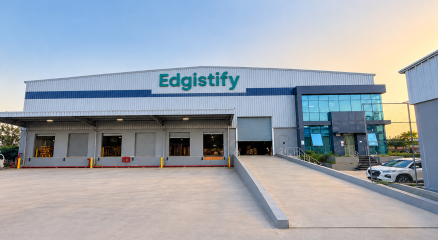
Edgistify has expanded its fulfilment network in the Gurugram region with the addition of a 68,000 sq ft warehouse at IndoSpace’s logistics park in Luhari, Haryana. The facility marks the company’s third high-grade warehouse in the region, with both new and existing customers already shipping orders from the site. The expansion comes ahead of the festive season, when consumer brands face heightened order volumes and tighter fulfilment timelines. With its two existing Gurugram facilities operating at full capacity, Edgistify is positioning the Luhari warehouse to provide additional storage and fulfilment capacity, enabling brands to consolidate inventory rather than distribute it across multiple logistics partners during demand peaks. The company’s operations are designed to accommodate order surges of up to 2.5 times normal volumes, supporting brands as they navigate seasonal demand fluctuations across multiple sales channels. The new facility will serve direct-to-consumer websites, online marketplaces, quick-commerce platforms and modern trade through a common inventory pool. This integrated approach is particularly relevant as quick-commerce platforms increasingly require brands to fulfil smaller business-to-business consignments more frequently and within fixed delivery slots. Such requirements make inventory proximity and efficient dock operations increasingly important for timely dispatch and truck turnaround. “Our brands have grown faster than our existing space could keep up with, and the festive season is when that pinch shows most,” said Umang Shukla, Co-founder and CEO, Edgistify. He added that the company selected IndoSpace for its warehouse infrastructure, while the Luhari facility would operate under the same team as its existing sites, providing customers with additional capacity within a familiar network. On the technology front, Edgistify will continue to accommodate different warehouse management requirements. Brands using their own warehouse management systems can retain them while Edgistify manages on-ground operations. Those without an existing system can use EdgeOS, the company’s in-house platform, which integrates with their existing storefronts, marketplaces and enterprise resource planning (ERP) systems. The company has also sought to simplify expansion for existing customers, allowing them to move inventory to Luhari without undergoing a fresh vendor onboarding process. By adding capacity in a key logistics market ahead of the festive peak, Edgistify aims to address growing fulfilment requirements while supporting multi-channel distribution and the faster replenishment cycles associated with quick commerce.
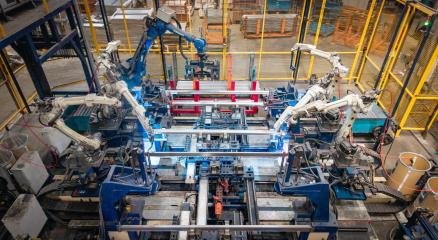

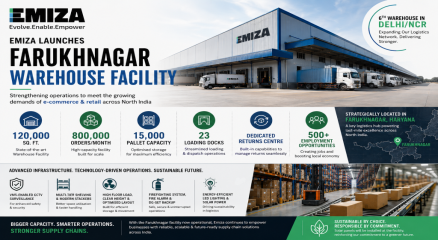
Emiza, one of India's leading Third-Party Logistics (3PL) providers, has strengthened its warehousing and fulfilment network with the launch of a new logistics facility in Farukhnagar, Haryana. The expansion comes amid rising demand from the e-commerce, retail and consumer sectors for faster, scalable and technology-driven supply chain solutions across northern India. The newly operational facility spans 120,000 sq ft and marks Emiza's sixth warehouse in the Delhi-NCR region, taking the company's overall warehousing footprint to more than 60 million cubic feet across 11+ cities and 11+ states. Strategically located in one of North India's key logistics hubs, the warehouse offers a pallet capacity of 15,000, features 23 loading docks, and is designed to process up to 800,000 orders per month. The facility will also function as a dedicated returns processing centre, enabling partner brands to efficiently manage reverse logistics operations while improving inventory visibility and customer experience. Commenting on the development, Ajay Rao, Founder & CEO, Emiza, said: “The Farukhnagar warehouse is a milestone in Emiza’s journey to redefine how logistics infrastructure supports modern businesses. Beyond its physical scale, it reflects a vision of agility, resilience, and forward-thinking design, where operations can quickly adapt to changing market needs. This facility enables us to respond faster to client demands, integrate advanced systems for seamless supply chain management, and set a benchmark for future expansion.” Built to support high-volume operations, the facility incorporates VMS-enabled CCTV surveillance, multi-tier shelving systems, modern stackers, balanced ventilation, and advanced warehouse management infrastructure. Its high floor load-bearing capacity, optimised clear height, and dedicated loading and unloading bays are designed to improve storage efficiency and accelerate cargo movement. Jitendra Kumar, Co-founder, Emiza stated, “The Farukhnagar facility has been built with a strong focus on operational efficiency and smooth movement of goods. From the layout of the warehouse to the equipment installed, every element is designed to support faster handling, accurate storage and timely dispatch.” The facility also integrates comprehensive safety measures, including advanced firefighting and alarm systems, DG-set power backup, and energy-efficient LED lighting to ensure uninterrupted operations and compliance with industry standards. In line with Emiza's sustainability roadmap, solar panels will be installed at the warehouse, replicating initiatives already implemented at the company's KSquare facility. Beyond operational expansion, the project is expected to generate more than 500 employment opportunities, contributing to regional economic growth and strengthening Farukhnagar's position as a prominent logistics destination. With the addition of the Farukhnagar warehouse, Emiza continues to deepen its presence across strategic logistics corridors, enhancing its ability to deliver reliable, scalable and future-ready supply chain solutions for India's rapidly evolving commerce ecosystem.
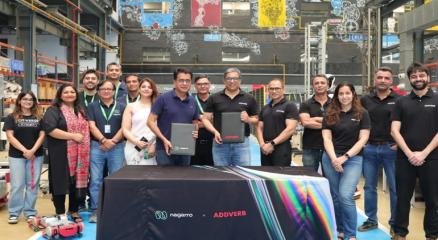
Nagarro, a well-known digital engineering leader, and Addverb, a global leader in robotics and warehouse automation solutions, have formed a strategic partnership to drive innovation in robotics and digital automation. This collaboration, marked by a Memorandum of Understanding (MoU), is set to transform industrial automation by creating advanced robotic solutions and digital twin technologies that cater to markets around the world. The alliance brings together Nagarro's strengths in software engineering, digital integration, and intelligent technologies with Addverb's expertise in robotics hardware and warehouse automation systems. By combining these capabilities, the two companies aim to design integrated solutions that effectively link digital intelligence with physical automation processes. As part of this collaboration, both companies will engage in co-developing solutions, including joint intellectual property creation and knowledge-sharing programs. They also plan to establish advanced robotics experience centers and innovation spaces that support experimentation and promote faster adoption of new technologies. Sangeet Kumar, CEO and Co-founder of Addverb, emphasized that the future of automation lies in connected ecosystems where software and robotics work in harmony. He said that Addverb is evolving from providing standalone hardware to delivering comprehensive, intelligent automation systems that meet the changing needs of supply chains. Furthermore, he highlighted that this partnership with Nagarro will help reinforce this vision by enabling the development of flexible, scalable, and future-proof automation solutions. The collaboration will also explore opportunities in various sectors, including warehousing, manufacturing, and broader supply chain operations. Both companies plan to enhance their global presence through coordinated marketing efforts and mutual referrals. Narro will concentrate on software integration, digital platforms, and intelligent technologies, while Addverb will focus on hardware implementation, automation infrastructure, and lifecycle support services. Ganesh Sahai, CTO of Nagarro, pointed out that many automation efforts are confined to isolated applications, but this partnership aims to integrate software systems, robotics, and operational workflows seamlessly. He noted that such integrated solutions can enhance execution speed, increase operational efficiency, and improve predictability for businesses. This collaboration also showcases Nagarro's increasing focus on AI-driven engineering solutions that connect digital ecosystems with physical operations, helping enterprises achieve faster growth and improved reliability and performance. For more such news and updates, visit CARGOCONNECT.