
Loading...
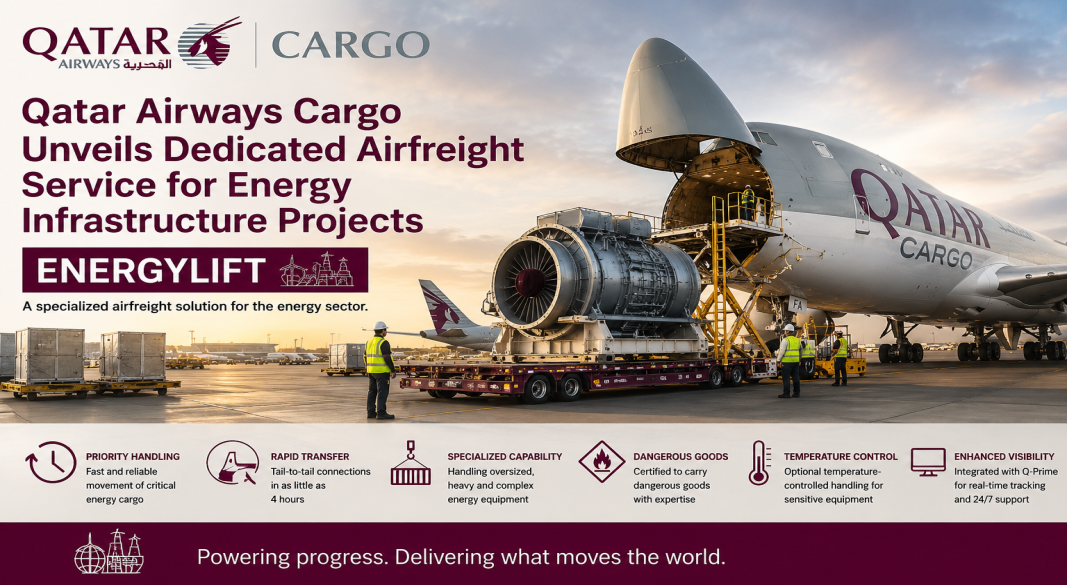
Qatar Airways Cargo has launched a new airfreight product aimed at supporting the movement of critical equipment for energy and infrastructure projects, expanding its portfolio of specialized cargo services as demand grows for time-sensitive industrial logistics solutions.
The new service, branded EnergyLift, is designed to handle urgent shipments linked to sectors including oil and gas, power generation, renewable energy, and water infrastructure. The carrier said the offering addresses a gap in the market for faster and more tailored transport options for high-value, project-critical components.
EnergyLift provides airport-to-airport transportation with priority handling and expedited transfer processes. According to the airline, shipments can benefit from transfer times of as little as four hours between connecting flights, helping reduce transit delays for equipment required at operational sites and infrastructure projects.
The service is also equipped to accommodate oversized and complex cargo, a key requirement for the energy sector where components such as turbines, generators, valves, and industrial machinery often require specialized handling. Additional capabilities include dangerous goods management and optional temperature-controlled transport for sensitive cargo.
For customers requiring additional service assurance, EnergyLift can be combined with the carrier’s Q-Prime solution, which offers shipment monitoring, dedicated support, and uplift guarantees for critical recovery situations. The airline said these features are intended to improve reliability for projects where equipment delays can result in significant operational and financial consequences.
Bookings are available through Qatar Airways Cargo’s Digital Lounge platform as well as third-party booking channels. The launch follows the carrier’s recent introduction of a specialized pharmaceutical logistics product, reflecting a broader strategy to develop sector-specific cargo solutions.
The move highlights increasing competition among cargo operators to target industrial verticals that require specialized handling and guaranteed capacity, particularly as energy and infrastructure investments continue to expand across global markets.
Follow CARGOCONNECT for more such updates.

Munich Airport has reinforced its long-standing Sister Airport partnership with Japan's Chubu Centrair International Airport (Centrair), hosting a high-level delegation for a multi-day knowledge exchange focused on innovation, operational excellence, digital transformation and future airport development. The delegation, led by Centrair President & CEO Hironori Kagohashi, was welcomed by Munich Airport CEO, Jost Lammers as both airports reaffirmed their commitment to strengthening international collaboration and sharing best practices across airport operations, passenger services and commercial development. Highlighting the significance of the partnership, Lammers said that by sharing experiences and learning from one another, we can jointly develop innovative solutions, enhance operational excellence and continuously elevate the travel experience for our passengers. The partnership between Centrair and Munich Airport is a strong example of how airports can create value through international cooperation and prepare airports for the future. A key component of the visit was an extensive workshop programme hosted by the Munich Airport Academy, where specialists from both airports discussed a broad range of strategic priorities. Among the topics were long-term capacity planning, Munich Airport's planned extension of the T-shaped pier at Terminal 2, and strategies to efficiently manage seasonal traffic peaks and demand associated with major international events. The discussions also focused on preparations for the 2026 Asian Games in Aichi-Nagoya, which are expected to generate substantial passenger traffic across the region. Both airports explored operational planning approaches to maintain service quality while accommodating increased travel demand. Commercial strategy also formed part of the agenda, covering airport advertising, media and parking business models, alongside commercial opportunities linked to infrastructure expansion projects. Innovation in airside operations featured prominently during the exchange. Munich Airport shared updates on its autonomous cargo transport testing activities, reflecting the growing role of automation in enhancing logistics efficiency and airside operations. In return, Centrair presented progress on its Smart Ramp initiative, including the deployment of autonomous vehicle technologies designed to improve safety, productivity and operational performance. Digital transformation was another central theme, with experts comparing automated passenger processing systems and Fast Travel solutions aimed at streamlining airport operations. The exchanges highlighted how automation, digitalization and intelligent infrastructure can help airports improve throughput, optimize resources and deliver a more seamless passenger journey. Therefore, this collaboration underscores the value of the Sister Airport network, an international alliance that includes Munich Airport, Denver International Airport, Chubu Centrair International Airport, Airports of Thailand (Bangkok), Singapore Changi Airport, Beijing Capital International Airport and Airports Company South Africa. By leveraging collective expertise, member airports continue to develop innovative solutions that support sustainable growth, operational resilience and the evolving needs of global aviation, air cargo and passenger mobility. 𝐒𝐭𝐚𝐲 𝐓𝐮𝐧𝐞𝐝 𝐭𝐨 CARGOCONNECT 𝐟𝐨𝐫 𝐥𝐚𝐭𝐞𝐬𝐭 𝐮𝐩𝐝𝐚𝐭𝐞𝐬!

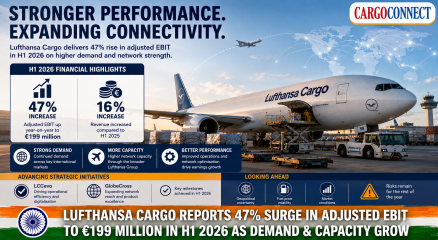
Lufthansa Cargo reported a 47% year-on-year increase in adjusted EBIT for the first half of 2026, reaching €199 million, as stronger cargo demand and higher network capacity supported improved financial performance. Revenue also increased 16% during the period. The cargo carrier benefited from continued demand across key international markets while expanding available freight capacity through the broader Lufthansa Group network. The company said improved operational performance and network optimisation contributed to the earnings growth. During the first half, Lufthansa Cargo also advanced strategic initiatives under its LCCevo and GlobeCross programmes, which are focused on operational efficiency, digitalisation and network development. The company indicated that both programmes achieved key milestones during the reporting period. Despite the strong cargo performance, the wider Lufthansa Group has highlighted continued uncertainty in the aviation sector due to geopolitical developments, fuel price volatility and broader market conditions. These factors remain potential risks for airline profitability during the remainder of the year. Follow CARGOCONNECT for more such updates.

The Telangana government has approved an administrative sanction of ₹2,278.14 crore for the development of a joint-use airport at Adilabad, marking a significant milestone in the state's efforts to strengthen regional connectivity, logistics infrastructure and industrial growth. The project is expected to enhance multimodal transport capabilities in north Telangana while creating new opportunities for air cargo movement, manufacturing and investment. The proposed airport will be developed as a joint-use facility by the Indian Air Force (IAF) and the Airports Authority of India (AAI). Under the approved plan, around 2,009.23 acres of land will be acquired, with 1,609.23 acres earmarked for defence operations and the remaining 400 acres allocated for a civil aviation enclave. The civilian section will accommodate passenger services, maintenance, repair and overhaul (MRO) facilities, cargo terminals, aircraft hangars and future expansion. Beyond land acquisition, the sanctioned amount also covers critical enabling infrastructure required for project execution. These include diversion of existing roads, relocation of high-voltage transmission lines, shifting of drinking water pipelines, stream diversion and movement of utility infrastructure. The state government has directed district authorities to complete land acquisition and associated utility relocation by December 2026, enabling the project to move into the construction phase without delay. From a supply chain and logistics perspective, the airport is expected to emerge as a strategic gateway for north Telangana. The inclusion of dedicated cargo handling facilities and MRO infrastructure is likely to improve freight mobility for sectors such as agriculture, pharmaceuticals, mining, paper, textiles and engineering. Faster air connectivity could reduce transit times for high-value and time-sensitive cargo while improving access to domestic and global markets. The project is also expected to complement Telangana's broader logistics development strategy by improving connectivity between road, air and industrial corridors. Better transport infrastructure is anticipated to attract investments in warehousing, distribution centres and manufacturing clusters across Adilabad and neighbouring districts, supporting balanced regional development. State officials have described the project as a catalyst for economic transformation in north Telangana. Besides improving passenger connectivity, the airport is expected to generate substantial direct and indirect employment during construction and operations while strengthening the region's defence infrastructure. Once operational, the Adilabad joint-use airport is expected to play a pivotal role in enhancing regional trade competitiveness and positioning Telangana as an emerging logistics and aviation hub. 𝐒𝐭𝐚𝐲 𝐓𝐮𝐧𝐞𝐝 𝐭𝐨 CARGOCONNECT 𝐟𝐨𝐫 𝐥𝐚𝐭𝐞𝐬𝐭 𝐮𝐩𝐝𝐚𝐭𝐞𝐬!