
Loading...
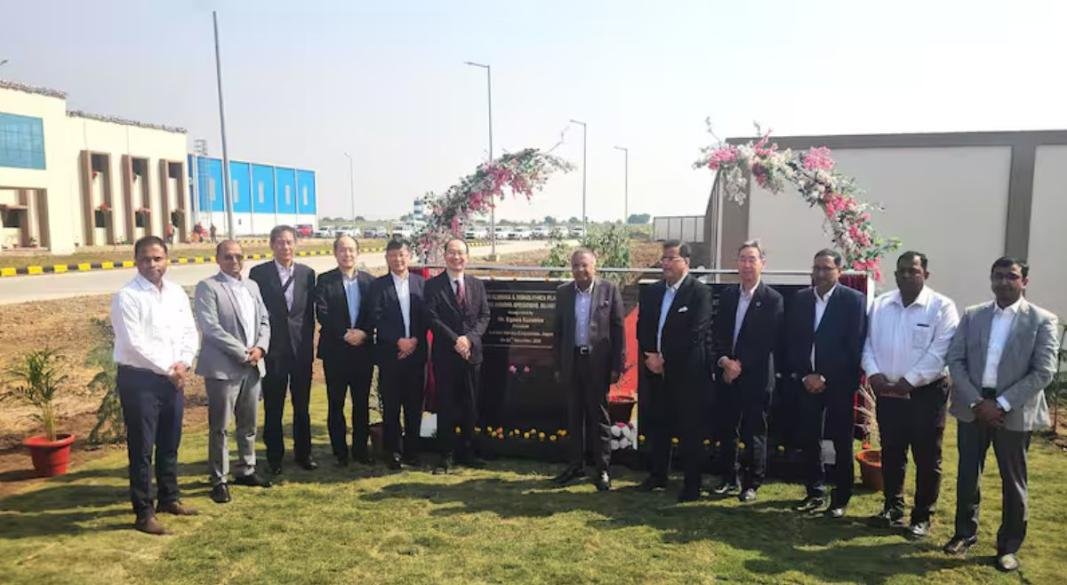
TRL Krosaki Refractories Limited has commissioned a ₹140-crore greenfield manufacturing facility at Juna Katariya, Gujarat, adding a new production base to its manufacturing network and strengthening its ability to serve industrial customers across western and southern India, as well as overseas markets.
Commissioned on 22 November 2026, the facility will manufacture high-alumina refractory bricks and castables used by cement, steel, aluminium and glass manufacturers. The investment is also expected to support the company's regional distribution and export operations, with access to raw materials, proximity to industrial customers and connectivity to seaports influencing the location decision. The Odisha-based company, part of Japan's Krosaki Harima Corporation group, has listed the Gujarat facility's annual production capacity at 66,000 tonnes, covering alumina bricks and alumina castables.
New capacity for industrial material supply
The plant will produce high-alumina refractory bricks and various grades of castables, including trough, low-cement, conventional and insulation castables. These materials are used in high-temperature industrial processes across several manufacturing sectors. Its production infrastructure includes grinding and mixing units, automated batching systems, electric screw presses, tunnel and high-temperature kilns, and driers. A dedicated mould shop and quality-control laboratory will support manufacturing and product testing. The additional capacity strengthens TRL Krosaki's production footprint and gives the company another manufacturing location to serve industrial demand in western and southern India.
Location connects raw material sourcing with customer markets
The company laid the foundation stone for the Gujarat project near Samakhiyali on 21 January 2025. At the time, it cited demand from cement and steel manufacturers in western and southern India, along with overseas markets, as key drivers behind the investment. The location also brings inbound raw material sourcing and outbound product distribution into focus. Access to refractory-grade raw materials and proximity to customers can support material movement through the manufacturing supply chain, while seaport connectivity offers an additional advantage for overseas shipments.
However, the company has not disclosed the ports that will handle exports from the facility or provided plant-specific export volumes and shipment targets. Managing Director Prasanta Kumar Naik highlighted Gujarat's access to suitable raw materials and important customer locations. Chairman Hemant M Nerurkar noted that the project had progressed despite geopolitical uncertainty and supply chain disruptions. Kazuhiro Egawa, President of Krosaki Harima Corporation, attended the commissioning.
Part of a phased manufacturing expansion
TRL Krosaki's FY2025–26 annual report described the Gujarat project as a phased development. The monolithics unit had already been commissioned, while production at the high-alumina brick facility was scheduled to begin in November 2026. The latest commissioning marks a further step in bringing the planned manufacturing capacity into operation. The company has also been investing in automation, process monitoring and quality improvements across its wider operations. These initiatives include a new coking furnace that increased monthly slide-plate production capacity from 168 tonnes to 220 tonnes, along with digital monitoring at its tap-hole clay plant.
Expanding the manufacturing footprint
TRL Krosaki's manufacturing network includes facilities at Belpahar in Odisha, Salem, Jamshedpur and Madhya Pradesh, alongside its Gujarat operations and manufacturing presence in China. Its Belpahar facility has a listed annual production capacity of 225,210 tonnes across several refractory product categories. The Gujarat plant adds another manufacturing location closer to key industrial markets in western India. Its contribution to the company's export supply chain will depend on production utilisation and customer demand. For the logistics sector, the investment highlights the role of manufacturing location decisions in connecting raw material availability, industrial consumption centres and export gateways. The extent to which the new facility translates into additional cargo movement will become clearer as production and overseas orders scale up.
Follow CARGOCONNECT for more such updates
TRL Krosaki Refractories Limited has commissioned a ₹140-crore greenfield manufacturing facility at Juna Katariya, Gujarat, adding a new production base to its manufacturing network and strengthening its ability to serve industrial customers across western and southern India, as well as overseas markets. Commissioned on 22 November 2026, the facility will manufacture high-alumina refractory bricks and castables used by cement, steel, aluminium and glass manufacturers. The investment is also expected to support the company's regional distribution and export operations, with access to raw materials, proximity to industrial customers and connectivity to seaports influencing the location decision. The Odisha-based company, part of Japan's Krosaki Harima Corporation group, has listed the Gujarat facility's annual production capacity at 66,000 tonnes, covering alumina bricks and alumina castables. New capacity for industrial material supply The plant will produce high-alumina refractory bricks and various grades of castables, including trough, low-cement, conventional and insulation castables. These materials are used in high-temperature industrial processes across several manufacturing sectors. Its production infrastructure includes grinding and mixing units, automated batching systems, electric screw presses, tunnel and high-temperature kilns, and driers. A dedicated mould shop and quality-control laboratory will support manufacturing and product testing. The additional capacity strengthens TRL Krosaki's production footprint and gives the company another manufacturing location to serve industrial demand in western and southern India. Location connects raw material sourcing with customer markets The company laid the foundation stone for the Gujarat project near Samakhiyali on 21 January 2025. At the time, it cited demand from cement and steel manufacturers in western and southern India, along with overseas markets, as key drivers behind the investment. The location also brings inbound raw material sourcing and outbound product distribution into focus. Access to refractory-grade raw materials and proximity to customers can support material movement through the manufacturing supply chain, while seaport connectivity offers an additional advantage for overseas shipments. However, the company has not disclosed the ports that will handle exports from the facility or provided plant-specific export volumes and shipment targets. Managing Director Prasanta Kumar Naik highlighted Gujarat's access to suitable raw materials and important customer locations. Chairman Hemant M Nerurkar noted that the project had progressed despite geopolitical uncertainty and supply chain disruptions. Kazuhiro Egawa, President of Krosaki Harima Corporation, attended the commissioning. Part of a phased manufacturing expansion TRL Krosaki's FY2025–26 annual report described the Gujarat project as a phased development. The monolithics unit had already been commissioned, while production at the high-alumina brick facility was scheduled to begin in November 2026. The latest commissioning marks a further step in bringing the planned manufacturing capacity into operation. The company has also been investing in automation, process monitoring and quality improvements across its wider operations. These initiatives include a new coking furnace that increased monthly slide-plate production capacity from 168 tonnes to 220 tonnes, along with digital monitoring at its tap-hole clay plant. Expanding the manufacturing footprint TRL Krosaki's manufacturing network includes facilities at Belpahar in Odisha, Salem, Jamshedpur and Madhya Pradesh, alongside its Gujarat operations and manufacturing presence in China. Its Belpahar facility has a listed annual production capacity of 225,210 tonnes across several refractory product categories. The Gujarat plant adds another manufacturing location closer to key industrial markets in western India. Its contribution to the company's export supply chain will depend on production utilisation and customer demand. For the logistics sector, the investment highlights the role of manufacturing location decisions in connecting raw material availability, industrial consumption centres and export gateways. The extent to which the new facility translates into additional cargo movement will become clearer as production and overseas orders scale up. Follow CARGOCONNECT for more such updates



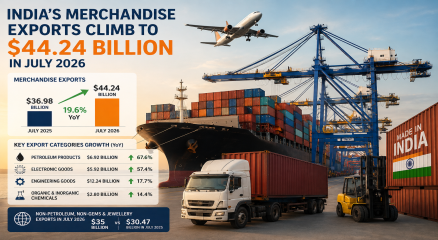
India’s merchandise exports rose 19.6% year-on-year to $44.24 billion in July 2026, marking a sharp increase from $36.98 billion a year earlier, according to provisional data released by the Ministry of Commerce and Industry. The increase was led by petroleum products, electronic goods and engineering products, even as higher imports pushed the merchandise trade deficit close to $32 billion. Among major product categories, petroleum product exports increased 67.6% year-on-year to $6.92 billion. Electronic goods exports climbed 57.4% to $5.92 billion, while engineering goods shipments rose 17.7% to $12.24 billion. Exports of organic and inorganic chemicals increased 14.4% to $2.80 billion. The broader export performance was not limited to petroleum and other high-value categories. Non-petroleum, non-gems-and-jewellery exports reached $35 billion in July, up from $30.47 billion in the same month last year. This points to continued expansion in several manufacturing and processed-goods segments. The improvement in exports came alongside a stronger increase in imports. Merchandise imports rose 17.5% year-on-year to $76.22 billion in July, compared with $64.86 billion in July 2025. As a result, the merchandise trade deficit widened to $31.98 billion, from $27.88 billion a year earlier. The export increase comes as Indian traders continue to contend with disruption across key international shipping routes. Higher freight and insurance costs, along with delays and container availability constraints, have added to logistics costs for exporters, particularly those dependent on West Asian trade corridors. Exports to West Asia nevertheless showed an improvement in July, reaching about $5.7 billion, an 8.6% year-on-year increase, according to government officials. The United States remained a major destination for Indian goods, although exporters continue to face uncertainty over tariff policy and market access. The latest figures therefore present a mixed picture for India’s external trade: merchandise exports are expanding at a strong pace, supported by manufacturing-intensive sectors, but imports are growing nearly as quickly. For logistics and supply-chain operators, the trajectory of freight rates, energy prices and geopolitical disruptions will remain important factors in determining whether the export momentum can be sustained through the rest of the fiscal year. Follow CARGOCONNECT for more such updates.

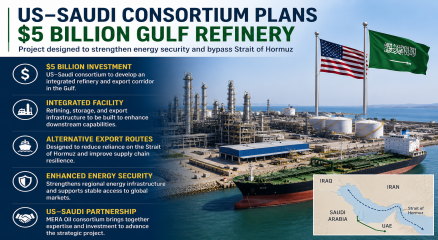
A consortium of U.S. and Saudi Arabian companies has moved ahead with plans to develop a US$5 billion integrated oil refinery and export corridor in the Gulf, aiming to strengthen regional energy infrastructure and reduce reliance on the strategically important Strait of Hormuz for crude exports. The project comes as geopolitical tensions continue to disrupt energy supply routes across the Middle East. The proposed development will combine refining, storage and export infrastructure, enabling crude oil to be processed and shipped through alternative routes outside the Strait of Hormuz. The initiative is expected to improve supply chain resilience by providing an additional export channel for petroleum products while supporting uninterrupted access to global markets. The project is being developed by the MERA Oil consortium, which comprises U.S. and Saudi partners. According to the consortium, the investment is intended to strengthen the Gulf's downstream energy capabilities at a time when regional producers are seeking to diversify export options amid continued security risks affecting maritime trade. The refinery project aligns with a broader regional trend of investing in infrastructure that bypasses the Strait of Hormuz, one of the world's most critical maritime chokepoints. Gulf countries have accelerated plans for new pipelines, export terminals and logistics corridors following repeated disruptions to shipping in the region. The Strait of Hormuz remains a vital artery for global energy trade, carrying a significant share of the world's oil exports. Recent geopolitical tensions have highlighted the vulnerability of this route, prompting governments and energy companies to pursue alternative transport and export networks to improve supply security and reduce operational risks. Follow CARGOCONNECT for more such updates.