
Loading...
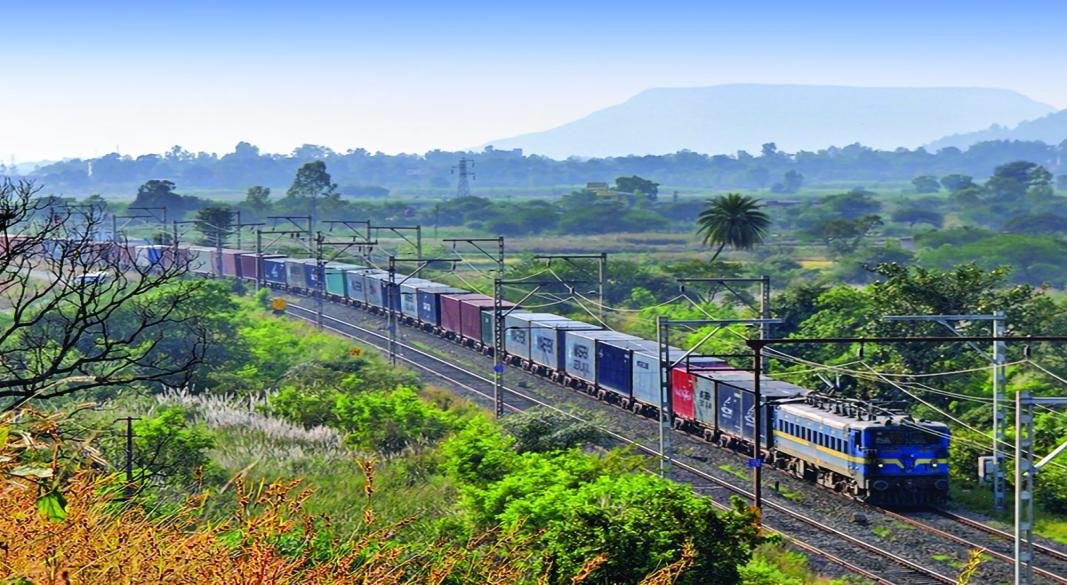
India has joined a select group of countries operating heavy-haul freight railway systems, marking a significant step in its efforts to improve freight efficiency and reduce logistics costs across the economy. The development follows the operationalisation of the country's dedicated freight corridors, which are enabling the movement of longer, heavier and higher-capacity freight trains. According to officials from the Dedicated Freight Corridor Corporation of India Ltd. (DFCCIL), India now ranks alongside nations such as the United States, China, Australia, Brazil, Sweden and South Africa that have established heavy-haul rail networks.
The announcement was made during the International Heavy Haul Seminar 2026 in New Delhi, where railway experts, technology providers and policymakers gathered to discuss advancements in freight transportation and rail logistics. The event focused on sharing global best practices and technologies that could further enhance the efficiency, safety and reliability of India's freight rail operations.
Heavy-haul railways are designed to move large volumes of cargo with greater efficiency than conventional rail systems. Their ability to transport higher payloads over long distances can help lower transportation costs, reduce network congestion and improve overall supply chain performance.
For India, the expansion of dedicated freight infrastructure is closely linked to the broader objective of reducing logistics costs. While logistics expenditure in several developed economies is estimated at around 7-8 percent of GDP, India's logistics costs have historically remained significantly higher, affecting the competitiveness of domestic manufacturers and exporters. Dedicated freight corridors were conceived to address this challenge by creating rail networks focused exclusively on cargo movement.
The Eastern and Western Dedicated Freight Corridors have already begun reshaping freight movement patterns by separating cargo traffic from passenger operations, improving train speeds and increasing network capacity. Industry studies cited by officials indicate that the corridors have contributed to more efficient freight transportation and lower logistics costs on key routes.
Looking ahead, the government has expanded its freight rail ambitions with plans for the proposed East-West Dedicated Freight Corridor. The project is expected to connect Dankuni in West Bengal with the Surat region in Gujarat through a high-capacity rail network spanning approximately 2,100 kilometres. Once completed, the corridor would strengthen connectivity between manufacturing centres, consumption markets and major ports across the country.
The next phase of development is likely to focus on technology-driven operations. Industry discussions at the seminar highlighted the growing role of artificial intelligence, predictive maintenance systems, automated inspections and digital monitoring tools in improving asset utilisation and operational reliability. These technologies are expected to become increasingly important as freight volumes continue to grow.
For the logistics sector, the emergence of a heavy-haul rail network could accelerate the shift of cargo from road to rail, particularly for bulk commodities, containers and long-distance freight. Improved rail efficiency may help shippers reduce transportation costs, enhance supply chain reliability and support India's ambition of building a more competitive multimodal logistics ecosystem.
Follow CARGOCONNECT for more such updates.
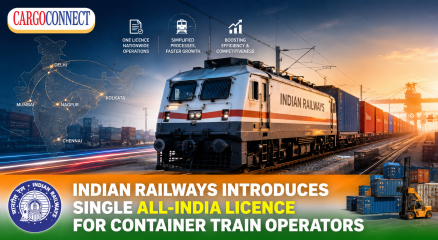
Indian Railways has approved a single all-India licence for container train operators (CTOs) to improve the ease of doing business in rail freight sector. The move replaces the existing zone-specific licensing framework and is expected to simplify operations, reduce compliance requirements, and encourage greater private sector participation in rail-based container logistics. The decision was approved by the Cabinet Committee on Economic Affairs (CCEA) as part of amendments to the Liberalised Special Freight Train Operator (LSFTO) and Container Train Operator (CTO) policies. Under the revised framework, operators will now be able to obtain a single licence permitting container train operations across the entire Indian Railways network, instead of securing separate permissions for multiple railway zones. A one-time licence fee of ₹25 crore will be applicable for the all-India permit. Existing operators holding licences for individual railway zones will have the flexibility to migrate to the new regime by paying only the differential amount between the fee already paid and the new all-India licence fee. This provision ensures a smooth transition while protecting previous investments made by operators. According to the government, the reform is designed to remove procedural complexities, create a more predictable regulatory environment, and improve operational flexibility for container train companies. A unified licensing system is expected to reduce administrative burdens, eliminate duplication of approvals, and enable operators to expand services seamlessly across different regions. The initiative aligns with the government's broader objective of increasing the modal share of rail in freight transportation. By making rail freight operations more efficient and business-friendly, Indian Railways aims to strengthen multimodal logistics, reduce transportation costs, and improve cargo movement across the country. Industry stakeholders are expected to benefit from faster network expansion, improved asset utilisation, and simplified business planning. The policy is also likely to support logistics parks, inland container depots, ports, and industrial clusters by facilitating uninterrupted rail connectivity across state boundaries. The reforms are in line with the government's vision under the National Logistics Policy and PM Gati Shakti initiative, both of which focus on improving logistics efficiency, lowering supply chain costs, and enhancing India's competitiveness in global trade. By streamlining licensing procedures and encouraging greater private participation, Indian Railways expects the new framework to accelerate containerised cargo movement while contributing to a more integrated and efficient national logistics ecosystem. 𝐒𝐭𝐚𝐲 𝐓𝐮𝐧𝐞𝐝 𝐭𝐨 CARGOCONNECT 𝐟𝐨𝐫 𝐥𝐚𝐭𝐞𝐬𝐭 𝐮𝐩𝐝𝐚𝐭𝐞𝐬!
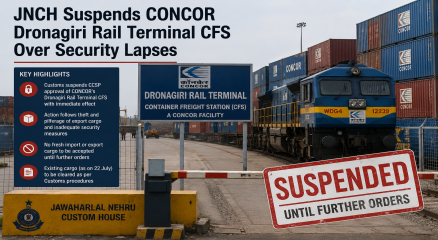
The Jawaharlal Nehru Custom House (JNCH) has suspended the Customs Cargo Service Provider (CCSP) approval of Container Corporation of India’s (CONCOR) Dronagiri Rail Terminal Container Freight Station (CFS) with immediate effect after identifying serious security deficiencies and incidents involving theft and pilferage of export cargo. The suspension will remain in force until further orders. According to a public notice issued by Customs under Regulation 11(2) of the Handling of Cargo in Customs Areas Regulations (HCCAR), 2009, the action followed an earlier advisory issued to the facility to strengthen security measures. Customs said subsequent inspections found that the prescribed safeguards had not been adequately implemented, leading to continued security concerns and cargo theft. As part of the suspension, the Dronagiri CFS will no longer accept fresh import or export cargo. However, cargo already present at the facility as of 22 July will continue to be cleared through the prescribed Customs procedures. Exceptions have also been provided for shipments where the Import General Manifest (IGM), Sea Arrival Manifest (SAM), shipping bill or bill of entry had been filed before the specified cut-off date, allowing those consignments to be processed. Spread over approximately 59 acres near Jawaharlal Nehru Port, the Dronagiri Rail Terminal is one of CONCOR's major rail-linked logistics facilities. The terminal handles around 14,000 TEUs each month, operates 90–100 freight rakes monthly, and provides warehousing for export-import, domestic and bonded cargo. The suspension is expected to temporarily disrupt cargo movement for exporters, importers and logistics service providers using the facility. Industry stakeholders said the suspension could add pressure on container freight stations and inland logistics infrastructure serving India's busiest container gateway, potentially leading to cargo diversions and longer turnaround times until normal operations resume. Customs has not indicated a timeline for lifting the suspension, stating that operations will remain restricted pending further review and compliance verification. Follow CARGOCONNECT for more such updates.

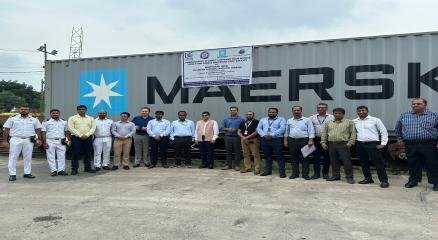
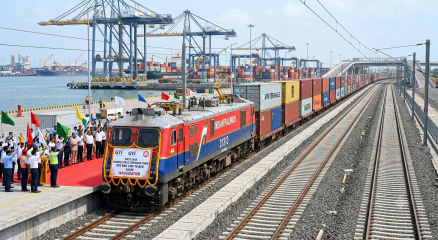
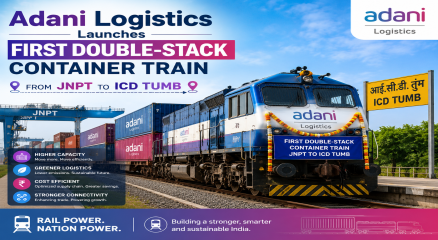
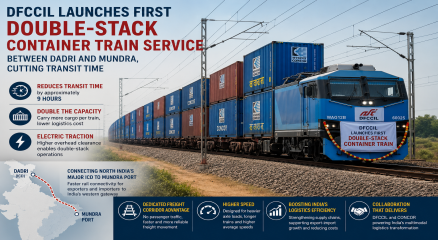
Gateway Terminals India (GTI) has marked a major milestone in India's logistics sector by successfully handling its first double-stack container train, unlocking direct access to the Dedicated Freight Corridor (DFC) and strengthening cargo connectivity between Nhava Sheva and the National Capital Region (NCR). The inaugural double-stack service to Dadri handled 270 TEUs, including 90 TEUs unloaded and 180 TEUs loaded, with the complete terminal operation completed in just seven hours. The achievement positions GTI among the growing number of terminals leveraging India's high-capacity freight corridor to accelerate inland cargo movement. The new DFC connectivity is expected to significantly improve the movement of import and export cargo by enabling direct rail access to key manufacturing and consumption hubs across northern India. Double-stack operations increase the number of containers transported per train, helping reduce transit times, optimize rail capacity, and lower overall logistics costs. According to GTI, the successful operation represents more than an infrastructure milestone. It strengthens multimodal connectivity between the port and inland markets while supporting faster, more efficient, and environmentally sustainable freight transportation. Industry experts believe the development will enhance supply chain reliability, improve cargo evacuation from the port, and encourage greater adoption of rail-based logistics as India's Dedicated Freight Corridor network continues to expand. With increasing demand for faster and more cost-effective cargo movement, double-stack rail services are expected to play a critical role in improving freight efficiency and reducing road congestion. Follow CARGOCONNECT for more such news