
Loading...
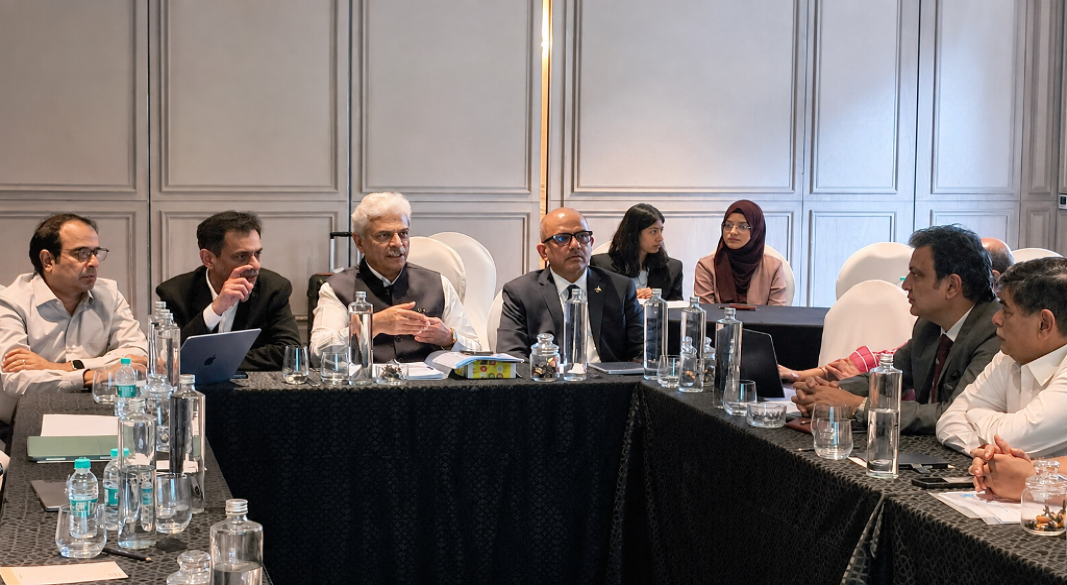
The Air Cargo Agents Association of India (ACAAI) held its Annual General Meeting at Aurika Hotel, Andheri East, Mumbai, followed by a meeting of its Managing Committee, bringing key issues shaping India’s air cargo and freight forwarding industry into focus.
The AGM reviewed ACAAI’s activities and initiatives over the past year, with members deliberating on trade facilitation, regulatory developments, operational challenges, infrastructure requirements and the evolving needs of the air cargo sector. Discussions also centred on the Association’s priorities for the coming year and its continued engagement with government authorities, Customs, airlines, airport operators, custodians and other industry stakeholders.
The subsequent Managing Committee meeting saw the constitution of the office-bearers for the ensuing term, with the existing leadership team continuing in office. Rajen Bhatia was elected as Honorary Secretary of ACAAI, joining President Samir J. Shah, Vice President Vikram Kumar and Honorary Treasurer Dinesh Krishnan in the Association’s leadership team.
The continuity in leadership underscores ACAAI’s focus on stability and sustained industry engagement as the air cargo ecosystem navigates evolving regulatory, operational and infrastructure requirements. Representing India’s air cargo agents and freight forwarding community since 1970, ACAAI remains focused on trade facilitation, policy advocacy, professional development and addressing operational challenges affecting the sector.
Looking ahead, the Association has reiterated its commitment to strengthening collaboration with Regional Councils and the wider membership, while working collectively with stakeholders to enhance the efficiency, competitiveness and ease of doing business across India’s air cargo and logistics ecosystem.
The Air Cargo Agents Association of India (ACAAI) held its Annual General Meeting at Aurika Hotel, Andheri East, Mumbai, followed by a meeting of its Managing Committee, bringing key issues shaping India’s air cargo and freight forwarding industry into focus. The AGM reviewed ACAAI’s activities and initiatives over the past year, with members deliberating on trade facilitation, regulatory developments, operational challenges, infrastructure requirements and the evolving needs of the air cargo sector. Discussions also centred on the Association’s priorities for the coming year and its continued engagement with government authorities, Customs, airlines, airport operators, custodians and other industry stakeholders. The subsequent Managing Committee meeting saw the constitution of the office-bearers for the ensuing term, with the existing leadership team continuing in office. Rajen Bhatia was elected as Honorary Secretary of ACAAI, joining President Samir J. Shah, Vice President Vikram Kumar and Honorary Treasurer Dinesh Krishnan in the Association’s leadership team. The continuity in leadership underscores ACAAI’s focus on stability and sustained industry engagement as the air cargo ecosystem navigates evolving regulatory, operational and infrastructure requirements. Representing India’s air cargo agents and freight forwarding community since 1970, ACAAI remains focused on trade facilitation, policy advocacy, professional development and addressing operational challenges affecting the sector. Looking ahead, the Association has reiterated its commitment to strengthening collaboration with Regional Councils and the wider membership, while working collectively with stakeholders to enhance the efficiency, competitiveness and ease of doing business across India’s air cargo and logistics ecosystem.


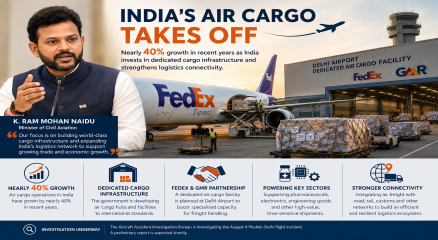
India’s air cargo operations have grown by nearly 40% in recent years, according to Civil Aviation Minister K. Ram Mohan Naidu, as the government looks to expand dedicated freight infrastructure and strengthen the country’s logistics network. Naidu said the government is working to develop air cargo hubs and facilities to international standards, reflecting the growing role of air freight in India’s wider logistics and trade infrastructure. A key development is planned at Delhi airport, where FedEx and GMR Airports have entered into a partnership to establish a dedicated air cargo facility. The project is expected to add specialised capacity for freight handling at one of India’s major aviation gateways. The increase in cargo volumes comes as India’s logistics sector handles rising demand for faster movement of high-value, time-sensitive and international shipments. Air freight is particularly important for sectors such as pharmaceuticals, electronics, engineering goods and other products where transit time is a significant consideration. The government’s focus on dedicated cargo infrastructure also points to an effort to separate freight-handling requirements from the operational demands of passenger aviation, while improving the efficiency of cargo processing and connectivity. Naidu’s comments come amid broader efforts to strengthen India’s aviation and logistics infrastructure. The government has been seeking greater integration of air transport with the country’s wider logistics network as trade and manufacturing activity expand. The reported growth in air cargo activity and planned investments in dedicated facilities indicate that freight capacity is becoming an increasingly important component of India’s aviation infrastructure. However, the effectiveness of the expansion will depend on how efficiently new cargo facilities are integrated with road, rail, customs and other parts of the supply chain. Follow CARGOCONNECT for more such updates



Munich Airport has reinforced its long-standing Sister Airport partnership with Japan's Chubu Centrair International Airport (Centrair), hosting a high-level delegation for a multi-day knowledge exchange focused on innovation, operational excellence, digital transformation and future airport development. The delegation, led by Centrair President & CEO Hironori Kagohashi, was welcomed by Munich Airport CEO, Jost Lammers as both airports reaffirmed their commitment to strengthening international collaboration and sharing best practices across airport operations, passenger services and commercial development. Highlighting the significance of the partnership, Lammers said that by sharing experiences and learning from one another, we can jointly develop innovative solutions, enhance operational excellence and continuously elevate the travel experience for our passengers. The partnership between Centrair and Munich Airport is a strong example of how airports can create value through international cooperation and prepare airports for the future. A key component of the visit was an extensive workshop programme hosted by the Munich Airport Academy, where specialists from both airports discussed a broad range of strategic priorities. Among the topics were long-term capacity planning, Munich Airport's planned extension of the T-shaped pier at Terminal 2, and strategies to efficiently manage seasonal traffic peaks and demand associated with major international events. The discussions also focused on preparations for the 2026 Asian Games in Aichi-Nagoya, which are expected to generate substantial passenger traffic across the region. Both airports explored operational planning approaches to maintain service quality while accommodating increased travel demand. Commercial strategy also formed part of the agenda, covering airport advertising, media and parking business models, alongside commercial opportunities linked to infrastructure expansion projects. Innovation in airside operations featured prominently during the exchange. Munich Airport shared updates on its autonomous cargo transport testing activities, reflecting the growing role of automation in enhancing logistics efficiency and airside operations. In return, Centrair presented progress on its Smart Ramp initiative, including the deployment of autonomous vehicle technologies designed to improve safety, productivity and operational performance. Digital transformation was another central theme, with experts comparing automated passenger processing systems and Fast Travel solutions aimed at streamlining airport operations. The exchanges highlighted how automation, digitalization and intelligent infrastructure can help airports improve throughput, optimize resources and deliver a more seamless passenger journey. Therefore, this collaboration underscores the value of the Sister Airport network, an international alliance that includes Munich Airport, Denver International Airport, Chubu Centrair International Airport, Airports of Thailand (Bangkok), Singapore Changi Airport, Beijing Capital International Airport and Airports Company South Africa. By leveraging collective expertise, member airports continue to develop innovative solutions that support sustainable growth, operational resilience and the evolving needs of global aviation, air cargo and passenger mobility. 𝐒𝐭𝐚𝐲 𝐓𝐮𝐧𝐞𝐝 𝐭𝐨 CARGOCONNECT 𝐟𝐨𝐫 𝐥𝐚𝐭𝐞𝐬𝐭 𝐮𝐩𝐝𝐚𝐭𝐞𝐬!