
Loading...
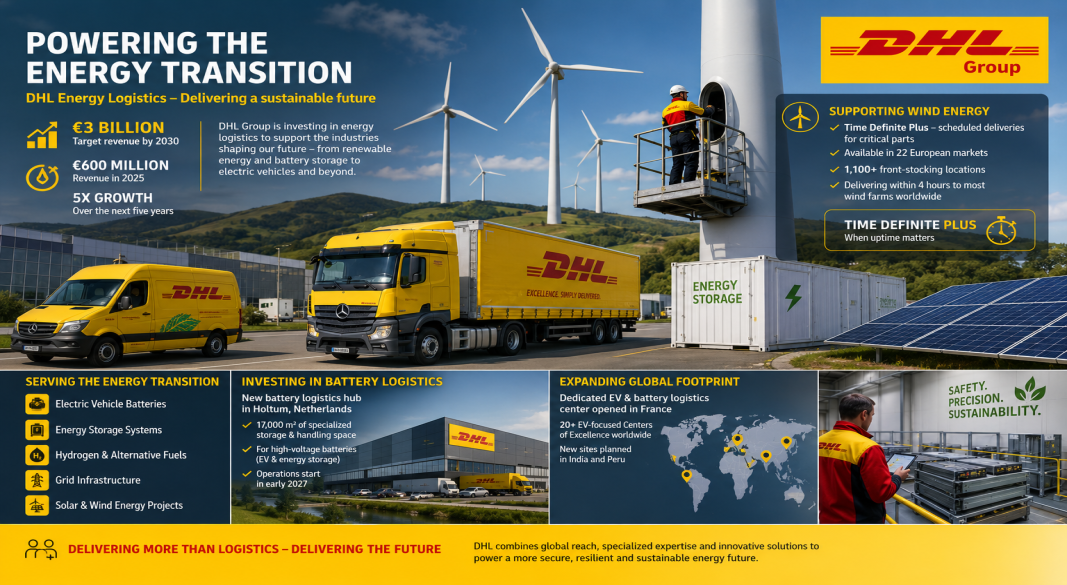
DHL Group plans to increase revenue from its energy logistics operations to €3 billion by 2030, betting on growing demand for supply chain services that support renewable energy, battery storage, electric vehicles, and other emerging energy sectors.
The German logistics company said revenue from its new energy logistics activities reached approximately €600 million in 2025 and is expected to grow fivefold over the next five years. The target forms part of DHL’s broader growth strategy, which identifies energy-related supply chains as a key long-term opportunity.
The company is expanding services across its express, freight forwarding and contract logistics businesses to support industries involved in the energy transition. DHL said increasing concerns over energy security and supply chain resilience are driving customer demand for specialized logistics solutions.
To strengthen its position in the sector, DHL has developed logistics offerings covering multiple segments, including electric vehicle batteries, energy storage systems, hydrogen, alternative fuels, grid infrastructure, and solar and wind energy projects.
A major focus is the wind energy industry, where DHL sees growing demand for maintenance and spare-parts logistics as installed capacity continues to expand worldwide. The company has introduced a new service, Time Definite Plus, initially available in 22 European markets, that provides scheduled deliveries and customized transport options for critical components and replacement parts.
DHL said its network of more than 1,100 front-stocking locations enables it to deliver spare parts to most wind farms globally within four hours, helping operators reduce equipment downtime.
The company is also increasing investment in battery logistics infrastructure. Construction is underway on a new battery logistics hub in Holtum, the Netherlands, which is expected to begin operations in early 2027. The facility will provide 17,000 square metres of specialized storage and handling space for high-voltage batteries used in electric vehicles and energy storage systems.
In France, DHL has opened a dedicated electric vehicle and battery logistics center and plans to expand similar facilities in other markets. The company currently operates more than 20 EV-focused Centers of Excellence worldwide, with additional sites planned in India and Peru.
The expansion reflects DHL’s effort to capture a larger share of supply chains linked to the global shift toward diversified energy sources while positioning itself as a logistics provider for both energy infrastructure development and aftermarket support services.
Follow CARGOCONNECT for more such updates.
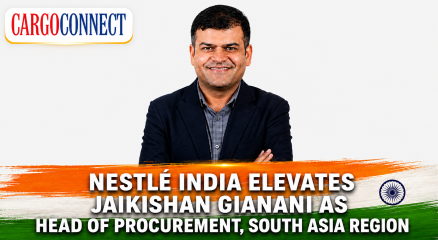
Nestlé India has elevated Jaikishan Gianani to the position of Head of Procurement for the South Asia region, effective 1st August 2026. Gianani brings extensive experience across procurement, supply chain operations, commodities and sustainability to the new leadership role. His career at Nestlé has included responsibilities spanning strategic sourcing, raw material procurement, packaging procurement, factory supply chain and supply chain projects. Over the years, he has worked across a broad range of procurement categories, including oils and fats, coffee, chicory, tea and other agricultural commodities. He has also handled global commodity procurement responsibilities covering regions across Asia, Africa, the Middle East and Oceania. Gianani holds an MBA from S.P. Jain Institute of Management & Research and a B.Tech degree from the National Institute of Technology, Durgapur. His experience extends beyond conventional sourcing. During his tenure as Head of Packaging Procurement and Lead for Sustainable Packaging in South Asia, he was involved in initiatives focused on packaging optimisation, recyclability and reducing the use of virgin plastic. His operational exposure also includes leadership of supply chain activities at Nestlé’s Nanjangud and Choladi factories, followed by a corporate procurement role. More recently, he has been associated with procurement of agri commodities and food ingredients at Nestlé. The new assignment places Gianani at the centre of Nestlé’s procurement agenda for South Asia, where supplier partnerships, commodity risk management, cost efficiency, sustainability and supply resilience remain important priorities. His experience across strategic sourcing and end-to-end supply chain functions is expected to support the company’s procurement objectives in the region. 𝐒𝐭𝐚𝐲 𝐓𝐮𝐧𝐞𝐝 𝐭𝐨 CARGOCONNECT 𝐟𝐨𝐫 𝐥𝐚𝐭𝐞𝐬𝐭 𝐮𝐩𝐝𝐚𝐭𝐞𝐬!

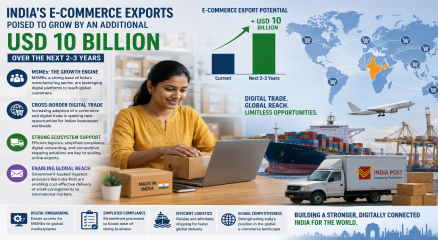
India's e-commerce exports have the potential to grow by an additional USD 10 billion over the next two to three years, supported by the country's large base of micro, small and medium enterprises (MSMEs) and increasing adoption of cross-border digital trade, according to a senior official from the Directorate General of Foreign Trade (DGFT). Speaking at an industry event, Rajesh Kumar Mishra, Additional Director General at DGFT, said India is well positioned to expand its presence in global e-commerce exports by leveraging its manufacturing capabilities and growing network of online marketplaces. He noted that while countries such as China generate significantly higher e-commerce export volumes, India has considerable scope to scale up its cross-border trade. The projected growth is expected to be driven primarily by MSMEs, which account for a substantial share of India's manufacturing sector. Digital commerce platforms are enabling these businesses to reach international consumers directly, reducing barriers traditionally associated with overseas trade. Officials also highlighted the importance of strengthening the ecosystem supporting online exports. Efficient logistics, simplified regulatory compliance, digital onboarding, and competitive shipping solutions are expected to play a key role in helping small exporters expand their global footprint. Government-backed logistics providers, including India Post, were identified as important enablers for cost-effective delivery of small consignments to overseas markets. The growth outlook aligns with the government's broader objective of increasing India's export competitiveness through digital trade. As more businesses adopt e-commerce channels, online exports are expected to become an increasingly important contributor to the country's overall export basket, while creating new opportunities for MSMEs to access international markets. Follow CARGOCONNECT for more such updates.
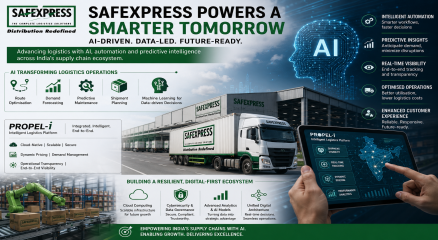
Safexpress is advancing an artificial intelligence (AI)-driven transformation of its logistics operations by integrating AI, automation and predictive analytics into its nationwide supply chain network, as the company seeks to improve operational efficiency, shipment visibility and decision-making across India's freight ecosystem. The company said it is developing an AI-first digital infrastructure capable of orchestrating complex logistics operations through real-time data processing and intelligent automation. The initiative focuses on connecting transportation, warehousing and distribution functions on a unified technology platform, enabling faster response to disruptions while improving resource utilisation and customer service. According to Safexpress, artificial intelligence is being deployed across several operational processes, including route optimisation, demand forecasting, predictive maintenance and shipment planning. The company is also using machine learning models to analyse large volumes of logistics data, helping improve delivery planning, network efficiency and asset utilisation across its nationwide operations. The digital transformation strategy builds on the company's earlier investments in cloud-native logistics technology, including its proprietary transportation management platform, PROPEL-i, which integrates core business functions and provides end-to-end shipment visibility. The platform supports dynamic pricing, demand management and operational transparency across the logistics network. Cybersecurity and data governance form another key pillar of the programme. Safexpress said it is strengthening compliance frameworks while implementing secure cloud infrastructure to protect operational data as digital adoption expands across its business. The company is also evaluating emerging technologies, including generative AI and intelligent automation, to further streamline logistics workflows and enhance customer engagement. Alongside technology investments, Safexpress is modernising its IT architecture to improve scalability and support future business growth. The roadmap includes wider adoption of cloud computing, enhanced analytics capabilities and tighter integration between digital systems to enable real-time operational decision-making across its logistics network. Industry experts view AI-enabled logistics as an increasingly important competitive differentiator, particularly as supply chains become more data-intensive and customer expectations shift towards faster, more predictable deliveries. Technologies such as predictive analytics, automation and intelligent route planning are expected to play a growing role in reducing logistics costs while improving service reliability. Safexpress said its long-term technology strategy is centred on creating a resilient, data-driven logistics ecosystem capable of supporting India's expanding manufacturing, retail and e-commerce sectors. By embedding AI across core logistics processes, the company aims to strengthen supply chain resilience while improving operational agility in an increasingly complex freight environment. Follow CARGOCONNECT for more such updates.