
Loading...
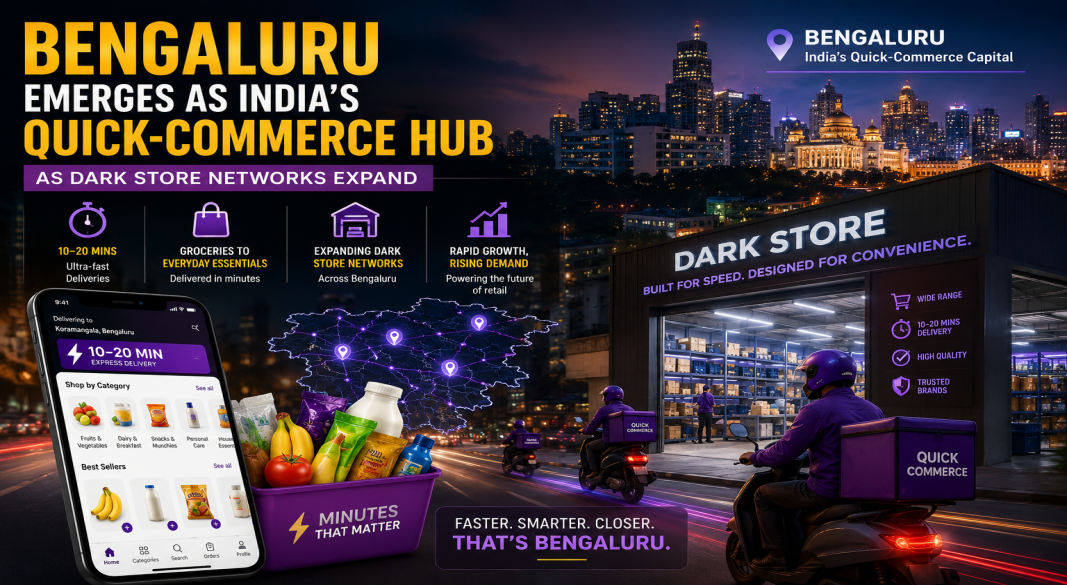
India’s quick-commerce industry is still in an early stage of expansion, but Bengaluru has already emerged as the country’s most concentrated market for dark stores — the small urban warehouses that power rapid grocery and essentials delivery.
According to recent industry estimates, India currently has an average of nearly 50 square feet of dark-store space for every 1,000 residents. Bengaluru stands far ahead of other cities with roughly 150 square feet per 1,000 people, underlining the city’s dominant position in the fast-delivery ecosystem.
The sharp lead reflects Bengaluru’s high digital adoption, dense base of app-driven consumers and strong presence of major quick-commerce operators such as Blinkit, Zepto and Swiggy Instamart. Analysts say the city’s technology workforce and familiarity with online services have helped create consistent demand for deliveries within 10 to 15 minutes.
Dark stores have become central to India’s quick-commerce race. Unlike conventional warehouses located on city outskirts, these facilities are positioned inside residential neighbourhoods to reduce delivery time. Most are compact fulfilment centres carrying fast-moving products and serving customers within a narrow radius.
Industry observers note that the business model is now shifting from aggressive expansion to improving productivity at existing locations. Companies are focusing more on order density, inventory efficiency and faster turnaround rather than simply opening new facilities across cities.
The rapid spread of dark stores is also beginning to reshape urban real estate patterns. Demand for small warehouse-style properties in residential pockets has increased, while rental values in some micro-markets have risen as quick-commerce companies compete for strategically located spaces.
At the same time, the growth has triggered concerns around traffic congestion, rider safety and the impact on traditional neighbourhood retail. In several cities, residents have raised questions over the increasing conversion of commercial and mixed-use spaces into logistics hubs operating around the clock.
Despite those concerns, experts believe India’s dark-store network still has significant room for growth. The relatively low national density compared with mature global quick-commerce markets suggests that companies will continue expanding deeper into urban and semi-urban regions over the next few years, particularly as consumer reliance on instant delivery services increases.
Follow CARGOCONNECT for more such updates.
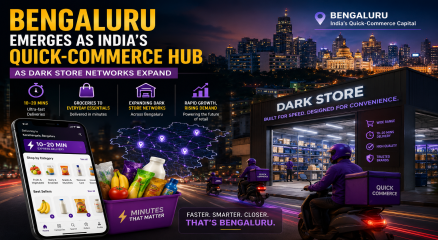
India’s quick-commerce industry is still in an early stage of expansion, but Bengaluru has already emerged as the country’s most concentrated market for dark stores — the small urban warehouses that power rapid grocery and essentials delivery. According to recent industry estimates, India currently has an average of nearly 50 square feet of dark-store space for every 1,000 residents. Bengaluru stands far ahead of other cities with roughly 150 square feet per 1,000 people, underlining the city’s dominant position in the fast-delivery ecosystem. The sharp lead reflects Bengaluru’s high digital adoption, dense base of app-driven consumers and strong presence of major quick-commerce operators such as Blinkit, Zepto and Swiggy Instamart. Analysts say the city’s technology workforce and familiarity with online services have helped create consistent demand for deliveries within 10 to 15 minutes. Dark stores have become central to India’s quick-commerce race. Unlike conventional warehouses located on city outskirts, these facilities are positioned inside residential neighbourhoods to reduce delivery time. Most are compact fulfilment centres carrying fast-moving products and serving customers within a narrow radius. Industry observers note that the business model is now shifting from aggressive expansion to improving productivity at existing locations. Companies are focusing more on order density, inventory efficiency and faster turnaround rather than simply opening new facilities across cities. The rapid spread of dark stores is also beginning to reshape urban real estate patterns. Demand for small warehouse-style properties in residential pockets has increased, while rental values in some micro-markets have risen as quick-commerce companies compete for strategically located spaces. At the same time, the growth has triggered concerns around traffic congestion, rider safety and the impact on traditional neighbourhood retail. In several cities, residents have raised questions over the increasing conversion of commercial and mixed-use spaces into logistics hubs operating around the clock. Despite those concerns, experts believe India’s dark-store network still has significant room for growth. The relatively low national density compared with mature global quick-commerce markets suggests that companies will continue expanding deeper into urban and semi-urban regions over the next few years, particularly as consumer reliance on instant delivery services increases. Follow CARGOCONNECT for more such updates.
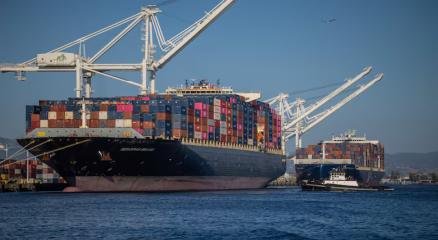


India is preparing to operationalise its trade agreement with Oman from June 1, as New Delhi accelerates efforts to secure alternative trade corridors and strengthen supply chain resilience amid continuing geopolitical and energy market uncertainty. Commerce and Industry Minister Piyush Goyal said discussions with Omani officials have progressed positively, with both sides moving toward implementation of the Comprehensive Economic Partnership Agreement (CEPA). The agreement, signed in December 2025, is expected to provide duty-free access for a large share of Indian exports to Oman, including engineering goods, textiles, food products and chemicals. In return, India will lower tariffs on several Omani exports, including petrochemical products and minerals. Trade and logistics stakeholders view the pact as strategically important for India’s westbound cargo movement and regional connectivity ambitions. Oman’s geographic position along major maritime routes in the Arabian Sea and Gulf region gives Indian exporters an additional gateway into West Asia and parts of Africa. The agreement is also expected to support warehousing, port-led trade and multimodal logistics integration between the two countries. Government officials indicated that the CEPA would cover more than 98% of Indian export tariff lines entering Oman, while India would gradually liberalise access across a significant portion of imports from Oman. Certain sectors, particularly petrochemicals, may see phased tariff reductions rather than immediate elimination. The push to activate the Oman pact comes as India expands its broader trade strategy through multiple bilateral agreements aimed at reducing dependence on concentrated supply chains and improving market access for domestic manufacturers. Recent discussions involving trade arrangements with the UK, EU and other partners have reinforced New Delhi’s emphasis on export diversification and trade-led industrial growth. Industry analysts expect the Oman agreement to particularly benefit Indian sectors linked to containerised exports, chemicals, automotive components, processed foods and MSME manufacturing clusters. Shipping and logistics companies are also likely to see increased cargo flows through western Indian ports as bilateral trade volumes rise under preferential tariff treatment. Follow CARGOCONNECT for more such updates.



Indian refiners are preparing to scale back purchases of Russian crude oil as a temporary US sanctions waiver approaches its expiry, prompting state-run oil companies to reassess sourcing strategies amid growing compliance and financial risks. The waiver, introduced by Washington earlier this year to stabilise global energy supplies during the West Asia conflict, allowed Indian refiners to continue importing certain Russian oil cargoes despite broader sanctions linked to the Russia-Ukraine war. The current authorisation is scheduled to end on May 16, creating uncertainty around future procurement and payment mechanisms. Industry sources indicate that major public-sector refiners, including Indian Oil Corporation (IOC), Bharat Petroleum Corporation Ltd (BPCL) and Hindustan Petroleum Corporation Ltd (HPCL), are evaluating alternative crude supply routes to reduce exposure to secondary sanctions and disruptions tied to Western financial systems. India sharply increased Russian crude imports in recent months as tensions in the Persian Gulf disrupted traditional Middle East supply chains. Russian oil became a commercially attractive substitute due to discounted pricing and availability through longer Cape-route tanker shipments. According to industry data, India’s Russian oil imports surged to record levels during the peak of the regional energy disruption. However, the economics behind those purchases have begun to shift. Analysts say discounts on Russian Urals crude have narrowed significantly as demand for non-Gulf oil supplies increased globally, reducing the commercial advantage that initially drove higher imports. At the same time, tighter scrutiny from the US Office of Foreign Assets Control (OFAC) has increased compliance concerns for refiners dependent on Western banking, insurance and shipping infrastructure. Indian refiners are now exploring diversification strategies that include higher volumes from the Middle East, West Africa and the United States. Crude sourced from Saudi Arabia, the UAE, Iraq, Nigeria and Angola is being considered as part of a broader effort to maintain supply stability while limiting sanctions-related exposure. Private refiners such as Reliance Industries and Nayara Energy are expected to retain some level of Russian crude sourcing due to greater operational flexibility and different financing structures. Market observers, however, expect Russia’s share in India’s crude import basket to gradually decline if Gulf supply routes normalise and the US waiver is not extended. The shift also has implications for global shipping and tanker operations. A significant portion of Russian crude transported to India over the past two years has moved through vessels operating outside conventional Western insurance and ownership frameworks, commonly referred to as the “shadow fleet.” As enforcement risks increase, Indian authorities and shipping companies are placing greater emphasis on expanding domestic tanker capacity under Indian regulatory and insurance systems. The evolving procurement strategy highlights the growing intersection between geopolitics, sanctions compliance and energy logistics, with Indian refiners balancing supply security against rising regulatory and operational risks in global crude markets. Follow CARGOCONNECT for more such updates.