
Loading...
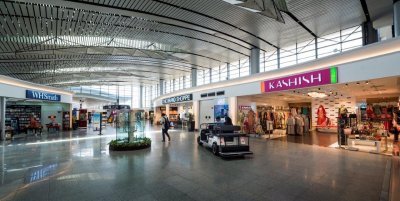
GMR Hyderabad International Airport Ltd (GHIAL), a GMR-led consortium, today announced that Rajiv Gandhi International Airport (RGIA) has been adjudged as the ‘Best Regional Airport in India and Central Asia’ for the third consecutive year in 2021 Skytrax World Airport Awards. The airport has also progressed in its overall ranking, moving from 71st position in 2020 to 64th position in 2021 World’s Top 100 Airport league. Additionally, Hyderabad airport has bagged accolades in following categories:
Commenting on the achievement, Pradeep Panicker, CEO, GHIAL said, “With immense pleasure we would like to dedicate this award to all the airport staff, stakeholders and partners working at Hyderabad Airport, who have done a commendable job with unwavering commitment during the pandemic times. We believe that our innovative and tech-enabled initiatives during the pandemic and crisis preparedness has led to this achievement. This recognition motivates us to further raise the bar and reinforce our commitment to provide a safe and seamless experience to all our passengers.”
GMR led Delhi International Airport Ltd. (DIAL) is another major winner of this prestigious awards. The airport has been adjudged as the ‘Best Airport in India and Central Asia’ for the third consecutive year in 2021 Skytrax World Airport Awards. The airport has also improved its overall ranking, moving from number 50 in 2020 to number 45 in the 2021 World’s Top 50 Airport league. This achievement marks the First Indian Airport to achieve this feat. DIAL has also been bestowed with the ‘COVID-19 Airport Excellence Award’ for providing exemplary safety protocols during the global pandemic, making it the only airport in India to be ascribed in this category.
Under the umbrella of GMR Airports, Delhi Airport has ranked 1st, whereas Hyderabad Airport has ranked 2nd in the ‘Best Airport in India and Central Asia’ category, beating Mumbai, Bangalore, Chennai airports in India and Colombo Airport in Central Asia region.
The Skytrax World Airport Awards are the most prestigious accolades for the airport industry, voted by customers in the largest, annual global airport customer satisfaction survey. They are regarded as the quality benchmark for the world airport industry, assessing customer service and facilities across over 550 airports. The survey and awards are independent of any airport control or inputs.
The Awards are based on the World Airport Survey questionnaires completed by over 100 nationalities of airport customers during the 6-month survey period. The survey evaluated the customer experience across airport service and product key performance indicators - from check-in, arrivals, transfers, shopping, security and immigration through to departure at the gate.
The World Airport Star Rating program is a global Quality-Evaluation-System for the Airport industry. It uses a direct and professional analysis of Airport's Product and Service Quality Standards. It began in 1999, when Skytrax launched its first global, Airport customer satisfaction survey. The survey evaluates traveller experiences across different airport service and product key performance indicators - from check-in, arrivals, transfers, shopping, security and immigration to departure at the gate.
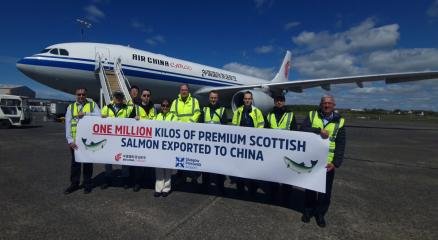
Glasgow Prestwick Airport has surpassed the milestone of exporting one million kilograms of Scottish salmon since January 2026, highlighting the growing strength of the airport’s temperature-controlled seafood logistics operations. The achievement follows the launch of Prestwick’s dedicated Scotland-to-China seafood export service last September, supported by investments in specialised cool-chain infrastructure, temperature-controlled handling systems and dedicated personnel for perishable cargo operations. The airport’s seafood export ecosystem now includes high-capacity metal detection systems, advanced temperature monitoring and tracking technologies, along with 87 tonnes of chiller capacity designed to support time-sensitive exports. According to Ian Forgie, Chief Executive Officer, Glasgow Prestwick Airport the milestone demonstrates increasing confidence among seafood exporters in Prestwick’s ability to provide faster and more resilient market access for premium Scottish produce. "Every hour saved between the catch and final market helps protect quality, shelf life, and value for exporters, and that is exactly where Prestwick can make a difference," he noted. The cargo growth has also been supported by expanded freighter connectivity with Asia. Air China Cargo recently increased its Prestwick–Chengdu cargo services from four weekly flights to daily operations, taking the airport’s total direct cargo flights to mainland China to 15 per week. Additionally, Ethiopian Airlines introduced three new weekly Hong Kong cargo flights earlier this month, further strengthening Prestwick’s position as a strategic gateway connecting Scottish exports to high-growth Asian markets including South Korea and Vietnam. The development reinforces the growing role of air cargo infrastructure and cold-chain logistics in supporting Scotland’s premium seafood export industry and enhancing supply chain resilience across international trade corridors.


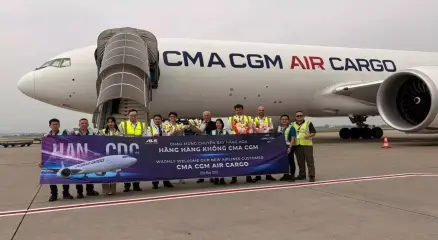
CMA CGM Group has launched a new Paris–Hanoi freighter service, reinforcing the growing strategic importance of Vietnam in global manufacturing and supply chain networks. The dedicated Boeing 777F operation connects Paris Charles de Gaulle Airport with Hanoi’s Noi Bai International Airport, with a return routing via Navoiy, Uzbekistan, enhancing cargo connectivity between Southeast Asia and Europe. The inaugural flight departed on May 9, marking another step in CMA CGM Air Cargo’s long-haul expansion strategy as shippers increasingly diversify sourcing and production activities beyond China. Vietnam has emerged as a critical export hub for electronics, textiles, footwear, industrial machinery and e-commerce products, driving sustained air cargo demand on Europe-bound trade lanes. The new service is expected to provide supply chain planners and freight forwarders with additional capacity and greater schedule reliability at a time when manufacturers are seeking resilient and multimodal logistics solutions. Industry analysts note that Vietnam’s role in global supply chains has accelerated due to continued foreign direct investment, expanding manufacturing clusters and the rapid growth of cross-border e-commerce. By integrating Hanoi into its freighter network, CMA CGM is also strengthening its end-to-end logistics strategy, combining ocean shipping, air freight and inland transport services under a unified supply chain offering. The move aligns with the group’s broader ambition to become a fully integrated logistics player capable of offering agile transport solutions for high-value and time-sensitive cargo. The routing through Navoiy further highlights the increasing importance of Central Asia as a transit and technical hub connecting Europe and Asia. The Uzbekistan stopover enables operational flexibility while supporting wider regional cargo connectivity. The deployment of the Boeing 777F on the route underscores CMA CGM Air Cargo’s focus on long-range, high-capacity freighter operations. The aircraft is widely used in global air cargo networks for transporting high-volume industrial shipments, electronics and e-commerce cargo efficiently across intercontinental trade lanes. As supply chains continue shifting toward Southeast Asia, the launch of the Paris–Hanoi service positions CMA CGM to capture growing trade flows between European consumption markets and Vietnam’s export-driven manufacturing economy. The added freighter capacity is likely to benefit exporters, logistics providers and multinational manufacturers seeking faster and more resilient cargo connectivity between Asia and Europe. 𝐕𝐢𝐬𝐢𝐭: https://cargoconnect.co.in/ for latest news!

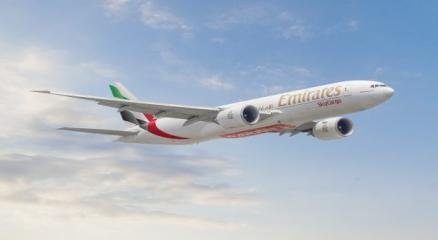
Emirates SkyCargo strengthened its position in the global air freight market during fiscal year 2025-26, supported by strategic freighter additions, network expansion, and resilient cargo demand across key trade lanes. The cargo division emerged as a major contributor to the Emirates Group’s record financial performance, reflecting the growing importance of air cargo in global supply chains. The Emirates Group reported a record profit before tax of AED 24.4 billion (US$6.6 billion) for FY2025-26, while revenues rose 3% year-on-year to AED 150.5 billion. Emirates airline alone generated AED 130.9 billion in revenue and retained its position as the world’s most profitable airline. Cargo operations played a significant role in this growth trajectory. Emirates SkyCargo transported approximately 2.4 million tonnes of cargo during the fiscal year and generated AED 16.2 billion in revenue, according to regional business reports. The carrier benefited from additional freighter capacity introduced over the past year as it responded to sustained e-commerce demand, pharmaceutical shipments, perishables trade, and manufacturing recovery across Asia, Europe, and the Middle East. The airline continued investing heavily in fleet and logistics infrastructure to strengthen its cargo capabilities. Emirates Group invested AED 17.9 billion (US$4.9 billion) during FY2025-26 in aircraft, equipment, technology, and facilities to support long-term growth plans. Industry analysts note that the addition of Boeing 777 freighters and leased cargo aircraft enabled Emirates SkyCargo to improve schedule flexibility and capacity deployment across high-demand international routes. The expansion comes at a time when global air cargo markets are stabilising after several years of disruption. Rising cross-border e-commerce volumes and increasing demand for time-sensitive shipments continue to support premium air freight services. Emirates SkyCargo has also expanded specialised logistics offerings for pharmaceuticals, dangerous goods, and temperature-sensitive cargo, reinforcing Dubai’s role as a global logistics hub. Despite geopolitical tensions and operational disruptions in the final month of the financial year, Emirates maintained strong cargo and passenger demand. Group Chairman and Chief Executive Sheikh Ahmed bin Saeed Al Maktoum highlighted the resilience of the company’s business model and its continued investments in innovation, people, and infrastructure. With additional freighters expected to join its fleet over the next few years, Emirates SkyCargo is positioning itself for further expansion as global supply chains increasingly prioritise speed, reliability, and network connectivity.