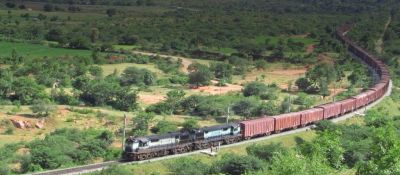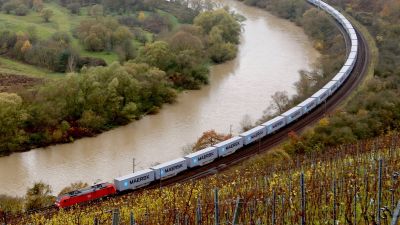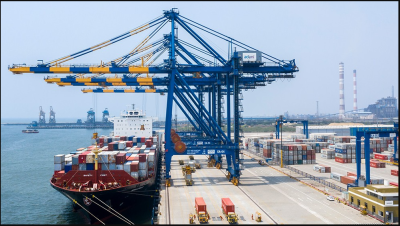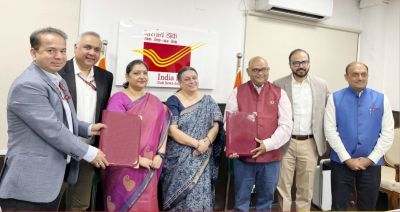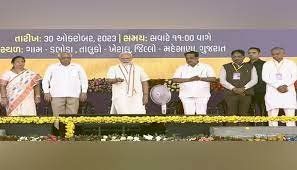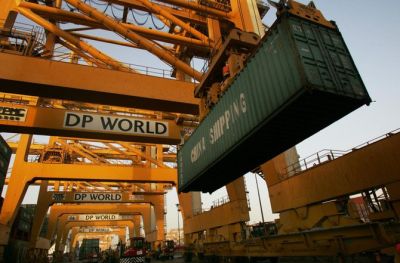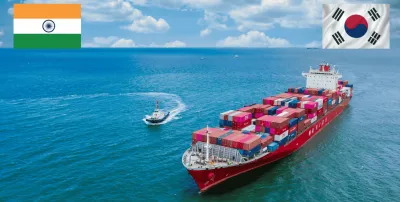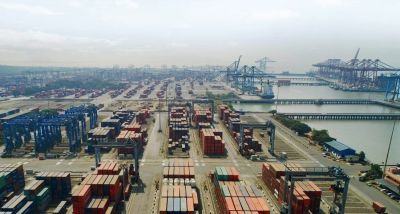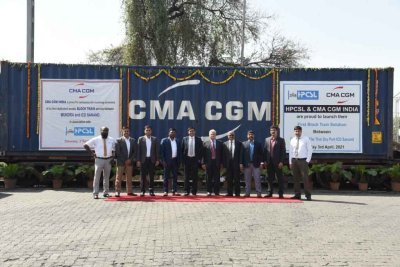
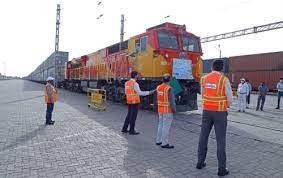
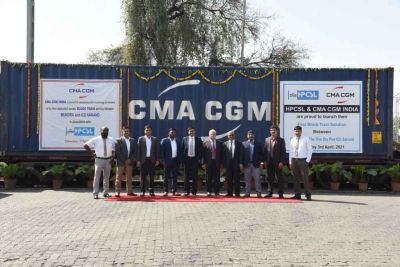
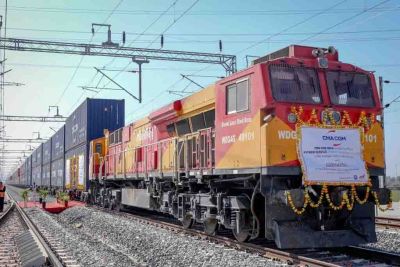
The CMA CGM Group and The Thar Dry Port (A unit of Hasti Petro Chemical & Shipping) jointly received their first-ever block train. This new service is the first block train by a shipping line between Mundra and Thar Dry Port (ICD) at Sanand, Gujarat.
The fully loaded 90-TEU train was flagged off from Mundra port on April 02 and was received at ICD Sanand on April 03 in the presence of representatives from The Thar Dry Port and CMA CGM India.
Fixed window and dedicated train service for Sanand for import shipments
The new weekly block train service is the first and only block train service by any shipping line, for Ahmedabad, Ex- Mundra. The train provides fixed window and dedicated service for customer import shipments ensuring a reliable departure schedule.
The schedule departure of train from Mundra Port will be on every Saturday/Sunday.
This new service from Mundra to Sanand offers customers effective cargo handling and provides priority loading for urgent import shipments with no additional cost. Another key feature of the service is to have no partial loading from Mundra, as all the containers will arrive together as per bill of lading (BL).
Going forward, the CMA CGM Group is planning on streamlining the service even more to have a priority connection with the Group’s Indamex and EPIC services, two major services of CMA CGM India, calling the Gujarat region.
CMA CGM, an expert in intermodal solutions committed to meeting its customers’ needs
The CMA CGM Group is an industry pioneer offering customised, innovative and customer centric intermodal solutions for seamless continental connections. This new block train service is another example of the Group’s commitment to offering its Indian customers the best service, wherever they are located in the country.
CMA CGM is developing sustainable door-to-door solutions to allow its customers to significantly reduce the carbon footprint of their transported goods. Compared to cargo movement via truck, the block train option reduces CO2 emissions by up to 67%.
Present in India for more than 30 years, the CMA CGM Group employs 4,700 staff members in India. It connects the country to the rest of the world with 12 services making 12 calls weekly.
On the launch of this block train service, Atit Mahajan, Managing Director, CMA CGM India said, “CMA CGM is the pioneer in providing a seamless and connected intermodal network in India, and we are pleased to team up with Hasti Petro Chemical & Shipping Ltd to serve India’s hinterland and meet our customers’ needs across the country.”
Hasti Petro Chemical & Shipping Limited (HPCSL), a leading logistics supply chain player
Incorporated in 1991, Hasti Petro Chemical & Shipping Limited (HPCSL) is a pioneer and market leader in providing tailor-made intermodal logistics solution for containerised movement of export and import/coastal and domestic cargo by rail and road through ICD’s at Sanand – Gujarat and Jodhpur – Rajasthan under the brand name– The Thar Dry Port.
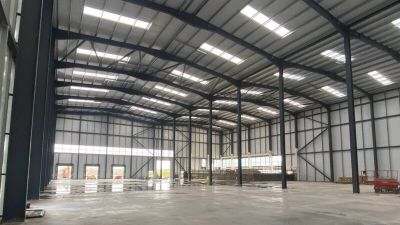
HPCSL has established itself as a trusted tested reliable logistics supply chain partner with dedicated team of professionals in ICD terminal services, 3PL warehousing/transportation distribution, special handling of auto rakes with robust infrastructure at both locations with additional ICDs coming up at Jaipur & Baroda. With an infrastructure consisting of 8 railway rakes, 418 trailers, container handling equipment’s, 100-acre land, 3 lakh sq ft of bonded and non-bonded warehousing, HPCSL handles through put of 1.5 lakh TEUs per annum, currently. HPCSL is a diversified– flagship of different verticals, i.e. petrol pumps, gas agencies, hotels, IMFL blending & bottling plants, and real-estate – and possessing unique management expertise to meet the needs of a wide range of customers.
Under the unwavering commitment of Ruchir Parekh, Managing Director and CEO of the Group, the business has grown to unprecedented height with a vision to become one of the largest players in private sector with state of art Inland Container Depots/Container Freight Stations in India.
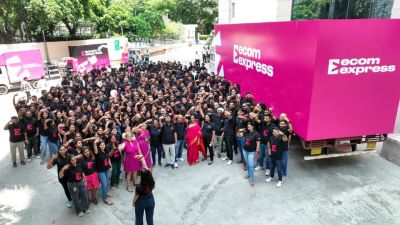
Ecom Express Limited, India’s sole pure-play B2C e-commerce logistics provider as of the Financial Year 2024, has introduced a new brand identity, underscoring its commitment to customer-centricity. This rebranding reflects a focus on addressing specific customer needs, prioritising customer-facing metrics, and integrating innovative technology across its nationwide express logistics network. The goal is to enhance speed, agility, and network reach, ensuring a customer-focused approach. The rebranding includes a dynamic logo and a refreshed visual identity, symbolising Ecom Express’s pursuit of excellence. The new logo features a forward-moving arrow within a square, representing the company’s dedication to delivery. The letter "E" in the logo stands for Expression, Innovation, and Progress, while the bold magenta colour signifies bravery, self-expression, and strength. This vibrant magenta reintroduction reflects Ecom Express's renewed commitment to customers, partners, and team members, as the company aims to simplify and democratise logistics for all. Ajay Chitkara, CEO and MD of Ecom Express, elaborated on the transformation, stating, “Our refreshed brand identity reaffirms our customer-first approach as we continue to integrate technology and innovation to provide reliable, high-speed services with the widest network reach. This transformation also underscores our commitment to our employees and delivery partners, who are essential to our business.” The new logo embodies Ecom Express’s dedication to its core values, focusing on customer welfare and fostering a diverse, inclusive environment. This rebranding signifies a promise to redefine logistics through advanced technology, making life easier for all types of customers.
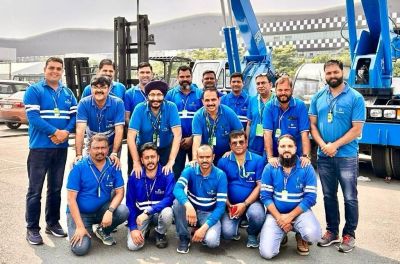
Building a visionary company requires one percent vision and 99 percent alignment. This analogy resonates deeply when we compare the process of building a company to conducting a symphony orchestra. Just as a conductor leads musicians to create a harmonious masterpiece, a successful business and its management fosters alignment among team members to achieve extraordinary success. In the business world, this vision translates into a clear understanding of where the company wants to go and what it aspires to achieve. The one percent of vision acts as the guiding force that sets the stage for greatness. However, a conductor alone cannot create a symphony. The true magic lies in the collective effort of the musicians, each playing their part to perfection. Similarly, in a visionary company, alignment becomes paramount. Every team member needs to be facing in the right direction, equipped with the right skills, and focused on delivering the right results at the right time. By fostering alignment, harnessing the diverse talents within the team, and continuously fine-tuning performance, savvy teams and visionary leaders carry the potential to transform their companies into harmonious and successful organisations that resonate with greatness. Embracing the power of alignment, inspiring teams with a clear vision, and actively cultivating an environment where every member can contribute their unique talents, RE Rogers India has over the years formed an indispensable pillar of business triumph. Most recently, the company orchestrated a symphony of success handling over 300 events in the fiscal year 2023. Four of these were mammoth events taking place in four different cities at around the same time frame. And these were not merely gatherings, they were milestones. The four gigantic events (CPHI and PMEC 2023 – 28 to 30 November at India Expo Centre, Noida; ENGIMACH 2023 – 6 to 10 December at Helipad Exhibition Centre, Gandhinagar, Gujarat; EXCON 2023 – 12 to 16 December at Bangalore International Exhibition Centre, Bengaluru; PLASTIVISION 2023 – 7 to 11 December at Bombay Exhibition Centre, Mumbai) entailed approximately 650 on-ground manpower, 4300 packages, 370 equipment display, and 3600 vehicles. The symphony of greatness bubbled up in RE Rogers India's operational procedures and functions, and the teams and management leadership soared to create a masterpiece of lasting success as always. "To our heroes who faced the challenges head-on in handling their jobs with total finesse, and to our valuable customers who trusted us blindly during our busiest period pan-India: A HUGE THANK YOU!," the RE Rogers India team was quoted expressing in a LinkedIn post. As the demand for large-scale events and exhibitions continues to rise, the need for comprehensive and reliable exhibition logistics services has never been more critical. In India, where the exhibition industry thrives, one name stands out among the rest — RE Rogers India — who have been delivering unparalleled logistical solutions tailored to the unique demands of the exhibition sector. RE Rogers India have years of first-hand, specialist experience in handling every aspect of exhibitions, ranging from freight forwarding, transportation, customs formalities, secure handling of materials, on-time delivery and site assistance and supervision. Remember that logistics is not just about getting your materials from point A to point B; it’s about ensuring a seamless and stress-free experience for everyone involved in your exhibition, from exhibitors to attendees. So, if you partner with RE Rogers India, you’re not just hiring a logistics company; you’re bringing a dedicated and reliable team on board to ensure your exhibition materials reach their destination in perfect condition and on time. Having served a variety of clients from both the domestic and international arena, the company has developed deep understanding of the unique challenges of delivering time-critical goods in the face of huge crowds, open day pressure, and complex logistical requirements. RE Rogers India fully understands the value of complete exhibition sets in terms of the clients’ reputation and market standing, ranging from trade show booths, exhibits, and other equipment, which include wooden panels, steel frames, prefabricated designs, bunk houses, E-houses, printed material, lights, electronic items and other display resources. The company therefore takes utmost care to pay close attention to critical things like packing, loading, storing, lifting, etc. so as to eliminate any chance of damage. Due diligence is also exercised in choosing optimum and fastest mode of transport to enable the materials to reach the venue well in time, so as to facilitate timely set-up by the clients team at the venue. Post-exhibition, pick-up and delivery back to the shipper is also handled. With RE Rogers India as your esteemed logistics partner, you can focus on wowing your audience and making the most of your exhibition experience. Under the astute leadership of Ravinder Sethi, RE Rogers India is not just reaching new heights; it is setting successive benchmarks. With the innate ability to see through the intricacies and a commitment to perfection down to the minutest detail, Sethi has steered the company towards a trajectory of unparalleled success. His visionary approach complemented by the team's meticulous attention to excellence have become the driving force behind RE Rogers' ascent in the events and exhibition logistics sector. The collective efforts of Sethi and his entire team continue to sculpt a legacy of precision and excellence in the world of logistics that remains exciting, challenging and rewarding.
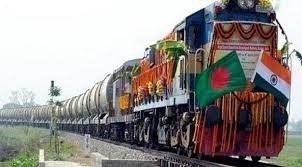
A significant milestone has been achieved in the Indo-Bangla railway project with the inauguration of the inaugural freight train connecting Bangladesh's Gangasagar to Tripura's Nischintanpur. This momentous event marks a significant step forward in strengthening the rail connectivity between the two neighboring countries. The new railway connection is set to enhance trade and commerce between India and Bangladesh, providing a more efficient and cost-effective mode of transportation for goods. It will not only boost bilateral trade but also promote economic development in the region by opening up new opportunities for businesses and industries. The Indo-Bangla railway project is part of a broader effort to improve connectivity and foster closer ties between the two nations. It is expected to play a vital role in facilitating the movement of goods and passengers, ultimately contributing to the economic growth and prosperity of both countries.
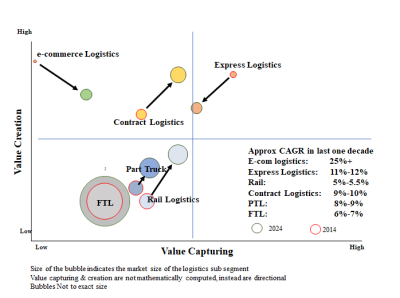
The past decade has been a transformative period for the Indian logistics sector, characterised by a blend of challenges and growth opportunities. Key milestones such as the formal recognition of logistics as infrastructure, the implementation of GST, and disruptions from COVID-19 have reshaped the industry landscape. During this time, technology adoption surged, sustainability became a focal point, and the sector prioritised agility and resilience. As a result, new business models emerged, and the sector registered a growth rate of 8%-9%. Throughout this period of growth, logistics companies have created significant value for their customers by offering innovative solutions, improving efficiency, and providing exceptional service experiences. However, the process of capturing and capitalising on this value is complex, requiring long-term investment and strategic focus. Companies typically follow one of two paths: competitive pricing or superior customer value. Yet, only a few have successfully extracted profits and solidified their competitive position, while others have faced decline. On a broader scale, while the logistics sector has made substantial progress in innovation, infrastructure, and technology, its financial returns and profitability have often fallen short of expectations. The challenge lies in the varied performance of subsegments such as express delivery, e-commerce logistics, and contract logistics. Each of these subsegments faces distinct challenges, influenced by factors such as market demand, regulatory policies, technological integration, and investment levels, leading to diverse outcomes across the sector. India's transportation sector is predominantly road-based, with nearly two-thirds of the market share. Among road logistics, Full Truck Load (FTL) remains highly fragmented, with a minimal presence of organised players. While the market has nearly doubled over the last decade, along with technology adoption in fleet and transport management, startups like Blackbuck have made attempts to drive the sector toward organisation, but no significant breakthroughs have emerged. As a result, FTL has struggled to create substantial value for customers, and profitability within the segment has remained stagnant. The second major segment in road logistics is Part Truck Load (PTL) services, where organised players have made gradual improvements. Companies like VRL and V-Trans India have established a national presence, supported by relevant infrastructure and technology. These organised players have delivered tangible value to customers, improving profitability alongside revenue growth through a cost-conscious approach. Rail logistics, on the other hand, has created significant value in specific subsegments, such as container train operators, private rail operators, and car carriers. While Indian Railways remains the primary infrastructure provider, private players like Adani, DP World, Gateway Distriparks, and Pristine have experienced profitable growth over the past decade. E-commerce logistics has been the most hyped segment in the last ten years. While e-commerce logistics started gaining traction in 2010, it exploded in 2014 with technological advancements and the emergence of new-age companies. This segment has grown into a US$6 billion market, creating immense value by reducing transit times, improving customer service, and offering tech-driven solutions. However, as these differentiators become industry standards, the rate of value creation has slowed. Despite significant investments to achieve profitability, most e-commerce companies are still either EBITDA-negative or marginally positive. While they have made strides in reducing losses, profitability remains below industry benchmarks. The express logistics segment, largely controlled by organised players, has also experienced incremental improvements in service offerings and customer service. Despite challenges such as declining document volumes, slow air cargo growth, and cost pressures, express logistics has achieved double-digit growth. However, the segment has failed to create significant new value, as many differentiators have now become standard offerings. This inability to create and capture value raises concerns for the future of express logistics. In contrast, the contract logistics segment has benefited from complex global supply chains and the post-GST momentum, providing significant opportunities for value creation through optimisation. Organised players, with their advanced solutions, technology, and automation, have been able to capture substantial value in this segment. Overall, while the logistics industry has created value across most of its segments, the ability to capture this value has been suboptimal. Factors such as technological advancements, sustainability trends, and evolving customer expectations will continue to influence value creation. However, value capture will hinge on effective pricing strategies, market positioning, and operational scalability. In the future, a balance between continuous innovation and profitability will be essential for long-term success in the logistics industry. Author: Vikash Khatri, Founder, Aviral Consulting
The Federation of Freight Forwarders’ Associations in India (FFFAI) held its 6th EC Meeting for the term 2021-23 on May 27 and 28 in Bengaluru. The meeting was attended by the Office Bearers and 28 Member Association representative of FFFAI from across the country, there were many issues discussed and updates provided concerning customs, CBLR, EDI, Service Tax/GST, logistics, air cargo, sea cargo, skill development,importance of social media which FFFAI has expanded recently, technology developments, etc. The special focus of the 6th EC meeting was the updates on forthcoming 24th Biennial Convention of FFFAI to be held from August 12 to 14, 2022 in Chennai with the theme LOGISTICS RESHAPE, EMBRACE AND SURGE IN THE DIGITAL ERA. At this EC meeting, FFFAI also implemented Digital Learning platform for members and next generation for e-learning. It has been decided that FFFAI would initiate FIATA eFBL here in India to benefit the trade, which empowers customs brokers, freight forwarders and logistics service providers. In addition, updates on the recently held FIATA HQ Meet was also provided by the concerned members of FFFAI. FFFAI members present at this EC meeting stressed upon enhancing productivity on ICEGATE for trade facilitation and Ease of Doing Business. The FFFAI members also urged for creating a dedicated portal for LSP integration. As regard to skill development initiatives, IIFF’s (training arm of FFFAI) past and forthcoming training programmes (both online and classroom/physical) for the entire logistics industry were presented at the EC meeting. In addition, FFFAI’s various initiatives on capacity building through technology/IT also discussed withadequate importance. Recent activities of FFFAI Women’s Wing including organising interactive meetings with Government of India officials and industry experts were highlighted at this meeting which drew huge appreciation from the members. The members committed to expand the activities of the Women’s Wing in all the 28 member association locations to empower/encourage the women logistics practitioners. At this EC meeting FFFAI has signed an MoU with the National Institute of Industrial Engineering (NITIE) with an objective of skilling the aspiring candidates looking for opportunities in the logistics sector. Notably, a special session was organised at this 6th EC Meeting where N Sivasailam, former Special Secretary (Logistics), Ministry of Commerce, Government of India was present to address the FFFAI members and highlight the recent initiatives of the government in strengthening the logistics infrastructure, thereby leading in increase of international trade through multimodal connectivity and faster cargo clearance. He projected the ambitious growth potential of the logistics industry in India with a strong collaboration between government and industry people. Also speaking on the occasion was Bani Bhattacharya, IRS, who interacted with members of FFFAI on various initiatives of CBIC for the trade facilitation without human intervention. FFFAI Chairman Shankar Shinde thanked all the 28 associations for their support and appreciated the contribution of CBIC/DG systems trade facilitation measures. FFFAI Member Associations are: 1. Ahmedabad Custom Brokers' Association2. Aurangabad Customs House Agents Association3. Association of Custom House Agents Thiruvanthapuram4. Bangalore Custom House Agents Association5. Brihnamumbai Custom Brokers Association6. Calcutta Customs House Agents Association7. Chennai Customs House Agents Association8. Cochin Customs Brokers' Association9. Coimbatore Customs House and Steamer Agents Association10. Custom Brokers Association Hyderabad11. Delhi Customs Brokers Association12. Goa Custom Brokers Association13.Indore Customs House Agents Association14. The Kakinada Customs Brokers Association15. Kandla Custom Brokers Association16. Kanpur Customs Brokers Association17. Ludhiana Customs House Agents Association18. Mangalore Customs House Agents Association19. Mundra Customs Brokers Association20. Nagpur Customs House Agents Association21. Nashik Customs House Agents Association22. Nadia Custom Brokers Association23. Pipavav Custom Brokers Association24. Pune Customs House Agents Association25. Rajasthan Customs House Agents Association26.Tuticorin Custom Brokers Association27.Visakhapatnam Cusotms Brokers' Association28.West Bengal Custom House Agents Society FFFAI welcomes Women in Logistics/Youth in Logistics to participate on FFFAI forums and also invites membership application form logistics service providers in industry as this is a big national and international forum to network.



India is going to change the face of rail transport with its first hydrogen-fuelled train, to be tested on a route between Haryana's Jind and Sonipat stations. Designed by the Research, Design, and Standard Organisation (RDSO), this is an initiative that makes India one among a small group of nations looking into hydrogen as a fuel for the railways. The hydrogen train is a first-of-its-kind large-scale endeavour in the world. It is likely to be tested for the last time in the first quarter of the next year. RDSO has designed it with much care and added modern utility and innovation to make it on par with the global level. The project was first introduced in December 2021, when the design was presented during the International Innovative Rail Expo in Lucknow. While hydrogen fuel has been tested in road transport, its application in railways is still in its nascent stages worldwide. India's advancements in this domain signify a major leap toward sustainable energy," said RDSO Director General Uday Borwankar while highlighting the features of the train. The hydrogen-powered train has eight passenger coaches with a carrying capacity of 2,638 passengers per trip. Additionally, three more coaches have space for hydrogen cylinders and store integrated fuel cell converters, batteries, and air reservoirs. At a maximum speed of 110 km/h, this train is suited for shorter distances, and it has already been integrated at the Chennai Integral Coach Factory. Hydrogen-powered trains generate electricity through the reaction of fuel cells combining hydrogen and oxygen to power the motor. While Germany and China are leading the way in hydrogen rail transport, success remains on smaller scales. In Germany, for example, there are hydrogen trains that run only two coaches. India's hydrogen train will not only represent the nation's commitment to green energy but also place it ahead of the pack in regards to sustainable transportation. Officials have unofficially referred to the train as "Namo Green Rail," but indicated that the name will come at launch. The nation breathes in as it eagerly awaits the trial run while this ambitious project reaffirms India's strides toward a greener, cleaner future in rail mobility.
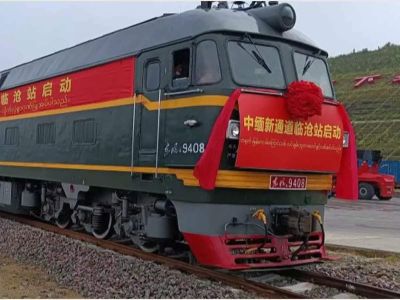
According to the reports, several companies including Konkan Railway Corporation, Sonu Cargo Movers, Om Logistics, Inland World Logistics (IWL), SSK Devcon, Pal Enterprises have recently participated in the pre-bid meeting to run Roll On-Roll Off (RORO) trains on the dedicated rail freight corridor. RORO trains will enable movement of loaded or unloaded trucks between two points. The pre-bid meeting was said to be held by Dedicated Freight Corridor Corporation of India Ltd (DFCCIL), which had invited bids to run Roll On Roll Off on a 636 km track between New Rewari and New Palanpur, and back. Konkan Railway has experience in running RORO trains in the Western region. This section is targeted to be operational in March 2021, and DFCCIL expects to attract many new traffic to the western freight corridor. At present, approximately 2,500-3,000 trucks ply daily between Rewari – Palanpur, according to official sources. All these trucks –with or without load – can simply drive on to a train and that train can move the truck fast between two points. On the freight corridor, traffic will move at 75 km per hour, providing assured transit and delivery time of about 10 hours against 24-36 hours by road. The solution is expected to be attractive in the backdrop of higher diesel prices plaguing transporters on road more than the railways.