
Loading...

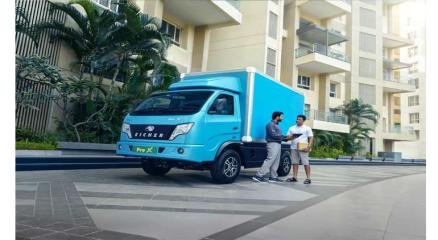
Amazon India is set to introduce up to 1,000 electric trucks from Eicher into its logistics network over the next five years as the e-commerce company accelerates efforts to reduce emissions across its middle-mile and last-mile operations.
The deployment will be carried out in partnership with VE Commercial Vehicles (VECV), the joint venture between Eicher Motors and Volvo Group. The companies said the electric trucks will support cargo movement between fulfilment centres, sortation hubs and delivery stations, as well as customer-facing delivery operations.
As part of the initial rollout, Amazon plans to induct 50 electric trucks in logistics hubs including Delhi, Manesar and Gurugram. The vehicles will be introduced progressively through Amazon’s transport service partners.
The trucks will be available in configurations ranging from 8-foot to 24-foot deck lengths, allowing Amazon to deploy them across varying payload requirements. According to the companies, the vehicles will include customised cargo layouts and support both fast and slow charging options depending on route and operational needs.
The move comes as India’s e-commerce and logistics sectors face increasing pressure to adopt lower-emission freight solutions amid tightening sustainability targets and rising fuel costs. Electrification of commercial fleets has gained momentum in urban delivery operations, though adoption in medium-duty and heavy-duty trucking remains at an early stage due to infrastructure and financing challenges.
Amazon has been steadily expanding its electric delivery fleet in India as part of its broader climate commitments. The company previously stated that it aimed to deploy 10,000 electric vehicles in the country by 2025 and had already crossed 6,000 EVs across more than 400 cities by 2023.
In 2024, Amazon said it had surpassed the 10,000-EV milestone in India ahead of schedule, while also testing long-haul electric freight corridors for intercity transportation.
Industry observers view the Eicher partnership as a significant step toward electrifying commercial freight movement in India, particularly in the growing e-commerce logistics segment where fleet utilisation levels are high and predictable delivery routes improve the feasibility of EV deployment.
Follow CARGOCONNECT for more such updates.

Miami International Airport (MIA) has launched an AI-powered Airport Cargo Community System (ACCS) developed by Kalé Logistics (Kalé), introducing a shared digital platform to improve coordination across its extensive air cargo ecosystem. Announced at the International Air Cargo Association’s (TIACA) Air Cargo Forum in Miami on 27 October, the initiative is designed to streamline logistics, reduce truck congestion and support lower carbon emissions. The platform creates a common online portal for freight forwarders, cargo handlers, truckers, carriers and ground handlers, reducing reliance on fragmented and manual information exchange. By improving information sharing, advance planning and truck scheduling, the system aims to reduce waiting times and enhance productivity across MIA’s cargo operations. Currently, cargo trucks arriving at the airport have limited information about arrival times and cargo types, contributing to congestion, operational inefficiencies and additional emissions. The ACCS is intended to address these challenges through better coordination among supply chain stakeholders. It will also provide the digital foundation for MIA to connect with international partner airports, supporting smoother cargo flows along specific global trade lanes. Miami-Dade County Mayor Daniella Levine Cava said the technology would help make MIA more future-ready by simplifying and expediting goods movement, supporting businesses and jobs linked to international trade, and strengthening the airport’s focus on efficiency and sustainability. MIA handled a record 3.4 million tons of freight in 2025, making it the busiest freight airport in the US and the third busiest globally, behind Hong Kong and Shanghai. The airport’s cargo operations require an average of 190 all-cargo flights and more than 1,600 truck trips daily, underscoring the scale of coordination involved. According to estimates cited in the announcement, implementing the ACCS across MIA’s entire cargo operation could generate substantial environmental and financial benefits. Based on an estimated 15% reduction in paper handling and an average saving of two hours in truck turnaround time, the system has the potential to save approximately 5,900 US tons of carbon dioxide emissions and 3,000 trees annually, while generating up to $250 million in annual operational cost savings across the air cargo supply chain. Amar More, Co-founder and Chief Executive Officer of Kalé Logistics, said cargo community systems were already improving collaboration and visibility across the industry, with MIA offering an opportunity to apply these benefits at a major global cargo gateway. He noted that even small operational inefficiencies can accumulate at an airport handling 3.4 million tons of freight annually, adding that a common digital platform could make a meaningful difference and help connect MIA digitally with the wider world. The launch marks a step towards greater digital coordination in airport cargo operations, with the potential to improve efficiency, strengthen international connectivity and support more sustainable freight movement as cargo volumes and stakeholder networks grow.


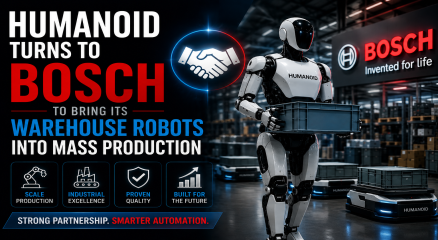
Humanoid’s warehouse robots now have a clearer path from pilot project to production line. UK robotics startup Humanoid has partnered with Bosch to scale production of its HMND 01 humanoid robots for the European market. This follows a successful proof of concept earlier this year. The agreement focuses on Humanoid’s effort to commercialize its robots for logistics and manufacturing. Bosch will serve as the company’s contract manufacturer. They will also assist with production planning, hardware design, supply chain operations, and cost optimization through what the companies call a Design for Excellence approach. This partnership follows testing in March at Bosch’s logistics facility in Bühl, Germany. There, Humanoid’s robots moved boxes autonomously from conveyor systems onto trolleys in a live workflow. Humanoid reports that the robots handled five different box sizes with varied weights and dimensions while adjusting to changing conditions. They also tested advanced scanning systems, multi-conveyor coordination, and flexible handling capabilities. Humanoid’s KinetIQ AI framework coordinated the warehouse operation and demonstrated that the robots could scale beyond experimental use. “For Humanoid, this agreement is a critical step in our roadmap, connecting the gap between proof of concept validation and large-scale deployment,” said Artem Sokolov, Founder and CEO of Humanoid. “Our goal has always been to shorten the path between innovation and real-world integration, and this agreement reflects that approach. Together with Bosch, a strong manufacturing partner, we aim to bring humanoid robots into industrial settings, expand their deployment, and speed up adoption in logistics, manufacturing, and beyond,” Sokolov added. Bosch views the partnership as part of its move into industrial robotics manufacturing. “This partnership is based on a shared belief in the great potential of robotics in industry,” said Peter Svejkovsky, Head of Corporate Intellectual Property. “Bosch’s goal is to advance humanoid robotics and further develop this field. With our global production network and deep expertise in industrialization, we are the ideal partner to transition from prototype to large-scale production.” Humanoid currently offers the HMND 01 in two versions: a bipedal humanoid and a larger wheeled mobile manipulator. The bipedal version stands 5 feet 10 inches tall, weighs 198 pounds, and can move at nearly 5 feet per second with a three-hour battery life. The wheeled model is larger at 7 feet 3 inches and weighs 661 pounds, with faster speeds and up to four hours of runtime. Both systems can carry payloads of up to 33 pounds while working in spaces designed for people. Humanoid states that the robots use KinetIQ, its four-layer AI platform for managing fleets of robots in industrial environments. This system oversees everything from fleet coordination and reasoning to movement control and handling tasks. The Bosch agreement comes shortly after Humanoid announced another major partnership with Schaeffler, which plans to use thousands of Humanoid’s wheeled robots in factories over the coming years. For more such news and updates, visit CARGOCONNECT.

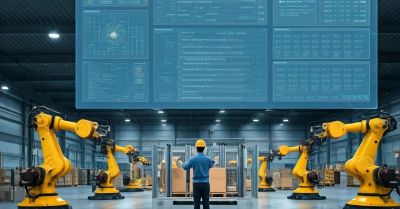
Accio Robotics, a leader in warehouse fulfilment solutions, has partnered with US-based SCM Champs, specialists in SAP and supply chain consulting, to transform warehouse management through advanced robotics and seamless SAP integration. This strategic collaboration aims to optimise efficiency and productivity in warehouse operations globally. The partnership centres around Accio's AccioOS operating system, designed to integrate with mobile robots (AMRs), Automated Guided Vehicles (AGVs), and SAP warehouse management systems. By enabling real-time communication between these systems, the collaboration enhances order fulfilment, robot deployment, and picking efficiency, offering businesses an automated and streamlined warehouse solution. Pranav Srinivasan, Co-founder of Accio Robotics, expressed confidence in the partnership, saying, “The integration of AccioOS with SAP warehouse systems positions us as a global leader in warehouse automation.” SCM Champs' CEO, Prabhjot Singh, added, "Our expertise in SAP supply chain execution, coupled with Accio's robotics solutions, provides an unmatched level of automation and efficiency for clients." This partnership underscores the shared vision of Accio Robotics and SCM Champs to push the boundaries of warehouse automation and reshape supply chain management on a global scale.